The Pillar 2 Coup: Rural Payments Agency poaches Countryside Stewardship from Natural England.

this is just a copy of an earlier post which I have now deleted as it looks like it might have been infected by malware.

Last week the Government launched its long awaited “what on earth are we going to do about paying farmers, after Brexit” consultation, called Health and Harmony. At the heart of the new policy lies the principle of “public goods for public money”. No longer will bagless vacuum cleaner billionaires and Saudi princes be able to hoover up subsidies “just for owning land.” There will be a transaction – taxpayers will pay landowners and get something in return – some public goods in the economics jargon.

This is not a new idea. Schemes which paid farmers to look after wildlife or archaeology on their land, or create new areas for wildlife, have been around in Britain since the 1980s, starting with Environmentally Sensitive Areas and Countryside Stewardship. These evolved from modest beginnings, into the Entry Level and Higher Level Schemes (in England) from 2003. These in turn evolved into Countryside Stewardship Mid-Tier and Higher Tier schemes in 2013.

Each scheme in turn had its pros and cons. Entry Level spent a great deal of money across a large area of land delivering very little benefit for nature. Countryside Stewardship has been overly bureaucratic, complex to administer and put a lot of landowners off  joining. Former Natural England agri-environment expert Steve Peel recently wrote eloquently on here about what makes a good agri-environment scheme and what makes a bad one. Let’s hope the Government takes note of this advice before designing the new “One Agri-Environment Scheme to rule them all”  system, which will replace CAP payments once we leave the EU (or some time afterwards.)

Yesterday’s news does not bode well that the advice Steve (or anyone else) offered is being read. Farmers Guardian’s Abi Kay reported that Countryside Stewardship is going to be taken away from Natural England and given to The Rural Payments Agency.

“Natural England staff who worked on Environmental Stewardship and CS delivery will move to the RPA so their knowledge and expertise is maintained.”

According to some people commenting today, staff working on Higher Tier Stewardship schemes (eg on SSSIs) will stay at NE. So the idea that this move is about simplification doesn’t wash. It also begs the question of whether the staff working on Stewardship at NE will have any authority to over-ride decisions made by RPA staff.

But isn’t it a good idea to have all of the admin for Stewardship under one roof? Yes, in theory, but it depends on which roof.

The Rural Payments Agency is notorious among farmers as the organisation which comprehensively screwed up the payment of the as then new Basic Payment Scheme back in 2014. A highly complex new IT system was commissioned to enable farm payments to be moved online. 7 years later the system is still not working properly.

Parliament was scathing in its criticism of the RPA’s failure to effectively distribute basic farm subsidies – criticizing its culture and revealing internal in-fighting. Given the RPA’s central role in making Countryside Stewardship work (they provided the scheme maps) it is perhaps not that surprising that Stewardship also fell over. But this time the blame has been laid at Natural England’s door.  It doesn’t seem inconceivable that, after the beating the RPA received over Basic Payment Scheme, they were going to make sure NE took the punishment for Countryside Stewardship.

This is what seems to have happened now. But this is part of a bigger turf war between Defra agencies. Once Brexit had happened it became very clear to everyone that there was going to be some fundamental reorganisation of Defra agencies – getting nearly £4Bn a year of farm subsidies out of the door is a massive bureaucratic exercise. Once we leave the EU – and the CAP – that job disappears. Since the end of June 2016 the race has been on, to see which Defra agencies come out on top. This news is a strong indicator of who has won.

This hasn’t been helped by the fact that Natural England bosses weren’t prepared to fight the fight  – especially after they took a verbal beating for Countryside Stewardship in front of the EFRA committee (Guy Thompson subsequently left Natural England and now works for Wessex Water). And let’s not forget that the RPA is a much larger organisation than Natural England, and is much more closely aligned with Defra – it could be seen as an arm of Defra. The RPA never had that independence of spirit that characterised Natural England when it was first created – though that spirit has been comprehensively crushed since 2010. So perhaps it’s not surprising that, in having to choose between the two, Defra has chosen to go with RPA.

As far as getting Agri-Environment schemes to create better farmed landscapes for wildlife, or anything else, it’s a huge error. RPA’s culture is administrative, bureaucratic. It’s all about process and compliance. Farmers complain about the excessive administrative burden of receiving farm payments or applying for Countryside Stewardship – they have the RPA to thank. The idea that RPA culturally (regardless of whether their staff are interested, or indeed qualified) will be able to work closely and flexibly with farmers to achieve improvements for nature on farmland is a fantasy. Their motto may as well be “computer says no.”

Meanwhile once Natural England has had its Countryside Stewardship function (and staff) surgically removed, what remains will be on life-support, because that has been a large part of the organisation’s role. Further, the fabled one-stop shop, single point of access approach that Natural England had been required to develop, has just been abandoned. Natural England staff tasked with ensuring Sites of Special Scientific Interest (SSSI) are protected, are now potentially lined up against RPA staff delivering agri-environment schemes on those SSSIs. You can imagine who will win those tussles.

Does all this matter? Isn’t it time to abandon Natural England as a failed quango? Commenting this morning, George Monbiot suggested as much.
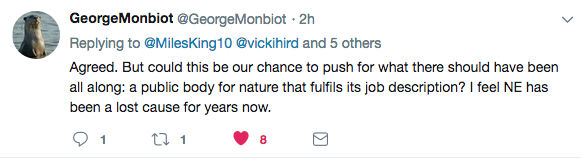


Perhaps George is right.

If so, then what is also vital is that the Rural Payments Agency is also abolished before the introduction of the new England Agriculture Policy. We need a publicly-funded independent champion for nature (as Natural England was intended to be when it was set up); and we need a new body which will deliver the public goods for public money approach being advocated by Michael Gove.
 

Posted in Uncategorized | 2 Comments

The People’s Manifesto for Wildlife

It was back in June that I first heard about the idea of a manifesto for wildlife, to accompany a walk for wildlife in London. Chris Packham asked me if I wanted to be Minister for Farming (and I extended that to Food later) – how could I refuse? Especially after he reeled off a long list of people who I admire and declared his determination that the “cabinet” would be balanced for gender and include young and BAME representatives too.

Now the manifesto has been published – you can download it here A Peoples Manifesto for Wildlife expanded. There’s also a short version A Peoples Manifesto for Wildlife.

The Manifesto covers a wide variety of topics – all of which are directly relevant to nature in the UK (and overseas.) Each contribution finishes with a set of proposals that if carried out would make a big difference to the plight of nature. It would be arrogant of me to say how good my bit is but I can say that I think the other contributions are excellent. There are also some excellent commentary snippets from other people with a great passion for nature and who are experts in their own fields.

It also doesn’t completely feel like a coincidence that the Manifesto has appeared almost 25 years after Biodiversity Challenge, which sought to do a similar thing, albeit in a much more traditional way. It’s good to see some of the key contributors to BC – Mark Avery and Carol Day, also making big contributions to the manifesto.

Please read the Manifesto. It is controversial. It is, dare I say, radical? But that’s where we are. Nature is disappearing fast from this country (as it is across the planet.) We need to take urgent action. The same old same old is not enough.

So please come along to the walk for wildlife on Saturday.

Who knows where this will go afterwards? It very much depends on how much of a groundswell of feeling it generates.

Chris has also set up a crowdfunder to help fund its the costs of the walk, which are substantial. Please contribute whatever you can.

UPDATE

Podcaster Charlie Moores from Lush Times has produced this podcast with each author reading their own section of the manifesto.

Posted in Chris Packham, peoples manifesto for wildlife, the walk for wildlife | Tagged , , | 10 Comments

Did Socialism kill off Mrs Tiggywinkle?

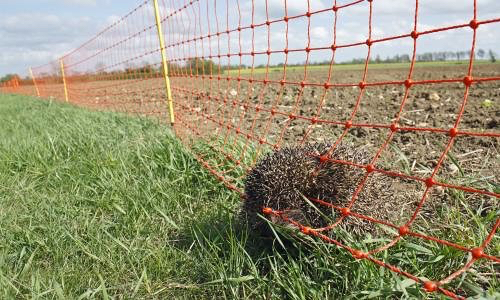
Hedgehogs are back. Well, when I say they are back, they aren’t back. They are disappearing rapidly. But they are back in the news. Perhaps this is just a valiant effort by a few newspaper editors to keep former Foreign Secretary Boris Johnson away from the public glare he clearly so desperately courts … even if just for a few hours.

A Guardian story  has revealed the findings from a major survey which looked at hundreds of rural locations across England and Wales. The researchers were specifically looking at the relationship between badgers and hedgehogs. What they found was astonishing. Only one in five of the 261 areas searched showed any signs of hedgehogs at all. And none were found anywhere in south-west England.

This is not to say that hedgehogs are extinct in the south-west. But it does mean they are in perilous danger of becoming so – at least in the countryside. We have hedgehogs in our back garden in Dorset, and they are doing ok in other parts of Dorchester, but can we really accept that our humble hedgehog must be renamed the Gardenhog? The Telegraph and Mail also covered the story, with the Telegraph misrepresenting the research.

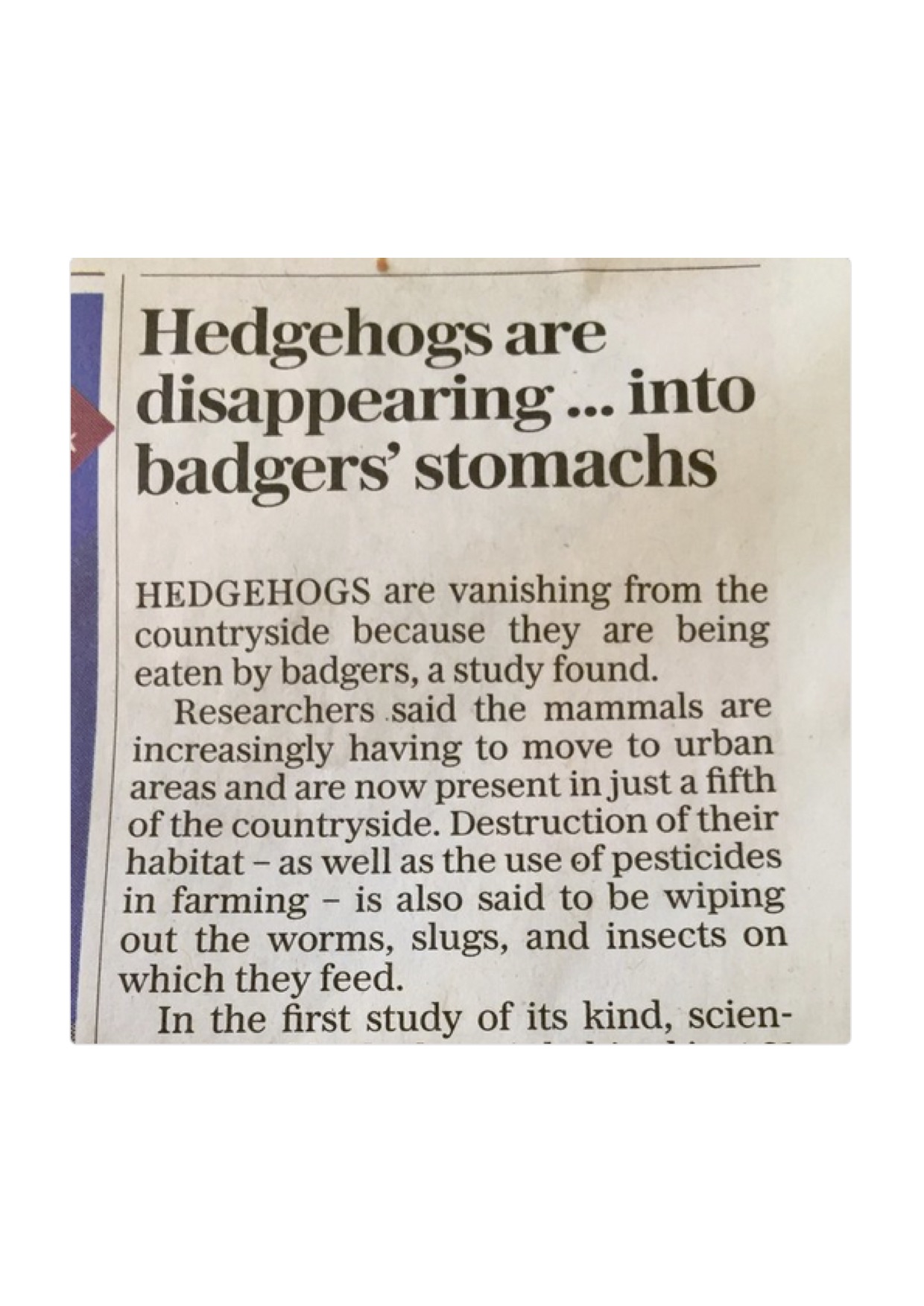
The Telegraph, true to form, blamed the demise of hedgehogs on badgers: “Hedgehogs are disappearing…into badgers’ stomachs” they shrilled.

Badgers do eat hedgehogs, there is no question of that. But to blame the decline of the hog on badgers and ignore everything else is, perhaps, courting an audience which hates badgers.

Historian Tom Holland, a self-acknowledged Hedgehog fanatic, suggests a legally binding obligation on Government to restore hedgehog populations. How might this work? One way might be to wipe out badgers to save hedgehogs, but does it make any sense to make one native mammal extinct, to save another?

This week we are likely (unless the Parliamentary agenda is trammelled by the rampaging ego of Boris Piccaninny Watermelon Letterbox Johnson) to see the first new Agriculture Bill placed before Parliament in over 50 years – and the most important one in over 70. The odds are that it will introduce a radical new approach to supporting farmers – paying them to provide public benefits, such as nutritious food and clean water, to take action to reduce climate change, improve wildlife and create better soils. This approach (if it survives the inevitable push to water it down by the farming unions) will mark a significant shift away from that of successive Governments who, between 1940 and 2005, encouraged farmers to grow more food by paying them to do so. The last 13 years has seen landowners receive farm subsidies whether they grow food or not, just for owning the land.

The Drive for Self-sufficiency

Looking back at the grants available to farmers in the past is real eye-opener. Grants of £7 an acre were available in 1960 to plough up old grassland. There was a fertiliser subsidy, a shotgun cartridge subsidy, subsidies to help grub out hedgerows and small woodlands (or not so small woodlands.) and to drain wetlands. Subsidies were also available to put up farm buildings and silos for grain or silage. And if the bank was sniffy about lending money knowing they would be repaid from all these government subsidies, a three year credit agreement could be arranged on purchases paid for by the Government. On top of this, if there was more food than the market needed, price support mechanisms would kick in to ensure farm income remained the same. This was all part of the drive to produce more food, to make us more self-sufficient in food production which was the target laid down by successive Governments.

It’s fair to say that the push for greater food production was particularly strong under post-war Labour Governments, compared to Tory ones. Attlee’s radical post-war Labour Government introduced the Agriculture Act with all its various different support schemes. That administration also set up a variety of different agricultural research stations whose job it was to find ways to modernise agriculture so as to increase food production – breed new varieties of cereal crops; grow new and more productive grasses that would respond better to new types of artificial fertiliser; work with the chemical industry to develop new types of pesticide.

A further round of support for more intensification happened under Wilson’s Government through the 1960s when Farm Improvement Grants paid for more hedgerow to be removed and fields to be drained. And again, after the UK joined the Common Agriculture Policy in 1973, for the rest of that decade a Labour Government enthusiastically pursued the now established policies of agricultural intensification.

What all this intensification did was to increase the level of self-sufficiency in indigenous food types (i.e. not bananas etc) to 87% in 1991. This has since dropped back down to 75%.  So it is in this context that we must consider why the current Labour farm policy team wants to increase food self-sufficiency to 80%. And this is assuming that the 80% refers to indigenous foods, not everything. Do we really want to grow more food here and import less? Is this intrinsically a good thing? The UK only produced a third of the food it consumed at the outbreak of the First World War in 1914 (though imports were mainly from the Empire and Dominions) and I don’t think many people today, other than perhaps extreme neoliberals, would argue that we should revert to producing that little of our own food.

Would it be possible, for example, to increase indigenous food production by 5% without causing further widespread environmental impacts, or at the very least without curtailing any efforts to reverse the impacts caused by previous policies? What is wrong with buying food from abroad? We’ve become used to importing food from the EU, confident that it meets our own standards on animal welfare, environmental impact, and food safety, among many other things. And food imported into the EU also has to meet those standards. Maintaining these standards after Brexit is vital – and consumers have, rightly, already rejected calls for cheap chlorine chicken or hormone beef to be allowed in.

Did Socialism kill Mrs Tiggywinkle? No, but successive Labour Governments did place food production above all other considerations. As hedges were grubbed out, wildlife-rich grasslands ploughed up, and pesticides poured onto pasture and cereal crop, poor Mrs Tiggywinkle paid the price. She’s retreated from her ancestral home in the countryside, to live in gardens and green spaces within towns and cities, away from intensive farming.

Can she be enticed back into the countryside? That will be a challenge, but shifting to a new way of supporting farmers with public funds – for public benefits, – is the right approach.

Today we see the Agriculture Bill being published and it does focus on public goods. More to come on this soon.

this article was first published on Lush Times.

Posted in Agriculture policy, Brexit, Lush Times | Tagged , , , | Leave a comment

The People’s Walk for Wildlife

I’ve shamelessly nicked this piece from Martin Harper‘s blog.

It’s by Chris Packham and he’s demanding we all join him on the People’s Walk for Wildlife. I will be there. Will you?


56%. It says 56%.

Since 1970

I think back to 1970, I think about what I was doing in 1970, what happened in 1970. I remember Apollo 13, I remember Bobby Moore’s bracelet and Gordon Bank’s save. And that damned Mungo Gerry song. It seems like yesterday, going to see Kelly’s Heroes. But since that yesterday yellowhammers have declined by 56%. Almost half of the UK’s yellowhammers are gone.

I’m sat in my caravan on the Springwatch set waiting for the morning meeting to start and I’m looking at some notes. They say “we’ve lost 56% of our yellowhammers”. Except that isn’t true. Because its not like these birds have mysteriously disappeared into the ether, like they’ve been inadvertently misplaced, like they’ve annoyingly, accidentally vanished. They haven’t been ‘lost’, they are dead, or they don’t exist. Destroyed is the word. Our ‘little bits of bread with no cheeses’ have been destroyed. Their hedgerows have been ripped up and their food has been poisoned, since The Goodies, in my lifetime, whilst I was meant to have been looking after them – they’ve gone. It’s my fault. I’ve failed. I’ve let millions of yellowhammers die.

I look up the IUCN Red List website on my phone. It says ‘the species suffers indirectly from the use of insecticides and herbicides, as these reduce the abundance of arthropods and the availability of weedy patches rich in seeds (Perkins et al. 2002, Morris et al. 2005, Hart et al. 2006). And then I walk to the meeting and look out into the countryside. Nothing buzzes, no flowers speck the fields, there’s no bread and no cheese.

They are all talking, and someone is saying that the yellowhammer population on one of the farms has significantly increased because the farmer has been doing good things. So all’s not lost then, that’s okay, good, great, phew.

No, it’s ***. We are orchestrating an ecological apocalypse in our own back yard and for all the work done by good farmers and conservationists our ‘green and pleasant land’ is going to hell fast and we’ve got the data, the science, the graphs to prove it. The truth is we can make a difference, but we’re not, because what we are doing is piecemeal, tiny, inconsequential in the face of the ruthless and relentless agricultural monster which ploughs, pollutes and poisons our so-called countryside. Neither are we repelling the greedy concreting sprawl of our towns and cities or stopping the senseless slaughter of ever decreasing species for fun.

By the time I get back to the caravan I’m a very angry man. And for me anger is an energy, a fuel to be harnessed and re-directed into making a difference. So, I weigh up some options for a full five seconds and then decide its time to take to the streets. The People’s Walk for Wildlife.

Because it’s not my fault that the yellowhammers are dead, the foxes are hunted, the badgers are culled, the eagles are shot, the meadows are vacant, and they are cutting down all of Sheffield’s street trees. It’s not down to me that there are just three ‘no-take’ zones in our seas, that the uplands are barren, the farms are toxic, that children don’t meet wildlife anymore, that there are so few black birders. It’s our fault. Mine and yours. So, if I do something, that’s ‘me’, but if you do something too that’s ‘we’, and if there’s a whole load of ‘we’ then that’s a full bladder and something will have to be done. And quickly. So let’s walk.

By lunchtime I’ve got this idea that people could download an MP3 of yellowhammer song, nightingale song, and play it on their phones as they walk through London to remind us of the missing millions, the 44 million birds that have been destroyed in our countryside. Then I scribble a quick sketch for a poster and then I ring Patrick Barkham and he thinks a good idea and then I mail Robert Macfarlane and he is excited too. And that night I lie awake remembering the ‘Rock Against Racism’ carnival in 1978 when 100,000 people marched to Victoria Park and The Clash played ‘White Riot’ and the ground shook and my life was never the same again. I remember Billy Bragg saying that he was there, and his world changed too. So I sit up in bed and re-write one of his songs and ponder about having the balls to actually send it to him. I can’t sleep because I’m imagining Billy Bragg on a stage singing about Rachel Carson and loads of people ‘unsilencing spring’ with their mobile phones playing birdsong. It’s already beyond the point of no-return.

Three days later the date is set. And then the overall purpose begins to focus. I’m at home with Scratchy, in the lounge designing another poster and I draw a big heart and write ‘See The Bigger Picture. We Are United Because We Love Life – All Life’. It’s obvious to me that, for all our energies, passions, skills and endeavours, our simple failing is that we are disconnected. That we are all too focused on our own specialisms, too sure that they are the most important thing, that they, that we, can ‘save the world’ on our own. But we can’t. If those of us who campaign to stop the illegal persecution of raptors succeed, will that stop the decline in hedgehogs or water voles? If we finally stop fox hunting will that help restore our wildflower meadows? If we sort out the ludicrous mowing of our road verges will that help re-introduce the beaver? No. Not independently, but if we can just open our eyes for a moment, put our egos in a box, stop bickering over details, summon the courage to admit the truth about what is really wrecking our landscape and just SEE THE BIGGER PICTURE, then together we can make a real, a big enough difference. If we stop mumbling about ‘loss’, if we wake up to the fact that we have somehow normalised living without wildlife, if we collectively realise that it’s now or never, that our wildlife needs us, and needs us more than ever, then we can have our ‘little bits of bread and cheese’ back and a bright yellow bird will stir hearts from hedgerows again.

So please, whoever you are, get off your *** and join us on September 22nd in London and help us make the ground shake because we need to change the world now.


Posted in Chris Packham, people's walk for wildlife, Uncategorized | Tagged , | 3 Comments

Vested Interests fight back against Gove’s Green Brexit for farming

Steam-powered threshing machine ©Miles King

Yesterday we returned to the Great Dorset Steam fair for our annual pilgrimage. The ground had dried out a bit following sunday’s deluge, but not enough for the traction engines to trudge around the main ring, which was a small disappointment. They just couldn’t make it up the moderate slope without slipping backwards or sideways (no doubt creating an insurmountable health and safety risk.)

My mind wandered to thoughts of traction engines slipping and sliding on wet arable fields in the 1920s and 30s, perhaps even tipping over. How would such a leviathan be righted? Could a team of plough-horses have had enough strength, or would the farmer have to wait until another traction engine arrived to right the fallen giant. And what if this had happened at a critical moment, when that season’s wheat needed to be threshed by the latest innovation, the steam-powered threshing machine? As I watched the wheat being fed, by hand, into the threshing machine, I noted how quickly things have changed in agriculture over the past 75 years.


The pace of change was driven by, amongst other things, a massive injection of public money. Bearing in mind that Britain was essentially bust after the second world war, it is worth noting that money was found to pay farmers subsidies to produce as much food as they possibly could. But not only that, funds were found to set up agricultural research stations, breeding new types of grass, new types of wheat, new types of cattle and sheep and pigs and chickens. New insecticides and herbicides and more efficient industrial methods for producing artificial fertilisers. And new machinery to replace all those men and women who had worked the fields previously.

Now we look back on this incredible era of innovation, with mixed feelings. 75 years of production subsidies (firstly from the Treasury, then the EU) have left the countryside in a terrible state. Archaeology and history has been swept away, along with wildlife, along with ways of life, with culture and with communities – all in the name of food production and nothing else. Brexit has provided the opportunity, a once in a lifetime opportunity, to radically reform our approach to supporting farming in the UK, to rebalance the need to produce food, with the need to replenish the countryside with wildlife, with culture and with community.

All of this is folded inside a wrapper called “public money for public goods.” It is an ugly wrapper which hides more than it reveals. It is a phrase which means little to those outside the technocratic community of policy wonks (I self-identify as an amateur policy wonk) interested in the intersection between the environment, people and food production. Yet it is the rallying cry taken up by chief Brexist Michael Gove on his arrival at Defra a year ago. Gove has recognised the opportunity to make a radical change, to fight against Vested Interests (in this case the farming unions, especially the National Farmers Union – the NFU.) I have written far too much about this to provide links, but you can find a lot on here or on my Lush Times column.

As the moment approaches when the first major Agricultural Bill since 1947 is published, dark rumours are circulating that those self same vested interests are pushing back hard against this public money for public goods approach. RSPB head honcho Martin Harper appeared on the Today Programme this morning to express his grave concern that all the good work that has gone into convincing this Govt of the need to change they way farmers are supported by the public via subsidies, is for naught. Humphrys played devil’s advocate – presumably they couldn’t find anyone from the NFU williing to admit that they were scuppering proposals which had overwhelming public support. NFU has a very public profile, but most of their key work is done in the shadows, and always has been. What can Civil Society do? A letter, with many organisations signing on, has  flown to Number 10, and you can see it on Martin’s blog this morning.

Will it make a difference? Has the die already been cast? NFU has been around for over a hundred years remember, and has for much of the time, at least since 1940, not only had a constant seat at the table with the Minister, but has also drafted legislation and policy for the Minister to sign off.

Gove talked of taking on the Vested Interests. Above all else, his tenure at Defra will be judged according to whether he was successful at taking on the NFU. We will know the results of that show-down in the next few weeks.

Posted in Agriculture policy, Brexit, Michael Gove, NFU, RSPB | Tagged , , , | 2 Comments

Rearranging the deck chairs on the Natural England Titanic.

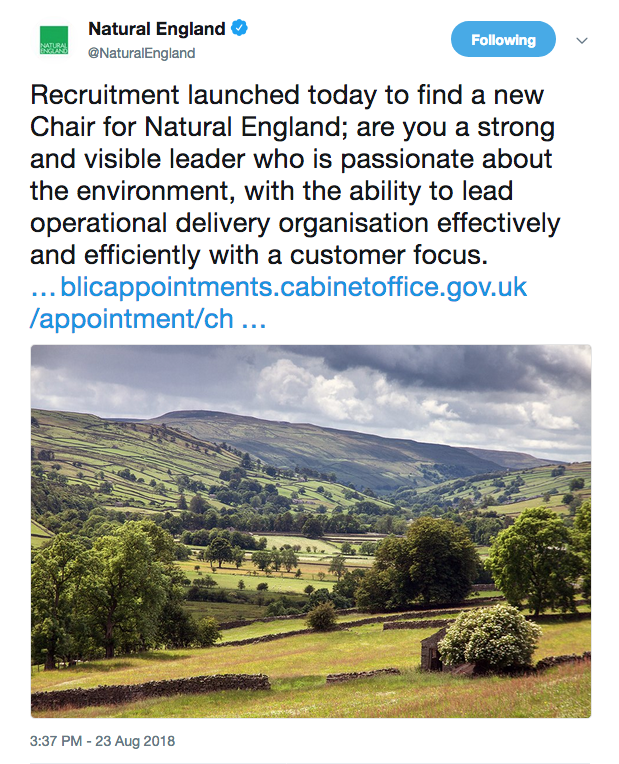
Natural England chairs come and go, and today’s publication of the advert inviting applicants to be the next chair, gives me an opportunity to look, once again, at the absolute state of Natural England.

Some may feel all I do is bash Natural England whenever I write about them. As if NE-bashing was my favourite past-time. Nothing could be further from the truth – just yesterday morning I was defending Natural England from a demented attack by a Tory buffoon. I am often critical of Natural England – not because I want rid of a public body which protects nature, like some certainly do. But because above all else I want to see a strong regulator, working its collective arse off, for nature, in England. There are still plenty of people in Natural England doing exactly that, but every day, every little thing, makes their job a little more difficult.

Let’s look at a few examples of these little things.

Blencathra

For instance the recent appointment of Lord Blencathra as deputy chair of Natural England. Lord Blencathra is a Tory peer, who was previously a Minister. He was deeply involved with the 1992 Rio Summit, so, we must surmise, he has a genuine interest in environmental matters. He is also a very enthusiastic supporter of hunting. Some have suggested that he took his peerage name from his local hunt, the Blencathra Hunt. I can find nothing to confirm or deny whether this is true. But what is clear is that he provided detailed advice and support for the Countryside Alliance during the passage of the Hunting Bill through Parliament. Their aim was to make the legislation as weak as possible, allowing hunting to continue under the radar, making it difficult for prosecutions to succeed. And this is exactly what has happened. Blencathra was previously put forward as chair of the Food Standards Agency but had to step back when the proposal was criticized as a political appointment. He was also severely criticized for taking employment as a lobbyist for the tax haven Cayman Islands. He avoided more serious action by claiming that he had never actually done any lobbying of his fellow Lords (though he had lobbied MEPs.)

Some have asked why the appointment of a leading pro-country sports Lord to deputy chair of Natural England’s board is even worth mentioning. And in mentioning it I have been accused of all sorts of dark activities, including “ethnic cleansing.” Honestly, country sports people, do grow a backbone. The point is not whether Blencathra loves hunting or not, its whether his love of hunting and other blood sports conflicts with the purpose of Natural England. One particular purpose of Natural England, for example, is as a regulator which job is to make sure laws protecting wildlife are taken seriously. Laws protecting species like Hen Harriers, and laws protecting internationally important habitats like blanket bogs.

Grouse Training

As if by magic, and purely coincidentally of course, news seeps out that Natural England staff are being educated on the environmental benefits of driven grouse shooting, on a grouse moor whose head keeper was prosecuted and fined for err setting illegal traps for birds of prey like err Hen Harriers. Natural England does need to work with the owners of SSSIs and European Sites on Driven Grouse Moors (while the latter exist, anyway.) But what I find deeply worrying is the idea that NE and owners of grouse moors are to be seen as partners, that NE should be “customer-focused” above all else. And if you think that’s wrong, go back to the top of the post and read the tweet from Natural England, describing what the role is about. I don’t even believe Natural England should be considering SSSI owners as customers. It’s not a shop! Natural England, above all else, is a regulator, whose job is to see the law effectively applied. There is no other regulator with that job. There is no-one else that nature can turn to, metaphorically, to ask for help. There is only Natural England. And if NE is too busy seeing how vital it is for grouse-moor owner’s to burn blanket bog, then it’s much less likely to take legal action against them to stop it.

Judicial Reviews

Natural England’s willingness to roll over and play dead when it comes to implementing the laws protecting our wildlife, has got so bad, even the RSPB is taking legal action against them, as is Mark Avery. Another Judicial Review against Natural England was recently rejected. This one focused on Natural England’s failure to consider the effect of badger culling on European Sites supporting scarce and vulnerable ground-nesting birds, feeding grounds for wildfowl and non-breeding roosts of rare raptors such as hen harrier. European Sites (Special Protection Areas and Special Areas of Conservation) have very strict legal protection – thanks to the EU. This means any project which might have an impact on the species and habitats for which those sites were designated, has to be assessed – the so-called Habitat Regulations Assessment (HRA). The claimant pointed to several instances where Natural England had failed to carry out HRAs looking at whether the badger cull would lead to, for example, a change in the fox population. Or the well-established perturbation effect, whereby culling badger causes surviving badger colonies to disperse away from their home areas. In a surprise judgement, the Judge decided that although Natural England had breached its duties under the Habitats Regulations, he was satisfied that they would have concluded that the badger cull would have had no impact on the nearby European Sites anyway, even without the proper assessments. Natural England appear to have relied on a reference to “routine monitoring” of protected sites, but their monitoring programme has suffered serious funding cuts so they don’t even know what state the sites are in, or whether the special species and habitats on them are doing ok, or have disappeared altogether. I understand an appeal is being considered.

Cuts and Reassignments

If I’m painting a picture of an organisation in crisis, which has lost all sense of identity, and purpose, perhaps you’re thinking this picture is as black as one of Goya’s black paintings, or reminds you of a particularly dark film noir. But I leave you with one further piece of evidence. Sue Everett reports in this week’s British Wildlife, that 200 NE staff are to be “reassigned” to work on “Brexit duties”. What she means is that 200 NE staff are being taken away from NE and transferred to Defra. Requests for volunteers have only resulted in 65 willing to make the sacrifice, so the word is that the others will be compulsorily reassigned. These are secondments, but who in their right mind would really believe they were going to return to NE in 2 years time? Still, reducing the head-count will enable NE to meet its ongoing budget cuts. These cuts, which have gradually been paring away at NE’s body since 2010, follow on from the transfer of staff working on countryside stewardship, which I wrote about earlier this year.

The picture is an ugly one. Natural England is failing in its role as the statutory regulator for nature. It’s struggling against a rising tide of pressure from Defra and elsewhere not to rock any boats, especially with powerful vested interests like the Countryside Alliance. And its budgets and workforce are cut and cut again, making those that are left increasingly despondent.

Who then would be interested in taking on the role of chairing this failing organisation?

Given this Government’s previous record of getting away with political appointments,  I predict we’ll see someone rewarded with a sinecure. It may be Lord Blencathra who is given the nod to slip from deputy chair into the chair role. He would certainly do Defra’s bidding without any dissent. Or it could be someone like Rob Wilson, who failed to get the Charity Commission chair because it was such a blindingly obvious political appointment. The outgoing chair had close links with Policy Exchange, Gove’s thinktank. So we could see another horse from that stable. The choice is academic though.

I think it’s time we all agreed that Natural England’s time has come and gone. We need to start afresh. After Brexit, after the chaos of a crash-out no-deal no food on the supermarket shelves Brexit, after the smoke has cleared, it will be time to start rebuilding.


Posted in Andrew Sells, badgers, countryside alliance, Europe, Habitats Directive, Natural England, SSSis, Uncategorized | Tagged , , , , , | 10 Comments

A Monday morning Round-up

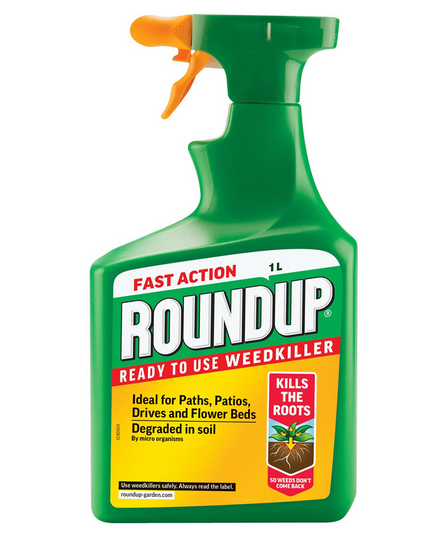
Round- up.  It’s a clever name, isn’t it.

Combine two alternative, but complimentary, meanings – first, the “rounding-up” of weeds, like cattle. Just round-’em up and dispose of them. So simple.

A second more subtle meaning might also seep into our sub-conscious. Rounding up, as in getting a bit more (for our money.).

Round-up – Not only simple, effective, but also money-saving.

I first came across Round-up when I was still living at home as a teenager. My dad bought some to control some weed or other (there were quite a few) in the garden. I still have a pot (of Tumbleweed) in the greenhouse, though I haven’t used any in probably 10 years. I had a bit of a bindweed problem in the veg patch. I gave up using round-up on it, because it didn’t work. It just killed the leaves and a bit of the rhizome. I realised the only answer was digging down deep to find the long-established roots – and keep digging and removing every last bit. It’s more or less gone now, certainly contained.


It’s about 9 months now since I last wrote about glyphosate (the chemical name for Round-up). Wow I got a lot of stick for that article. There were a few errors in it, for sure. But then there was a lot of fact in it too.

Since then things have moved on. The EU came within a whisker of banning glyphosate – and it turns out the only reason they didn’t is because the German agriculture minister ignored his Government’s own policy. Schmidt is no longer farm minister. It’s pure coincidence I’m sure that, at the time Schmidt made his fateful decision, German agrochemical giant Bayer were in the process of taking over the US company Monsanto, maker of Round-up and the GM-crops which depend on it.

Despite the EU’s collective decision to give glyphosate just another five years of licenced use, many member states have decided to act unilaterally and phase its use out. Obviously that doesn’t include the UK. This is partly because of Brexit, but mainly because there is such a strong lobby (from within the agricultural industry) working here to protect it. Its main use in UK agriculture is to prepare standing arable crops for harvesting, by desiccating them and killing any weeds that might be in there.

A much more minor, but more interesting use, is by zero- and min-till farmers who use it to kill cover crops (and weeds) when preparing to direct drill their crops. Killing the cover crop at the right time releases things like Nitrogen from the cover crop, enabling the growing crop to make use of it, rather than applying artificial fertiliser. The over-wintering cover crop also reduces the risk of soil erosion, or loss of nitrogen and phosphate into rivers.

Then there was last week’s historic judgement by a US court. The jury concluded that glyphosate had caused a rare type of cancer in a groundsman who had regularly used the chemical. He’d been spraying it in school grounds. Imagine your children had been at that school. Now imagine that the school your children attend here in the UK, uses glyphosate. Because they do.

Can farmers and the agrochemicals industry continue with their “glyphosate is vital” and “glyphosate is safe” media campaigns, now that the jury is no longer out on this question?

Probably yes.

Monsanto (which as a company no longer exists – very conveniently) has repeatedly turned to the Tobacco Industry playbook of lies, smears, character assassination, buying “friendly” scientists, and astro-turfing (setting up fake civil society groups to provide “independent” support) to prevent regulatory action on glyphosate. No doubt they will appeal the California verdict. But the flood gates have opened and thousands of others, who believe their cancers or other illnesses have been caused by glyphosate, are now going to launch their own legal actions. Perhaps some even in the UK.

It’s true that when glyphosate was first introduced as a new herbicide, it replaced earlier chemicals which were more dangerous – Paraquat for example. Paraquat is still manufactured in the UK, for export to countries which have not yet banned it. But just because something is safer than the thing it replaces, doesn’t mean it’s safe, does it. It just means that work needs to be done to find a safer alternative. That’s really part of what we might call civilisation. Why stop at glyphosate?

For me, there’s a bigger issue, which is why farmers are using so many agrochemicals (like glyphosate) to produce our food. As bee expert Dave Goulson noted recently, while the weight of pesticide use in the UK has declined over recent decades, the capacity to kill wildlife (specifically bees) increased six-fold. And that wasn’t even taking into account the impact of widespread, almost ubiquitous use of glyphosate in the countryside. That use has one over-riding impact – to remove wild flowers, which provide pollen and nectar for bees and other insects.

Would it cost more for UK farmers to produce food without using glyphosate, neonicotinoids, or the myriad other agro-chemicals currently being used? Yes it would. But it wouldn’t cost much more. And, more importantly, the cost of producing food is only a small component of the total cost of food we buy on the supermarkets shelves. So – if the UK Government decided to ban glyphosate (and to be honest there should be an immediate ban on its use in gardens and parks – and its use preparing crops for harvest) in agriculture, and food prices went up a smidgen, would anyone notice? I doubt it, given all the other factors which influence how much our food costs.

What about the use of glyphosate in zero- and min-till farming? I would suggest a three year phase out for this use. This would give time for alternative methods to be developed – and the Government should put up some funding to help develop these techniques.

But while Defra and its leader Michael Gove continue to stand in support of glyphosate (and his Biodiversity minister enthusiastically endorsing it immediately after the court finding), it will take concerted public action to shift that position.


Posted in Agriculture policy, agrochemicals, glyphosate, monsanto | Tagged , , , | 23 Comments

Looking after farmers as well as the land : Guest blog by Heidi Saxby

I recently read a fascinating paper exploring how farmers gain personal benefits to their wellbeing, from taking part in projects which help wildlife on farms – in this case a project to help conserve rare cornfield wildflowers in North Yorkshire. I contacted the author Heidi Saxby, and this is a blog she has written on her research. This article was first published on Sociology Lens.

Examining flowers in North Yorkshire Cornfield Flowers Project (CFP) margin. Image courtesy of CFP.


Do farmers derive any personal benefit and well-being from their Agricultural Environmental Schemes (AES) work?

Being a volunteer grower and seed guardian for North Yorkshire’s Cornfield Flowers Project (CFP) made me aware of how this project functioned differently from other, mainstream AES. The CFP capitalises upon farmers’ personal interest in arable flowers [1] Participating farmers are not paid for the work, do not sign contracts, and are not obliged to adhere to prescriptive cultivations methods imposed by an external agency. Unlike most AES, the project is also restricted to a relatively small geographical area of North East England.

Research shows that most AES are considered by farmers to be bureaucratic, time consuming and onerous. They are organised so that they can be applied generically across the whole country and prioritise process over outcome. Central administration is easier, but farmers cannot easily modify the schemes to local conditions such as land type and weather patterns. Farmers’ own skills, motivations and interests are not optimised, and AES work can become a chore rather than a satisfaction.

For my dissertation for a Food and Rural Development Research MSc in Newcastle University’s Centre for Rural Economy, CFP became my case study. I found that this drew my attention to social processes within the project which I had largely overlooked within my role as a volunteer. These included the ways that alliances were formed amongst farmers because of their interest and expertise in arable flowers, differentiating them from other, local arable farmers with no interest in or even a disdain for what they saw as weeds. CFP farmers’ social networks provide opportunities to consult, advise and receive advice about cultivating arable flowers, share seed and plant material otherwise difficult to obtain, and indulge in competitive banter about growing the most extensive range of, or the best examples of flowers. On a local and individual level this appears to contribute to their sense of belonging and identity, but it also performs a practical function in that the farmers have become a unique community of expertise now sought out by agricultural and environmental professionals wanting to know how to manage arable land for biodiversity. The farmers relish this role reversal; outsider experts seek their advice instead of telling them how to manage an AES.

Garden growing CFP plants for seed production and saving. Photo by Heidi Saxby.

My own volunteer status and capital within the project benefited me whilst I was planning and doing my research fieldwork. Being a seed guardian may have reassured farmers of my genuine interest in the project and their work, so that they were sanguine about the time my visits took up and receptive to my endless questions. And perhaps my (limited) knowledge of arable flowers gave me a head start when discussing propagation methods. The farmers took great pride in showing me around their farms, carefully diarising my visit according to the forecasted weather and crop maturity, in order that I would enjoy a ‘good show’ of flowers.

When visiting their flowering field margins I was especially struck by farmers’ pride in ‘their’ flowers, and the meanings they attributed to them. One farmer speculated about his grandfather seeing these beautiful weeds when ploughing with horses; slow work giving farmers closer proximity to arable flowers than is afforded by modern farming methods and mused about his current conservation efforts enhancing the chances of his grandson and potential great grandchildren seeing them on the same land in the future. For this farmer, as for others, the arable flowers represented permeance, place attachment and his family’s history on that land, with the flowers elevated to a status more complex and personal than that of being ‘just’ a pretty weed.

Each flower had a story associating it with its particular farm or farmer’s family. Abundant Cornflowers create a blue haze on the headlands of one farm, yet refuse to grow on another nearby CFP farm. Gowland Lane, near to a different CFP farm bears the local name for Corn Marigold, indicating it once grew profusely there. Venus’s-Looking Glass thrives on yet another farm at the extreme north of its geographical range.  All the Corn Buttercups now flourishing on CFP farms were originally propagated from the tattered, post-harvest remains of one solitary plant located by chance. Such stories and the manner of their telling suggest that the farmers become emotionally invested in the flowers and the process of caring for them, and demonstrate the flowers’ symbolic and well as their material value. Farmers spent considerable time hunting for, ‘good examples’ of elusive, especially rare or beautiful flowers to show to me, with some visiting their flowering margins shortly before my planned visit to stake out particular plants for my appraisal. I spent hours walking around field margins where farmers grow their flowers, listening to their gleeful stories about other CFP farmers and photographed the flowers that they carefully displayed. I was shown to places regarded with especial affection because of their flora, fauna and tranquillity, and heard explanations about the meanings these things had for them. It would be intrusive to relate those here, but they illustrate how farmers’ efforts to look after the natural environment brought satisfaction, and motivated ongoing CFP (and AES more generally) work.

Blue-flowered form of the Scarlet Pimpernel. Photo by Heidi Saxby.

My research contact with CFP farmers has ended, but my ongoing seed guardian role gives a legitimate reason to revisit them. These visits are opportunities to share stories, seeds and updates about developments in both the CFP and in research outcomes. On one visit I informed them about recent publication of our co-authored academic paper [2] from the research. They were interested to hear how their conservation efforts are perceived by outsiders and proud that the research was being positively received. This led me to recall our fieldwork conversations, and the remark of one farmer, who said: ‘well, as I say people like yourself who come; it pleases them that there’s something, something special to them so, you get a satisfaction out of knowing that you’ve helped’

References

[1] ‘Arable plants are the most critically threatened group of wild plants in the UK. Identifying sites where these rare species remain is essential to ensuring their conservation through sustainable management’ (Plantlife. Threatened arable plants. Identification guide. Sailsbury, Wiltshire.)

[2] Saxby, H., Gkartzios, M. and Scott, K. (2017) ‘‘Farming on the edge’: Wellbeing and participation in agri-environmental schemes’, Sociologia Ruralis.

Heidi Saxby is a Doctoral Researcher in the School of Natural and Environmental Sciences, Newcastle University, UK


Posted in Agri-Environment Schemes, wellbeing | Tagged , , , | 3 Comments

Will the New Environment Bill be Michael Gove’s golden opportunity, poisoned chalice or a dead duck

the parched landscape of Dorset, from Blackdown. ©Miles King

Let’s face it, it’s been a pretty disastrous couple of weeks for our Prime Minister Theresa May. After the apparent success of the Chequers Brexit agreement, May has lost two of her most outspoken pro-Brexit ministers, whose departure triggered a further wave of resignations.


No sooner was the ink dry on the Chequers deal when it was unceremoniously ripped to shreds by Jacob Rees-Mogg and his band of extreme Brexiteers, in the European Research Group (ERG). The Government had to cave in to the ERG’s demands to destroy the heart of the Chequers proposals, making them completely unacceptable to the European Union (though they were almost certainly going to be rejected anyway.)


To add insult to injury, May last Friday announced that she was abandoning her commitments, made last December, to the Northern Ireland border “backstop” agreement. This will be seen as a betrayal by both the EU negotiators, and by our neighbour across that particular border, the Republic of Ireland. The backstop was put in place to ensure that the terms of the Good Friday Agreement were not broken, and to ensure that a hard border between the Republic and Northern Ireland did not return, with all the many problems that hard border brings with it.


What all this manoeuvring points to, is that we are headed for a no-deal crash-out Brexit. So it is in this context that we should consider whether to celebrate the announcement, by Theresa May, that her Government will bring forward an Environment Bill.


May made the surprising announcement in her regular appearance in front of the House of Commons Liaison Committee – formed from all the chairs of all the Select Committees from the Commons. In normal times, this sort of thing would either have been written down in a Queen’s Speech, or announced by the relevant Secretary of State (Michael Gove) to the House of Commons. Presumably May thought this would be a good opportunity to pull a political rabbit out of the hat, to wrong foot her opponents. On this occasion the person who was questioning her was Tory MP and chair of the Environment Food and Rural Affairs select committee Neil Parish. Parish was pressing her on the Government’s failure to do anything about our appalling air quality in the UK. Air quality which continues to fail to meet standards set by the EU and air quality which has seen the EU taking repeated legal action against the UK.


May seemed quite pleased with herself with this particular rabbit-pulling trick. Perhaps it helped her to forget, for a second, just what a disaster Brexit has been, and continues to be, for her, for her party, and for the country. May bragged that it would be the first Environment Act since 1995, as if no laws on the Environment had been created in the past 23 years. In fact, the ‘95 Act made relatively few changes – it enabled the creation of the Environment Agencies and National Park Authorities. Somewhat ironically, it also created a duty to prepare a National Air Quality Strategy. May then conveniently forgot about the Countryside and Rights of Way Act 2000; the Natural Environment and Rural Communities Act 2006; the Climate Change Act 2008 and the Marine and Coastal Access Act 2009. There have been no significant new pieces of legislation on the Environment since 2009, other than where the EU has created new environmental law which the UK has adopted. (For an excellent review of May’s stumbling responses to her environment questions, read this by James Murray on the Business Green website.)


Michael Gove, who is keen to make his mark during his tenure at Defra, must be wondering whether this is a golden opportunity, a poisoned chalice, or a dead duck? On the one hand, a new Environment Act could introduce laws which help Gove move towards his stated aim of leaving the Environment in a better state than he found it. But even just to maintain the current situation (the latest set of environmental indicators show a steady decline), he would need to ensure that all the elements of environmental law which currently flow from the EU, were enshrined in this new Environment Act.


As I have already related, the Government’s latest proposals to replace the “watchdog” or legal enforcer role the EU has played, are insufficient to meet this test (though better than the original proposals). Gove also has to counter moves from Trade Secretary Liam Fox who, following the latest Brextremist victories, is filled with renewed fundamentalist zeal as he goes about his business of ripping up environmental protections, food safety, workers rights and other hard-won victories. Then there is the distinct possibility that this Parliament will be in a state of permanent paralysis, or indeed will have collapsed, long before the Environment Bill makes its way through to becoming law.


Having said all that, I have been wondering what might be put into such a Bill? May has specifically mentioned action on clean air. I would add in a few other things. I would introduce a duty on the Government to designate all remaining areas of wildlife which meet the standard for a Site of Special Scientific Interest as such. This would probably double the area of best wildlife sites under legal protection. I would also create a very strong duty to protect wildlife outside these special sites – some have suggested picking a few iconic species to which this duty would apply (e.g. the Hedgehog.) I would throw the net widely to encompass a wide range of species and habitats. I would also introduce a law which required 40% of all new housing developments to be green space, to be specifically maintained for wildlife.


And I would place a legal duty on the Government to make 10% of the UK into new wild land. Wild land could include places like the Knepp Estate, as well as areas of the uplands which were restored to healthy blanket bog, and naturally regenerating woodland. In the marine environment 10% of our seas would become no-take zones, effectively rewilding them.


New laws are a great way to help change people’s actions which affect the Environment. They can also help change attitudes towards environmental change. I’ll update you, as we get more details of what might go into this forthcoming Environment Bill – and what you can do to help make it as good as it can be.

This article first appeared on Lush Times.

Posted in Brexit, Environment Bill, Michael Gove | Tagged , , , | Leave a comment

Where has all our wildlife gone?

riotous nature on Chesil Beach, Dorset ©Miles King

What is really, truly happening to wildlife across the UK? Is wildlife disappearing, or are the reports of disappearing insects, road-verge dwelling wildflowers being mown to destruction, and swifts vanishing from our skies, merely agenda-driven doom-mongering by extreme environmentalists, hell bent on taking us all back to the Stone Age?

Some in the farming community are deeply sceptical that Nature is in trouble, let alone in trouble on their land. There are undoubtedly many farmers who care deeply about the wildlife on their land, are fiercely protective of it, proud of the way that they farm, and reject claims that their farms, which may be rich in wildlife, are in any way unusual. But the evidence, gathered across the country, over a period of many decades, by professionals and amateur naturalists alike, tells us an incontrovertible truth: while a small group of species are doing well, many are doing very badly indeed.

Butterflies associated with particular types of land (known as habitat specialists) are down by 77% since 1976, while those which live in the countryside are down by half. Farmland birds numbers continue to decline, with some species, such as the Turtle Dove down by as much as 95% over the past 50 years. Formerly common plants like Ragged Robin or Harebell are now classed as “near threatened” because they have disappeared from large parts of the UK. There is just 2% left, of the wildlife-rich grasslands that once clothed these islands with a riot of colour and fragrance – as highlighted by the charity Plantlife just last Saturday on National Meadows day. And cornfield weeds that were once regarded as the  bane of farmers’ lives, like Corncockle and Cornflower, are now extinct or surviving in the wild, in just a handful of places.

We know these things to be true, because people go out and collect data. They monitor butterflies with a well-established method called the butterfly transect. Volunteers working for the British Trust for Ornithology use a variety of approaches to measure which birds are breeding where (the Breeding Bird Census), and which birds are over-wintering in our coastal wetlands (WEBS). Volunteers from the Botanical Society of Britain and Ireland (BSBI), as well as other learned societies covering everything from seaweeds to millipedes, record the presence (and absence) of species – often using a standardised grid of squares created by the Ordnance Survey. This allows the distribution of species to be monitored over a long time period, showing how they are disappearing, or indeed spreading into new territory, in response to things like climate change.

Another approach to finding out what is happening to Nature is to focus effort into one small area and attempt to identify as many species as possible on one day, or over a few days. This is known as a Bioblitz and has become increasingly popular over the last few years. Bioblitzing a site enables a snapshot to be taken of the wildlife on that site. It’s great for getting everyone involved, and includes experts on different aspects of Nature on hand during the day to help people who want to come along and help.

And it’s in this context that Chris Packham will be touring the country over a 10-day period this month, starting in the north of Scotland and finishing here in Poole Harbour (on a boat.) He’ll be visiting a wide range of different sites, many, but not all, of which are nature reserves. Having gathered together a group of experts to identify species and habitats on each of the sites being visited, Chris will be able to create a snapshot assessment of the state of Nature on each site, comparing what is found this year with what had been recorded in the past.

I would fully expect new species for the site to be discovered – who knows, there may even  be species previously unknown to the UK being recorded. Equally, it would not be surprising if species and habitats which used to occur at these sites are shown to be no longer be present. Where species or habitats have disappeared from a site, it’s always worth exploring why this has happened, and hopefully there will be an assessment of the reasons why the biodiversity in a place has changed, declined, or even increased. If you’re interested in going along to a bioblitz near you, check the list of locations Chris is visiting, on his website. Many are open for the public to join in the bioblitz on the day.

It occurred to me that it might be salutary for Chris and his experts to visit some typical farmland to explore its biodiversity – or indeed lack of it. Arable farmland- where artificial fertiliser and pesticides are used regularly – is often devoid of anything other than a few species of wildlife, which is also the case with intensively managed pastures where a single species of grass is sown, fertilised and sprayed with herbicides. But then which farmer would enthusiastically invite Chris Packham and a group of wildlife experts along to their farm, to confirm that no wildlife remains there? Probably very few.

One reason behind the Bioblitz campaign is to raise funds for the conservation projects that Chris is visiting on his journey across the UK. If you would like to help Chris raise funds for these projects (and the National Autistic Society) then please do via his JustGiving page.

this column first appeared on Lush Times

Posted in bioblitz, Chris Packham, farming, Lush Times | Tagged , , , , | 2 Comments