Who are the real radicals?

Jeremy_Corbyn,_Tolpuddle_2015

By Rwendland (Own work) [CC BY-SA 4.0 (http://creativecommons.org/licenses/by-sa/4.0)%5D, via Wikimedia Commons

There is undoubtedly a shockwave running through British (or should that be English?) politics. Jeremy Corbyn: long time Labour rebel, someone no-one in “conventional” politics took seriously, ridiculed in the media for decades, is now the leader of the Labour party. I cannot imagine he wanted the job. Such is that anger in the Labour movement that, having taken the party as far to the right as it has ever been, the Brown-Blair movement of New Labour has failed to win 2 elections against the Tories.

That anger has translated into action, helped in no small measures by moved to introduce more democracy into the Labour leadership elections. Gone are the days when Trade Union leaders would hold up their cards signalling that 3 million union members had “voted” for a particular person. And gone are the days when Labour MPs had an overwhelmingly powerful vote or veto. For me, not a Labour supporter, this looks like democracy in action. 423000 people voted for Corbyn; that’s not a huge number compared say to the 4M people who voted for UKIP in the general election. Then again, David Cameron won the Tory leadership vote with 134,000 so that doesnt tell us much about whether Corbyn will win an election for Labour.

The media (including bizarrely the Guardian) were scathing about Corbyn during the election campaign. The Tories are now seeking to capitalise on his election by demonising him. Because of his objection to nuclear weapons, they claim that the country is not safe in his hands. Because he challenges the “austerity narrative” the economy is under threat, and therefore every family’s finances. This is crude propaganda.

Corbyn is vilified as a radical for holding these views. But who are the real radicals? I suggest it is the Tories, especially now that they are unfettered by the LibDems who are the real radicals in the current political arena. The Tories are now hell bent on moving the UK to a small state, albeit an authoritarian one. They believe the market can solve pretty much everything – this is the belief at the heart of the neoliberalism philosophy. Free the shackles of regulation and the market will solve all your ills. The neoliberals believe the state is intrinsically a force for ill, not good, because inevitably the state will interefere in markets, and prevent them from working properly. Beyond neoliberalism lies right-libertarianism, where the state is intrinsically evil and must be abolished.  It’s no surprise that there are libertarians of the right, such as John Whittingdale, in the cabinet. I was writing about this 4 years ago on the Grasslands Trust website; but now those early signs of libertarianism seem very mild in comparison to what has happened or is coming.

When the Tories won the election I suggested a rather doom-laded list of things they would do – its here if you havent read it. I underestimated them. They also do not believe in fundamental freedoms – freedom of speech, freedom of assembly, freedom to withdraw work. They continue to muzzle voices such as in the voluntary sector, they are proposing to attack the trade union movement (again) and restrict the right to protest. While civilian and therefore democratically accountable police forces are savagely cut, the intelligence services funding increases. And anyone who challenges the scam, the three card trick, that is the austerity narrative, is ridiculed, undermined and subject to character assassination.

At first it seemed that the Tories were relishing the prospect of  a Corbyn victory, but subtly this has changed. Now there is a note of fear in their voices and the voices that provide their echo chamber in the media and social media. Because while Labour may move to the Left, the Tories will not, can not, occupy the vacant centre ground. Their policies will not allow them to do so – since the election they have shifted, as one, significantly to the right. It’s a weird combination of free-market fundamentalism and the authoritarian right. The leader in waiting, the man in the shadows behind the throne, George Osborne, has no interest in the centre ground. His vision is to see the privatisation of every conceivable public organisation, the removal of every possible piece of regulation which prevents the market working, and will squash every dissenting voice he can.

I think this is why the Tory publicity/propaganda machine, led by Lynton Crosby, is swinging into action against Corbyn. New Labour bought in, at least in part, to the neoliberal agenda. Corbyn was one of the few voices of dissent. Corbyn will mercilessly attack the Tories for what they are doing to Britain (and their wider influence in the world.) Corbyn will out the Tories as the true radicals of our time. That’s why they are worried.


Posted in Jeremy Corbyn, radicals | Tagged , , | 12 Comments

Questions in Parliament: On Badgers, Dairy farms, Hedgehogs and Fewer Farm Inspections


The first session of Oral Questions to Defra ministers took place on Thursday. You can read through the whole lot here on the excellent “they work for you” website.

Reading through the questions and answers, three things jumped out for me.

  1. New biodiversity minister Rory Stewart answered with intelligence, wit and an apparent desire to work with the opposition, rather than score points – which is his Secretary of State’s usual modus operandi. He answered a series of questions about Badgers eating hedgehogs, and refused to be drawn into supporting claims that badgers were causing their 95% decline over the past 60 years, while quietly agreeing with Labour’s Barry Sheerman that this was black (and white) propaganda.

In answer to a separate question Badger cull minister George Eustice surprised everyone by announcing that the Dorset badger cull was not part of the pilot but part of the roll-out. The failed pilots in Somerset and Gloucestershire have been magically transformed into successes and the roll-out has begun. The Government had previously announced its intention to roll-out the cull to 25 areas over a 25 year period.

2. The most popular subject of the day was the dairy crisis. Various calls were made to extend the existing support for Dairy farming (dairy farmers no longer receive production subsidies linked to the amount of milk produced, but do receive direct support at around £200 per hectare of farmland, per year, plus more if they enter other schemes).

It is worth noting that there are 9,694 dairy farms in England and Wales. This compares with 7851 in Slovenia, a tiny country nearly eight times smaller, a fair chunk of which are covered by the Alps. The average size of a Dairy herd in England is now 136 cows, and this is up from 78 19 years ago – a 75% increase in size in less than 20 years. In 2013 there were 101,000 Dairy Cows in Slovenia in 8152 herds, making the average herd 12 cows.

In the same time period the area under forage maize, the most environmentally damaging crop grown in the UK, has nearly doubled, as Dairy farmers shift from growing grass to feed their cows, to growing Maize to produce Maize silage. More maize means more unhealthy cows and more unhealthy badgers, contributing to the bovine TB problems.

These figures clearly show that Dairy production in England and Wales is intensifying. This intensification is having a significant impact on the environment, but doesn’t appear to be helping the Dairy farmers, who are in crisis. Dairy farmers are in crisis because they are receiving less income for their products than it costs to produce them.

3. Not unrelated to the above, there were questions about Farm Inspections. The Secretary of State was asked what was being done to reduce the number of farm inspections.  She confirmed the Government wanted to reduce the number of inspections and the amount of “form-filling” to let farmers get on with farming.

It’s worth drawing another parallel here.

One of the reasons that the charity Kid’s Company ran into the ground and lead to all the various investigations and general fur-flying, was because the Cabinet Office seemed happy to hand over millions of pounds of tax payer’s money without carrying out the necessary checks, audits and err inspections, to see that the money was being used

a) for the purposes for which it was given and

b) to ensure that it was delivering the public benefit it was supposed to.

The last wadge of money from the Cabinet Office was £3M and this seemed like enough “wasted” cash for the Daily Mail to go into a tarantella of righteous indignation.

Farmers receive £3 Billion pounds a year of subsidy from UK taxpayers. That is a thousand times as much money as Kid’s Company received. Every year. And the Government wants to reduce the inspection regime. I think it’s reasonable for the taxpayer to be shown how its money is being used by farmers, just as it’s reasonable that Kid’s Company should have been audited and inspected to ensure it was properly using the grant it received.

For some reason a different set of rules seems to apply for owners of farmland.


Posted in agriculture, badgers, Common Agricultural Policy, Dairy farming, Rory Stewart | Tagged , , , , | Leave a comment

Turning point for Lodge Hill? Land Securities walks away, bird conservationist leads Medway Council

Quiz of the week: what connects The collapse of the Northern Ireland Assembly, John Keats and The Large Gold Case-bearer?

The answer lies in these pictures.

P1040179

Provisional IRA wall mural, Kent (c) Miles King

P1040181

PIRA village back gardens full of Dyer’s Greenweed (c) Miles King


Yes, it’s Lodge Hill on the Hoo Peninsula in Kent.

What are the connections? The photos show Lodge Hill’s “PIRA village”. PIRA stands for the Provisional IRA and, as the second photo shows, the Army went to great lengths to make the village as realistic as possible for the soldiers training to defuse booby traps, including painting a wall mural; the kind you will still see in Belfast today. The story is that the Provisional IRA are in action again, causing the collapse of the Northern Ireland Assembly.

Keats wrote Ode to a Nightingale, and despite it being a hot day in July when I visited with author Julian Hoffman, we were still granted a short burst of Nightingale song, from within a thicket created specifically to train soldiers in mine detection.

The Large Gold Case-bearer is a very rare micro-moth, found almost always on Dyer’s Greenweed, a low shrub now so threatened with extinction in England that it is listed on the Red Data List. In the Lodge Hill PIRA village, Dyer’s Greenweed was the main plant of the back lawns, which havent been mown by their phantom inhabitants for quite a few years.

Land Securities, who were so keen to promote the development of this unique site into a new town, walked away from it in the Summer, returning it to its owners the Ministry of Defence. One can only assume that is because they think the chances of the development going ahead are zero. Press reports today suggest they have suffered an £11M loss.

Changes at the top of Medway Council may also swing in favour of Lodge Hill being saved: Rodney Chambers, who was almost obsessively enthusiastic about developing Lodge Hill, is no longer leader. He was replaced after the council elections with new leader Alan Jarrett. Jarrett is very keen on his birds: he is chairman of the British Assocation of Shooting and Conservation, chair of the Kent Wildfowlers and chair of a local Kent conservation charity, the Wildspace Fund, which purchases land for bird conservation in Kent.

Now I’m not suggesting that Jarrett gets the Wildspace Fund to purchase Lodge Hill so it can shoot the Nightingales, though I imagine some of his chums on the Council might encourage him to do that.

But it does seem as though Medway may now have a Leader who recognises the importance of nature to his constituents. One of Jarrett’s fellow tory councillors is new Medway MP Kelly Tolhurst (yes she is a Councillor and an MP). Tolhurst is adamantly against the Lodge Hill development.

Preparations for the Public Inquiry into the proposed development continue, costing charities like RSPB and Kent Wildlife Trust a lot of money, which could be put to much better use.

While the MoD might cling onto a false hope they can sell Lodge Hill at development value, it’s high time Medway announced that it was abandoning plans for housing at Lodge Hill and that they will not be wasting council tax payer’s money in fighting the Inquiry.

Posted in Lodge Hill | Tagged , , , , , , | 5 Comments

BBC confirm their editorial guidelines show Countryside Alliance attack on Chris Packham is egregious

Chris_Packham

Is this Britain’s most extreme wildlife expert?

The Countryside Alliance wants to stand up for freedom of speech when it’s their freedom to promote hunting that is at risk of being curtailed. But it is very happy to try and close down debate that it doesn’t like. I wrote about these double standards yesterday .

Previously The Countryside Alliance also sought to punish a newspaper which had published a letter it didn’t like, by complaining to the Press Complaints Commission. The PCC werent overly impressed by the CA’s complaint and the newspaper editor complained that he had been bullied by the CA. Tim Bonner, now CEO of the Countryside Alliance, was the complainant then, back in 2004.

The CA’s position today is that Packham has transgressed the BBC Editorial guidelines, but they then go on to be highly selective in the sections they choose to apply, or quote in their publicity.

The guidelines state explicitly how the BBC values personal views on controversial subjects. What the CA has fastened onto is the statement

“It is not normally appropriate for BBC staff or for regular BBC presenters or reporters associated with news or public policy related programmes to present personal view programmes on controversial subjects.”

This raises a number of questions:

Is Chris Packham BBC staff? No, I don’t think so – I would imagine he is contracted in to present shows such as Springwatch.

This has been confirmed today by the BBC quoted in the Mirror: “Chris Packham is a scientist and author in his own right and is not solely employed by the BBC.”

Even if Packham was regarded as BBC staff, does writing in BBC Wildlife Magazine equate to being “associated with news or public policy-related programmes” ? I suppose if you squinted and looked through a small crack between your fingers you might relate Springwatch to public policy – but actually it’s a farcical notion. Springwatch is entertainment and education of the mildest most apolitical form. Perhaps there are hidden revolutionary cyphers in World’s weirdest events.

Is writing a personal opinion column in BBC Wildlife Magazine the same as presenting a “personal view programme” – again I don’t see how the two can be compared.

Again, this has been confirmed by the BBC today, who stated:

“If Chris Packham wishes to express his personal views outside of his employment on BBC Natural History programmes, he is entitled to do so.”

Evidently the CA’s complaint fails to pass the tests set out in the BBC’s own guidelines – and they must know that. Which leaves only one possibility – as Nick Milton has pointed out, CA has seen an opportunity to attack the BBC and smear Packham, in the hope they can put enough pressure on for someone at the Beeb to cave in.

Tim Bonner, new CEO at the Alliance is politically well-connected – he was a former Tory Councillor and parliamentary candidate and has worked closely with several current of former Tory MPs and ministers.

No doubt lunches will be being held with Defra and DCMS spads this week.

Photo By Humphrey the Camel from Reading UK, England (TW characters and Chris Packham) [CC BY-SA 2.0 (http://creativecommons.org/licenses/by-sa/2.0)%5D, via Wikimedia Commons
Posted in BBC, Chris Packham, countryside alliance | Tagged , , , | 2 Comments

Countryside Alliance attack on Chris Packham shows their conflicted attitude towards Freedom of Speech

Fox Hunting by Wenceslaus Hollar [Public domain], via Wikimedia Commons

Fox Hunting by Wenceslaus Hollar [Public domain], via Wikimedia Commons


One would imagine the Countryside Alliance to be a place that welcomed free speech.

Indeed the CA (both in England and Wales, and in Scotland) lobbied against the Lobbying Act, because they were worried it would restrict their rights to influence policy over things they particularly care about, like hunting foxes with dogs.

It is also interesting to recall that the CA sought to use the Humans Rights Act to overturn the ban on hunting resulting from the Hunting Act in 2004. The HRA and the European Convention from which it stems, also underpins our Freedom of Speech. In their most recent Annual Report (as a charity), the CA emphasise how they were “vocal for freedom of speech“.

So I was a bit taken aback to read that the new CA chief exec Tim Bonner is calling for Chris Packham to be beheaded and that his head be placed on a platter and delivered to said Bonner at CA mansions. No – of course, Bonner isn’t making such an extreme remark in public. But he is calling for the BBC to sack Packham, and he is claiming that Packham is “promoting an increasingly extreme agenda” and also that he is a “disciple of the animals rights movement”. Bonner seems to be believe that Packham is abusing his position as a BBC presenter, using the power of the BBC to spread this extreme agenda of animals rights.

Why so? Because Packham had the temerity to write an article in BBC Wildlife Magazine, in which he lambasted the National Trust, RSPB and Wildlife Trusts for failing to condemn the badger cull, grouse shooting and fox hunting.

The fact that the Countryside Alliance have felt the need to come to the aid of conservation NGOs being criticised for not taking a strong enough stand against hunting is bizarre enough in itself. And whether or not you agree with Packham is academic.

The BBC is supposed to be impartial – to provide the opportunity for people with a wide range of views to put those views into the public domain, to foster intelligent debate about issues that people find important. I expect hunting continues to fall into this category.

It seems to me that the Countryside Alliance is now advocating exactly the thing which it lobbied to oppose the Government doing as part of the Lobbying Act – which is to create a “chilling effect” on public debate.

Bonner claims

“We are lucky [to] live in a liberal democracy where people are able to hold any number of bizarre views. There is no issue with people voicing such opinions, but using the position granted by a public service broadcaster to promote an extreme agenda is a different thing entirely.”

Surely the point of an impartial public service broadcaster is to enable people to voice different opinions. But I think Bonner is using the word “extreme” to suggest that Packham’s opinions are beyond what is acceptable – drawing parallels with the likes of extremists such as radical Islamic preachers. The Home Office is apparently drawing up a list of Extreme individuals and organisations – will Bonner be writing to them recommending Packham’s name go on the list?

Now Bonner and the CA may feel offended by Packham’s remarks – although to be honest calling hunters “the nasty brigade” is pretty tame by the standards of modern debate – and I have seen some very heavy duty trolling on twitter by both pro-hunters/right-libertarians; and animal-rights advocates. But, there is no right not to be offended.

I have quoted this several times to people on twitter in the last few days, as Salman Rushdie said:

“Nobody has the right to not be offended. That right doesn’t exist in any declaration I have ever read. If you are offended it is your problem, and frankly lots of things offend lots of people.

I can walk into a bookshop and point out a number of books that I find very unattractive in what they say. But it doesn’t occur to me to burn the bookshop down. If you don’t like a book, read another book. If you start reading a book and you decide you don’t like it, nobody is telling you to finish it.

To read a 600-page novel and then say that it has deeply offended you: well, you have done a lot of work to be offended.”


Posted in Charities campaigning, freedom of speech, hunting, lobbying | Tagged , , , , , | 2 Comments

First People Need Nature talk, 23rd September, Knoll Gardens, Dorset

Here are the details for my forthcoming talk – the first one I will be giving for People Need Nature. Please come along if you’re in the area.

How should we value nature?

Conservationist Miles King will be asking ‘How should we value nature?’ on Wednesday 23 September at Knoll Gardens.

Miles has worked in nature conservation for 29 years, leading conservation work for Plantlife, The Grasslands Trust and Buglife, as well as working for Wildlife Trusts, English Nature, Dorset AONB and Natural England. He has recently set up a new charity, ‘People Need Nature’ to promote the importance of nature for its spiritual and inspirational value as well as a source of mental and physical wellbeing.

His talk at Knoll Gardens in Wimborne will be the first opportunity to hear him speak in his new role on a subject about which he is clearly passionate.

“We depend on nature for the essentials of life like clean air and water, food and timber, so there is no doubt that the natural world has a huge economic value”, said Miles. “It is obvious that people need nature, but I believe that it has a more intrinsic value that should prevent it becoming just another commodity: as an important source of spiritual wellbeing.”

‘How should we value nature?’ takes place at 3pm on Wednesday 23 September in the outdoor classroom at Knoll Gardens. It costs £5 and all proceeds will be divided between the Knoll Gardens Foundation and People Need Nature. To book go to www.knollgardens.co.uk or call the nursery on 01202 873931.

For more information on the Knoll Gardens Foundation go to www.knollgardensfoundation.org.


Posted in People Need Nature | Tagged | 6 Comments

The Dorset Steam Fair

P1040411

Traction engines at the Dorset Steam Fair move a very heavy thing on a trailer. (c) Miles King


It was our annual visit to the Great Dorset Steam Fair yesterday. We’ve been going on and off, for the past 16 or 17 years. It’s undoubtedly the strangest festival I’ve ever been to – though I didn’t really think of it as a festival until recently. But people come and camp for the week, there is lots of stuff to see and do, including music – so it fits all the criteria for a festival. We go mostly to see the steam engines, though there are other things worth looking at – I usually have a look at the vintage motorcycles and military vehicles.

There are strange corners with people sitting next to their old (2 stroke) stationary engines, pumping water or keeping an electric light glowing, or doing whatever it was that these little engines used to be used for. We bought a bag of flour, stone-ground by a little engine a hundred years old.

There is also a growing network of trenches to commemorate the first world war. Re-enactors from Kent talk to visitors about what life was like in the trenches – and to commemorate the first use of gas in the trenches 1oo years ago this year, there was a gas attack (thankfully not a real one) while we were in the trenches. The re-enactors realistically rushed to put their masks on, one having failed to do so was stretchered away.

Is this tasteless exploitation of suffering for entertainment? I didnt think so. Our girls were fascinated by the experience and certainly learnt things they would not otherwise have known. My grandfather was gassed in the first world war and I wondered what my mum would have made of it if she had been there. I think she would have appreciated the care and attention the re-enactors had gone to, to make the experience realistic and educational, rather than primarily providing an entertainment “experience”.  I was also pleased to find a single plant of dwarf spurge Euphorbia exigua, a rare “arable weed”, growing on the edge of the trench. The fields of Flanders were covered in arable weeds as a result of the ground being constantly churned up by bombardment, which is why the common poppy is our emblem for those that suffered in the Great War. The French use the Cornflower for the same purpose.

The Steam fair is about nostalgia, of course. We are always drawn to watch the steam-powered forestry and farming equipment in action and this time we were fascinated to watch a steam-powered Reed-Comber in action.

P1040409

Foster Murch Reed Comber 1943. (c) Miles King

This Heath Robinson contraption takes sheafs of cut wheat, separates the grain from the chaff (the large pile in front is chaff), then binds bundles of wheat stalks ready to be used for thatching. This machine dates from 1943. One person was on the engine, 2 on top of the comber feeding in the wheat, one was collecting the bundles as they appeared (and manually operated the binder). Another person was operating a separate baler and yet another moving straw bales around. it’s easy to imagine the fields full of people at harvest time. Our eldest commented that harvest must have been a very social event involving so many in the community, when this machine was in use.

Nowadays one person can drive a combine which does all these jobs, except produce combed wheat (or reed) for thatching. As there are still plenty of thatched houses in this part of the country, there is still a small demand for this type of operation and this website shows the processes involved.

While I am not suggesting we return to the days of using a traction engine to power the harvest, it is emblematic of the fact that the process of intensifying farm production, especially in the last 40 years, has created all manner of trade-offs; aside from the obvious impacts on nature, archaeology and history, it has also brought about the depopulation of farm workers from the countryside and consequently the near total loss of an agrarian culture that is millenia-old.

Perhaps this is what drives the people (who I imagine are all working in modern agriculture and its associated industries) who care about these machines to turn up to spend a week in Dorset every year, partly reliving the lives of their parents and grandparents. I certainly don’t get the impression that they see what they are doing (which is hard physical work) as entertainment.

Posted in agriculture, Uncategorized | Tagged , | Leave a comment

Beavers – cute and cuddly?

Just in case anyone thought Beavers were cute and cuddly, this news piece from Canada should make you think again. Imagine the scenes in Ottery St Mary…..

Posted in Beavers, rewilding | Tagged , , , | 2 Comments

As the Badger sacrifice commences in Dorset, French farmers bay for Wolves blood

P1040342

Alpine Pasture with Cowherd huts, Slovenia. (c) Miles King

As the first badgers are offered up for sacrifice to the farming gods and goddesses in Dorset, news from France: Sheep Farmers have temporarily kidnapped a National Park chief exec to protest at the increasing number of Wolves taking their sheep.

Wolves are back in France, having been extirpated in the 1930s. They returned about 25 years ago, from Italy, via the mountainous,  inaccessible terrain of the Alps. There are thought to be between 250 and 300 wolves now in France, with the population increasing by about 20% a year. Estimates for how many sheep have been killed by Wolves in France vary wildly, with shepherds claiming up to 8500 were killed last year. French farmers now want more Wolves culled – despite the Wolf being strictly protection from harm under the Habitats Directive. French farmers tend to get what they want.

Historically Wolves have always preyed on livestock which were taken onto mountain pastures in the summer – this is where the word Alp comes from: it means summer mountain pasture. Shepherds and Cowherds accompanied their animals to the Alps, living with them in wooden mountain huts. We saw a restored example of a cowherd hut village in Slovenia (which I will write about when I have more time). The shepherds and cowherds lived with their animals, took them in at night, kept watch against attacks by Wolves, Bears and “wild men”. They had fierce dogs to help them protect their livestock. It was an extremely tough existence for the people, mostly the young men and women of the village. But the quality of the mountain pastures (full of a myriad of wildflowers) produced the best milk and cheese, so it was worth the effort.

I wonder what protective measures modern French upland shepherds take against today’s Wolves. The France 24 article indicates they are reluctant to use guard dogs, which are as likely to attack tourists as wolves. Is this a reason for not using them? The statement “everything was fine until the wolves returned 15 years ago” suggests the farmers had grown used to not having wolves around – and had literally dropped their guard.

This is another example of “shifting baseline syndrome“. The Alpine farmers have become accustomed to the new normal ie alpine grazing without predators; and cannot countenance a return to the previous “normal”.

Could we see this happen in Dorset, once the Badger population has been reduced by 70, 80 or 90%?


Posted in badgers, grazing, uplands, wolves | Tagged , , , | 2 Comments

Refugee Crisis exposes the poverty of compassion in our politics and media

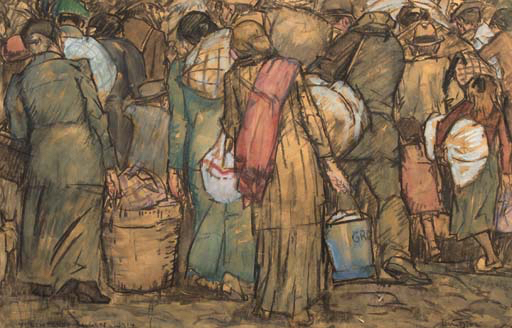
Leo_Gestel_Vluchtende_Belgen_1914

Refugees from another era


I am the son of an immigrant.

My mum arrived here from Australia in 1954 to work but also to explore her roots and travel around Britain and Europe – she had not planned to settle in Britain but met my dad and the rest is history, as the saying goes. She in turn was descended from people who moved to Australia, some as a result of transportation, some who chose to make the long and dangerous journey across the world to start a new life. Others were forced from the land, and had to find somewhere else to live, as I have written about before.

So my ancestors who travelled to Australia, who could be termed colonists, were a mix of convicts, migrants and refugees. I’m not going to dwell on whether this was a good or a bad thing, because it makes no sense to judge actions in the past with today’s mores or ethics, and what’s done is done.

Today Europe is engulfed in the worst refugee crisis since the second world war, when it’s estimated that 40 million people were displaced. Clearly what’s happening at the moment pales into the shadows compared with the chaos of the post-war years, but the fact that this is the worst crisis since then indicates what a relatively settled period Europe has been through in the past 60 years. Now it’s debatable to what extent European countries are responsible for creating today’s refugee crisis, although many come from  Iraq and Afghanistan where Britain at least played a significant part in recent wars. And in a sense, it matters as much, or as little, as whether my ancestors travelling to Australia was a good or a bad thing. The important point is that these people, these refugees, did not choose to leave their countries, their families or their cultures: they were forced to by events beyond their control.

The question which now occupies the leaders of Europe is “what do we do about it?”.

Perhaps because of Germany’s cultural memory of its role in creating the last great refugee crisis, or perhaps because it’s always identified itself as part of a greater Europe, with a great attention to social responsibility, Germany has taken the lead in accepting hundreds of thousands of refugees and migrants. Britain on the other hand (or should that be England?) is taking the opposite stance. David Cameron said yesterday that we should not take any Syrian refugees but instead “try and bring peace and stability” to the Middle East.

The irony of it: our interventions to bring peace and stability there have worked so well in the past have they not? Let’s have a quick romp through them – Iraq 2003-2012 – that one worked well. Of course supporting Saddam against Iran in their war 1908-88, that was a great success on the peace/stability front. Going back a little bit further we and the CIA arranged a coup to get rid of the democratically elected president of Iran, Mossadeq, in 1953, arguably helping create the foundation for the Islamic revolution 25 years later. And then there’s Palestine/Israel. Our Peace/Stability ideas encompassed in the Balfour declaration. This letter promised Palestine to the Jewish people. That must score highly on the Peace/Stability indicator – surely?

ok well I won’t labour the point any further. I think the lessons of history we should be learning are that British interventions in the Middle East, in the name of Peace and Stability, have generally not worked out well for that part of the world.

But regardless of whether they have or have not worked, there is a humanitarian crisis the like of which we have not seen in 70 years, and we have a duty, as fellow human beings, to help.

The issue of refugees, or migrants, trying to get into Britain via the Channel Tunnel has been turned into a bit of a media and political circus – used by all and sundry to push their own personal or party agendas, especially, but not exclusively, in the run up to the Euro Referendum. The very word “migrant” creates a misconception, “economic migrant” doubly so, as if by labelling them thus, it exonerates us from seeing their plight as worthy or compassion. It’s just another way that seeing through an “economic” lens can make us less human.

We travelled through the tunnel on our way to “Europe” (haha) this summer and saw the new fences – it does look a bit like a detention camp. On our way back we saw young men walking along the hard shoulder of the motorway near to Calais. As we drove through unmanned border crossings between France, Belgium, Luxembourg, Germany, Austria, Slovenia, Italy and France, the meaning of the Schengen Agreement became clear.  It’s completely free passage between these countries and others across Europe. Until you get to Blighty, when the barricades have gone up.

In some ways, we felt ashamed to be British, taking this Island Mentality, when for purely geographical reasons, we can physically refuse access to people in desperate need, people who have risked their lives to escape death or persecution, while our “continental” neighbours have no such choice: witness the scenes in Budapest or Macedonia in recent days.

Yvette Cooper thought she was taking a stance, creating policy distance between her and her Labour leadership rivals, by proposing that Britain takes 10,000 refugees. 1o,ooo? Germany already expects to take 800,000 asylum claims this year. These are not “economic migrants” but refugees. Thousands of people are drowning in the Mediterranean. Children’s bodies are found washed up on tourist destination beaches. 10,000?

After the end of the second world war Britain did take many refugees (I don’t have the exact number – if anyone does please let me know). They were often billeted in former prisoner of war camps or military bases – there’s some interesting history on Ukrainians here.  My mum remembers her parents providing a hut on their farm in New South Wales, for a couple of Ukrainians after the war; and I suspect this was also common practice in Britain. After the unspeakable horrors of the war, there was an innate willingness to help people who were homeless, suffering from trauma or who had lost their families, their homes and possessions.

What has happened to our society, that we can be so unwilling to help? Cries of “Britain is full” are self-evidently untrue. What happened to all those PoW camps and military bases? Many returned to the farmland from whence they came. Why is no-one suggesting we build temporary housing for the refugees who need our help?

Such is the poverty of compassion within Britain’s political and media spheres.

image:  “Vluchtende Belgen 1914” by Leo Gestel – Christie’s, LotFinder: entry 2073214. Licensed under Public Domain via Wikimedia Commons – https://commons.wikimedia.org/wiki/File:Leo_Gestel_Vluchtende_Belgen_1914.jpg#/media/File:Leo_Gestel_Vluchtende_Belgen_1914.jpg

Posted in Europe, refugees | Tagged , | 3 Comments