Guest Blog by Gavin Saunders: ECOS Review – Challenging Nature Conservation

Long long ago (well from about 2000-2004) I was on BANC Council, and I still write pieces for their journal, ECOS, from time to time (this was the most recent). So it gives me pleasure to have BANC Chair and Neroche Woodlander Gavin Saunders, to write a guest blog.


Thank you Miles for giving me this guest slot….
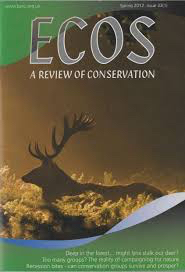
ECOS

This is a piece about ECOS, the little journal which, consciously and unconsciously, acknowledged and unacknowledged, has been flowing around the soup of the nature conservation sector as a catalyst for a rather long time. I think it’s great – and I’m very biased. And I also think, in my biased way, that anyone who enjoys the refreshing straightforwardness of Miles’s blog would also think ECOS is great. So this is, I admit, a selling job – but hopefully an interesting one!


When I started on the masters degree course in Conservation at UCL back in 1989 (where I first met the youthful Mr King, incidentally (I still had hair then – Ed)), we were introduced to a little journal called ECOS. In its diminutive A5 pages lurked a wonderful spectrum of articles about all aspects of nature and the battles to recognise, protect and connect with it, many of which were refreshingly left-field, irreverent and challenging, and which together seemed to leapfrog across boundaries between science and social policy, head and heart. All this was peppered with the whimsical but cutting cartoons of Neil Bennett. I subscribed to ECOS then, and have been a subscriber ever since.


Since that time, and especially in more recent years, ECOS has not been the only source of independent commentary on conservation issues – Miles’ own blog here, is an excellent example, and its popularity is a sign of how much we need this sort of free-thinking, unapologetic, unconstrained writing. Mark Avery’s blog is another, and there are more. But there are few places to turn for sources of truly independent thought in conservation. So much of what we hear from the conservation ‘side’ comes through the filters of big NGOs and the messages they choose to send out.


There’s an irony here: we all strive, as conservationists, to bring nature and its interests into the mainstream. Yet conservation isn’t a comfortable mainstream subject. It’s often at its best when it’s radical, questioning, even anti-establishment. That sort of position is often most easily represented by the individual, maverick ‘outsider’, but it can have a ‘home’ in a collective publication too.


ECOS was and is produced by BANC, the British Association of Nature Conservationists, which is a rather stuffy title for what has always been a very minimalist and non-establishment little charity. It was conceived and established by students on the UCL Conservation course, a few years before I did the course myself. Its founders and early supporters included people who became well known in the sector – Chris Rose, Sue Everett, Adrian Colston, Paul Evans, Heather Corrie, Bill Adams, Peter Shirley, Rob Jarman – and it received high profile support from the likes of Derek Ratcliffe and Marion Shoard. Rick Minter became editor early on and has remained in the role.


The founders saw the need for an independent source of challenge to mainstream conservation, which (even then) they saw as risking becoming smug and stuck in its own received wisdom. In the two decades which followed, ECOS quickly flowered into an influential source of critical commentary, inspiration and thoughtful rumination on all aspects of the conservation scene, read by everyone from students to chief execs who wanted a handle on what people were thinking amongst the rank and file. Amongst many topics where ECOS was a catalyst for the development of new thinking was rewilding (the discussion of which really took root through articles in ECOS), the ‘extinction of experience’ (the lack of nature contact amongst the young), alien species and our attitudes to them, and the various tribulations of the conservation agencies of England, Scotland and Wales. The BANC website now provides an archive of much of this back catalogue of material, and it makes fascinating reading.


Nearly thirty years later, I find myself chair of BANC. I joined its Council of trustees (who run the organisation as volunteers, with just a paid editor and development officer) a few years ago when it was clear that BANC was struggling, losing profile, and losing members. On the one hand, the printed journal was still popular amongst its core readership, though circulated and re-circulated copies meant readership didn’t translate into subscription income to support production and editorial costs. On the other hand, a potential new generation of readers were not very interested in a printed journal, which seemed quaintly old fashioned in an age of fast online news and opinion, so they were passing it by.


Something had to be done, and we took the decision to move ECOS online. As a result, the same quality and depth of writing which ECOS has always contained, is now available by annual subscription through www.banc.org.uk. We’re really excited by what it offers – but we need to bring it (back) to the attention of today’s crop of conservation professionals and practitioners.


And God knows we all need it more than ever! We need intellectual strength of purpose combined with heart-felt and spiritual confidence in the spark which excites us about nature. There’s a lot of dark, pretty malignant feeling ‘out there’ towards conservation, and it’s becoming politically acceptable in the devil-take-the-hindmost post-austerity world created by recent governments. Working in conservation is about more than having the qualifications and the licences and the CV. It demands the courage to stand up to the sneering, and the wisdom to see how nature infuses all aspects of human society. ECOS has always been a place to find little nuggets of that wisdom, but to continue to gather them, it needs people to subscribe.


To help bring ECOS content to that wider audience, we’re offering free downloadable access to a recent issue of ECOS, to encourage people to see what the online journal has to offer. So rather than take my word for it, please take a look here https://www.banc.org.uk/open-access-articles/.


An annual subscription to BANC is exceedingly good value at just £25 a year! To join, just follow this link https://www.banc.org.uk/join-banc/.



Posted in BANC, ECOS, Uncategorized | Tagged , , | 1 Comment

Biodiversity Day


Dryas octopetala

some biodiversity

Apparently it’s biodiversity day.

Or, to be more technically correct, it’s International Day for Biological Diversity.

The United Nations proclaimed this day as biodiversity day in 1993, shortly after the Rio Summit of 1992. The aim was to “increase understanding and awareness of biodiversity issues”.

It’s fair to say that the rest of biodiversity has not been treated well by that other singular species, us, Homo Sapiens, in the intervening 23 years.

Perhaps that’s part of the problem.

We don’t see ourselves as part of biodiversity, though we obviously are. Indeed though we may think of ourselves as individuals, members of families, communities, societies even citizens of states, we don’t think too much about ourselves as animals.

Or even symbionts.

While earlier estimates that bacteria outnumber human cells by 10 to 1 are now regarded with some scepticism, recent estimates still reckon we are as much made up of bacteria, viruses and fungi as we are of human cells. We are, each one of us, a mini ecosystem.

If the aim is to increase understanding and awareness, is biodiversity even the right word to use? I don’t think so. It’s a technical word with a specific meaning, and that meaning is known to a small coterie of activists, scientists and interested people. It’s a useful word for technical scientific use, but useless or worse actively unhelpful for communicating to a wide audience about nature.

Using the word Biodiversity creates a frame, a way of thinking about nature, which influences our attitudes and actions. While the original concept was noble, the consequence is that the word has become associated with a particular view of nature, leading to ecosystem services, natural capital and biodiversity offsetting. This was the subject of a talk I gave last year to the Chartered Institute of Ecologists and Environmental  Managers and I wrote up part of it here. I think it’s fair to say the audience was split, with some wondering what on earth I was talking about. You can see the slides here.

Having been a fully paid up, card carrying member of the biodiversity vanguard, I now prefer to use the word nature. Nature might mean different things to different people, but there is a core of understanding that most people will agree on. And the word nature, unlike biodiversity, creates an emotional response, an emotional connection, from humanity to the rest of non-human life.

So, forgive me, but I won’t be celebrating biodiversity day.

Does that mean I don’t care about nature? I’ll leave that for you to come to your own conclusions.


Posted in biodiversity, framing, language, Nature | Tagged , , , | 12 Comments

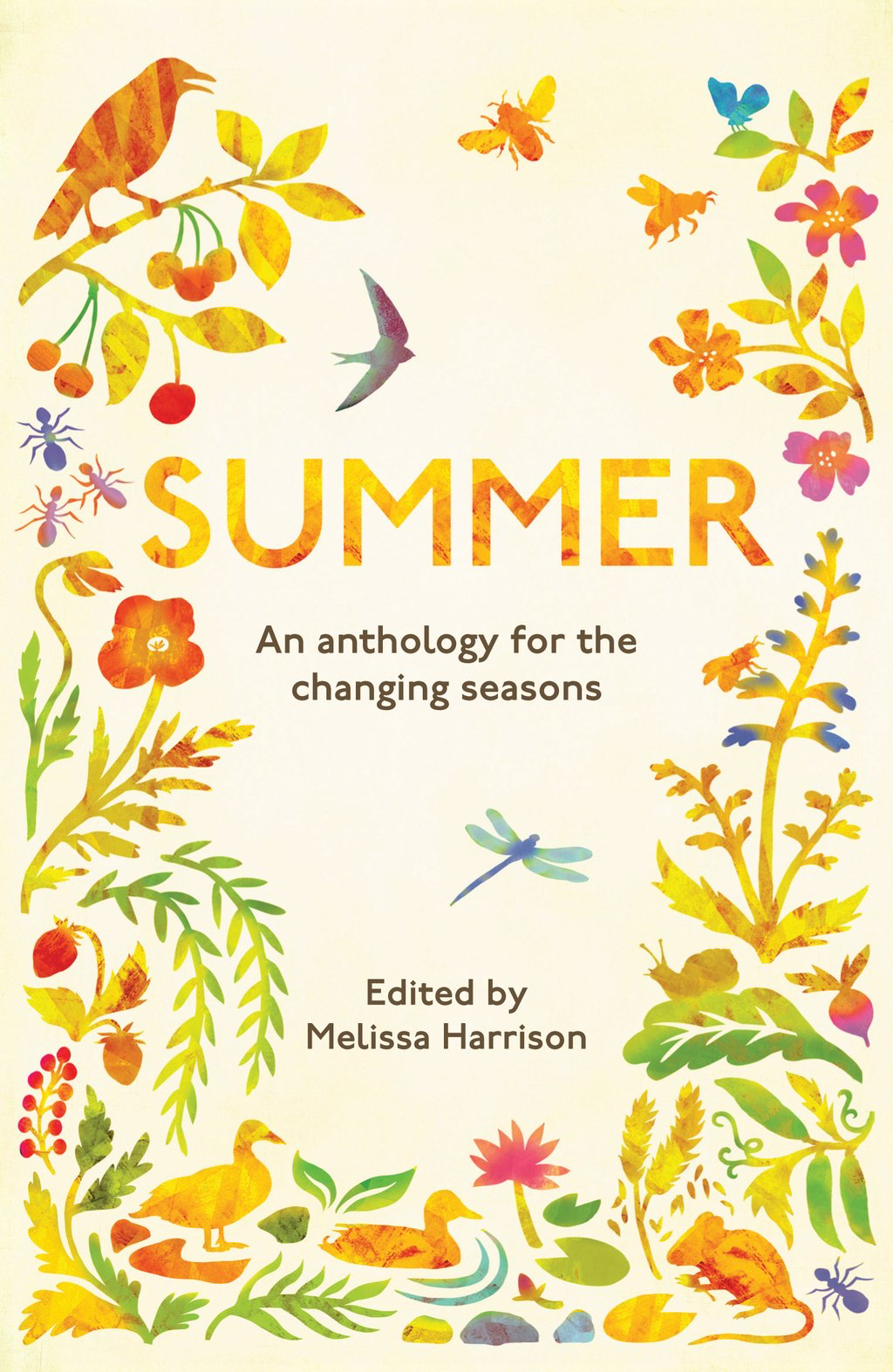
Summer: An anthology for the changing seasons

It’s a beautiful late Spring day here in Dorset. The temptation to leave the desk and computer and head off for a walk along the coast is almost overwhelming and I may well succumb shortly.

But first I’d just like to draw your attention to a wonderful book which is published today.

summer

“Summer: an anthology for the changing seasons” has been compiled and edited by the multi-talented Melissa Harrison and is the second of four books being published this year by Elliott and Thompson, in aid of the Wildlife Trusts. Buy it from NHBS or from your local bookshop.

I am immensely proud to say that I have written one of the contributions – and it’s sandwiched between one from the great Philip Larkin and one from another great, nature poet and writer (amongst many other things) Paul Evans. Other contributors range from George Eliot to Mike McCarthy, Gilbert White to Jo Cartmell, Richard Adams to Megan Shersby.

I’ve written about a particularly memorable summer of nature in my life, a long time ago. I will publish the piece on here, but not yet.

I hope you will all go and buy the book and enjoy dipping into its many treasures.


Posted in Uncategorized | Tagged , , | 4 Comments

Chris Packham mental health abuse update. Hunters blame Packham for inciting the abuse they gave him

This is just a quick follow-up post, to update you on things since yesterday’s about Chris Packham’s mental health problems and Asperger’s syndrome being used to attack him by the hunting fraternity.

Packham was asked for his views on the matter by the Huffington Post and in typical fashion responded in a sober, mature way.

 “It’s very disappointing to see such comments retweeted by an MP. People with Aspergers are not ‘nut jobs’ they are simply different.”

“And if associated depression qualifies them for such categorisation then I hope he manages to engage with some of the important messages from Mental Health Week.”

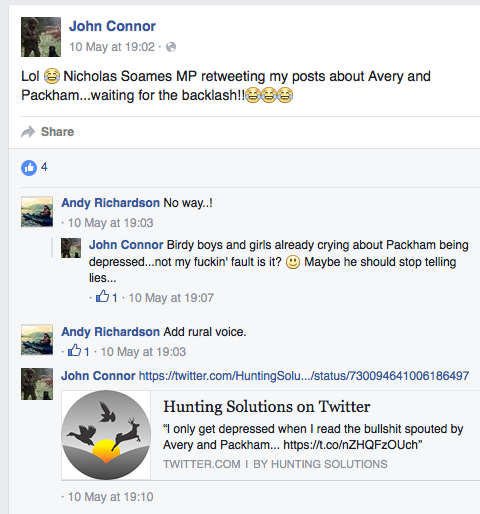
Meanwhile the origin of the story appears to be John Connor, the partner of the Nurse who runs the company Hunting Solutions. Connor realised he had hit paydirt for the pro-hunting anti-Packham campaign, as soon as Soames had retweeted the offending message. Here he is on Facebook:

connor


Hunting Solutions is now been trolled by equally offensive vegans and animals rights activists. This is par for the course – I have also been trolled on twitter by vegan animal rights people.

Someone insightfully suggested yesterday that hunt supporters and vegan animal rights activists feed off their mutual hatred – in a mutual dance of death. It’s an unedifying sight and will not solve anything.

Hunting Solutions, far from recognising the offence they have given to a large proportion of the population, sought to defend their actions by claiming that because Packham called fox hunters psychopaths, he was, literally, “fair game” and called him a “nutter”.

nutter

This claim refers back to the interview Packham gave when the Countryside Alliance were attempting to have him sacked from the BBC on trumped up charges. What Packham actually said was (of Foxhunting)

“I don’t understand it, I suppose. That’s the bottom line. To me, it has to have a psychopathic element, if you’re taking pleasure from killing things, just for that pleasure. If you’re going to eat it, if you’re culling an animal that is otherwise damaging the environment because it’s too abundant, I have no problem with killing animals. But if you have no reason but pleasure, then that surely is psychopathic.”

Now whether you agree with him or not, it is a reasoned argument, and he’s not calling Foxhunters psychopaths, but calling Foxhunting psychopathic – there is a big difference. A difference that will fly high over the heads of people like Connor.

While the Countryside Alliance’s famously spiky Chief Exec Tim Bonner declined to get involved, their head of shooting Liam Stokes dropped a comment in to the twitter conversation yesterday.

stokes

The petitioners relates to Packhams support for Mark Avery’s “ban driven grouse shooting” petition, which has now gained 36,669 signatures – that’s about 5000 added since yesterday – mostly I would imagine thanks to their own attack on Packham.

Stokes also appears to think attacking Packham for his Aspergers and Depression is the “petitioners” fault for having dared to suggest that driven grouse shooting was wrong. If a shooter had shot Packham dead would Stokes have nodded and sagely pointed out that if he hadn’t supported the petition in the first place, he would still have been alive?

Some commentators, who I respect, suggest the answer is to find the common ground and work with local communities, regardless of what their impact on nature is.This is undoubtedly an important approach to adopt, and the impact of farming on nature is a good example where this approach can help. But I’m not at all convinced it can apply to something like driven Grouse Shooting, which has as much to do with the politics of land ownership and property rights, as it does to do with the custom and practice of rural communities.

Would the Suffragettes have successfully gained Votes for Women by seeking to find common ground with men who would do anything to prevent their gaining suffrage? Would the Slavery abolitionists have succeeded if they had agreed to sit down and agree a common-ground approach to abolition? Clearly not. Common-ground approaches have their place, of course, but not every issue can be resolved this way.

Posted in Chris Packham, hunting, Mark Avery, mental health | Tagged , , , , | 18 Comments

Is it ok to call someone a nutjob because you disagree with their politics?

Chris_Packham

Chris Packham has been in the news recently, not least for the fact that he has Asperger’s Syndrome and suffered from depression which led to two suicide attempts. As someone who has also suffered from depression, I can understand to an extent what he has been through.

Chris is also a leading light in the campaign to ban driven grouse shooting, along with Mark Avery and others. I support this campaign, and if you haven’t signed the petition, please consider doing so.

Mark wrote yesterday on his excellent blog about the fact that some one from a hunting business called Hunting Solutions had called Chris Packham a “self-confessed nutjob” on twitter.

hunting solutions


In my experience being abused on twitter by people in the hunting industry is an occupational hazard of engaging with them. The use of the phrase “self confessed nutjob” on the other hand could be considered to be going beyond normal abuse. But this kind of language could be construed as being normal “banter” among the hunting fraternity.

What came next is more interesting;

soames nutjob retweet


The Right Honorable Nick Soames, grandson of Winston Churchill, retweeted Hunting Solutions tweeet calling Mark a “truth avoider” ie a liar, and Packham “a self-confessed nutjob”.

I find this interesting, especially in light of the way that the right wing website Guido Fawkes revealed Naz Shah to have “liked” on facebook a post that was widely considered as anti-semitic; and led to the now infamous “Hitler was a Zionist” spat between Ken Livingstone and John Mann.  Readers may recall that Labour leader Jeremy Corbyn launched an inquiry into anti-semitism in the Labour party, in light of these incidents.

Earlier this year, David Cameron publicly stated “we need to end the stigma of mental health”.  Cameron also has form though – calling David Miliband “nuts” and then quipping “I don’t want to get into an argument with the Mental Health lobby”,  as if that was the only problem with his use of language. Eric Pickles also talked about a child abuse survivor needing to “adjust her medication” and the aforementioned Ken Livingstone made a similar remark about a shadow minister needing “psychiatric help”, which was particularly crass as the minister had suffered from depression.

As we know, there is no right not to be offended in general, but clearly being offensive in a way that focusses on someone’s gender, race, religion, sexuality or indeed mental health or place on the autistic spectrum, is not only immoral and repugnant, but arguably illegal.

To use someone’s own mental health problems to undermine their well-reasoned arguments is disgraceful and should not be tolerated.

The Conservative party were lightning quick to jump on the bandwagon that Guido Fawkes started rolling, when it came to Labour’s problems with anti-semitism. When will they start to look at their own problems with other forms of prejudice and bigotry?

I put this to Nick Soames on twitter this morning  – his response? He blocked me.

Posted in Chris Packham, hunting, mental health | Tagged , , , , | 17 Comments

Three Years of a New Nature Blog

wishing tree

wishing tree and well, Burren.

Today I’m celebrating three years of writing this blog. It’s become quite an important part of my life, and I’m hoping to continue it for the foreseeable future.

I will also be writing blogs on People Need Nature‘s website, and at the moment am attempting to juggle my own twitter feed, the PNN twitter feed; and now facebook for PNN too.

This is becoming quite time consuming!

At some point something is going to have to give. I am hoping to raise enough funds to pay for a part- time social media person to take on the People Need Nature social media work.

If anyone has any bright ideas about how to fund that, please let me know.

The most popular post continues to be The strange case of Dr Earth and the UKIP environmental policies, which has been at the top of the table since September 2014. Hard on its heels now is The Flood, the Environment Agency and the Grouse Moor,  and I expect this one to make it to the top spot sometime this year. In third place (way behind the first two) is The Countryside Alliance, its charitable foundation and the Tory party.

Its pretty clear to me from these top stories, that what my readership wants is investigations into the murky area where politics and environmental issues meet. While I enjoy writing these pieces, they do take up a lot of time, which is being squeezed, as People Need Nature gets going. Expect to see more shorter pieces (have I said that before?) in the future.

Thanks to everyone for reading, and especially those who leave comments.

Posted in blogging | Tagged | 8 Comments

Iain Duncan Smith “may have done ok from the EU”

Iain-Duncan-Smith

Iain Duncan Smith has come out fighting today, insulting the Germans, deriding the Prime Minister as a push-over, but most importantly appealing to the British people’s better nature, arguing that the EU is “a force for social injustice”.

He apparently appealed to “those who may have done ok from the EU” to “think about people who haven’t”, targeting people who have benefited from cheap nannies, baristas and low paid East European labourers.

Perhaps IDS should follow his own advice, as someone who has benefited greatly from the EU.

Smith lives rent-free in a £2m (2013 prices) home on the capacious rural estate owned by his wife’s parents, Lord and Lady Cottesloe at Swanbourne, Buckinghamshire. Although relatively small for a country seat (only 1300 acres) The farm brings in £150,000 (in round figures) a year from farm subsidies.

Farm subsidies paid for by the – yes, you guessed it, European Union.

It’s easy for IDS to point the finger at people, because it helps divert attention away from the really big winners of EU largesse. Winners like himself.

Posted in Common Agricultural Policy, EU referendum, Europe, Iain Duncan Smith | Tagged , , , , | 1 Comment

West Dorset reject solar farm on landscape grounds

Some readers may recall that last year West Dorset District Council approved proposals for a 25MW solar farm to be built at Rampisham Down, inside the Dorset Area of Outstanding Natural Beauty and directly on a Site of Special Scientific Interest (this blog passim and ad nauseam). The decision was called in by the Secretary of State and a Public Inquiry is due to be held in September.

Last week the same Council rejected British Solar Renewables (the owner of Rampisham Down) proposals to build a relatively small 5MW solar farm at Thorncombe on the border with Devon.

The decision, which appears to have been delegated to Planning Officers, was taken to reject the proposal purely on landscape grounds. Here is the decision notice:

It is considered that the scheme, by reason of its extent and scale,

comprising dark coloured PV panel arrays in linear repetitive rows, together

with the ancillary infrastructure would result in a geometric industrial type

development visible from public rights of way. This would harm the character

and special qualities of the site, the Axe Valley Hills Landscape Character

Area, the setting of the Area of Outstanding Natural Beauty and the local

landscape. Hence the scheme is considered contrary to policies ENV 1,

ENV 10 and COM 11 of the West Dorset, Weymouth and Portland Local

Plan (adopted October 2015) and Contrary to advice within Section 11

(Conserving and enhancing the natural environment) of the National

Planning Policy Framework 2012.
 

So the Council have concluded that a solar farm near to the Dorset AONB will harm the character of the Dorset landscape, but putting one five times as big, within the AONB and on a SSSI, won’t.

I would expect this decision is likely to be considered closely by the Planning Inspector at the Rampisham Public Inquiry.


Posted in British Solar Renewables, Rampisham Down, Solar Farms, Uncategorized | Tagged , , | 2 Comments

Memories of the Boleyn Ground

I’m going to get a bit nostalgic now, so please forgive me, and if you don’t want to read on, look away now, as they say.

Today marks the last game to be played by West Ham United at Upton Park, and just writing that sentence has caused a lump in my throat and a tear in my eye (that’s enough cliches – ed).

Affectionately still known by Hammers supporters as the Boleyn ground (strangely I seem to remember it being pronounced Bol-een from my childhood but that could be a trick of the memory) as it was built on the grounds of Green Street House, originally built in the 16th century. One tower, known locally as the Boleyn Castle, survived until 1955. The Boleyn tavern next to the ground continues the historic association with Henry the 8th’s most vilified queen.

My grandparents lived a stone’s throw away from the ground and my grandad was a supporter before the first world war, at a time when West Ham had only recently moved into Upton Park. I’m pretty sure he did go to the FA cup final when we lost to Bolton Wanderers in 1922 in the first match to be played at Wembley, when the crowd was so large that the pitch had to be cleared by mounted police before the game could start.

My dad, Peter, was born there in Upperton Road before the war (it would have been his birthday yesterday) and had been a lifelong supporter of the Hammers, through the many downs, and occasional ups, over a period of 70 years. He lived through most of the Blitz, only being evacuated for a couple of weeks and going to see the Hammers was probably a highlight of the week. That part of East London was severely damaged during the Blitz and V weapon campaigns, and my dad used to point out places where V1 flying bombs had landed, or which had been wiped out by the V2 ballistic missiles.

Seeing West Ham win the FA Cup then European Cup Winners Cup in 64 and 65 were definitely high points for him, though he claimed me arriving a couple of months after West Ham won the FA cup gave him more joy.

When he died in 2010 he asked that we scatter his ashes at Upton Park. My mum approached the club chaplain who confirmed that we could put his ashes at the ground. When we arrived, he explained that ashes were no longer scattered on the pitch, as the players didnt really like running over grass with a grey sheen on it (and they knew why). So the ashes of the many who had made the same request  were buried under a Lombardy poplar by the main gates to Upton Park, in the corner of a car park.

We used to go to all the home games from when I was about four until I was about 16; after that I don’t think I went to quite as many (especially having saturday morning school in the 6th form.) Both my brother and I went to music school on a saturday morning and there would be a bit of a rush to get home, have some lunch (my mum always made sure we eat something substantial often a proper lunch, before we went) and then jump in the car to get down to the match. We would collect a friend of my dad’s and his son Chris on the way.  We used to park about 15 minutes walk away in a back road and as we approached the ground little knots of supporters would form bigger knots until suddenly, when an invisible threshold of critical mass had been crossed, we were in “the crowd”. The crowd was quite a scary place for a very small boy, not just because everyone was so big, but there was an undercurrent of excitement, of vaguely perceived threat. This was the late 60s early 70s when football hooliganism was at its height and West Ham was probably the place, the heart of skinhead culture. It wasnt unusual to see what I now realise were completely inebriated teenagers up for a fight looking for targets.

Once through the turnstiles, we bought our programme, excited to see who was playing – those earliest days we had football God Bobby Moore, along with the England 66 heroes Geoff Hurst and Martin Peters. But the team didn’t stop there – Harry Redknapp on the wing (chants of Harry Harry, Redknapp Redknapp, Redknapp Redknapp Harry Harry) and the young Trevor Brooking and Billy Bonds joined the side in 1967. West Ham was also very unusual in having one of the first black players in the First division, Clyde Best. It’s difficult to imagine his bravery to play in front of a crowd with so many racists, overt and covert.

Did I mention I was very small? my dad used to bring a stool for me to stand on. It was tubular steel, a sort of dull green colour with a wooden seat. I would be standing on this stool, teetering is perhaps a good word, on the south bank terrace. At the top of terrace was a group of hard core, many skinhead, supporters. From time to time they would all push hard down the terrace, forcing other supporters to move down Even though there were the crowd barriers to stop crushing (a sign at the exit stairs implored everyone to “remember Ibrox“) I still got knocked off my stool from time to time. This was pretty scary.

After a few years we moved from the South Bank into the Chicken Run. This was very small area of standing near to the pitch on the east side of Upton Park. There was no pushing or anything like that, it was all very civlised, apart from the shouting, much of which was obscene, and often very funny. From our new vantage point we could watch, sometimes with horror, as the South Bank hooligans attempted to break into the visiting supporters area, which had as I recall quite a tall fence around it.

One thing that I will never forget is the noise of football match especially a high octane one like a cup tie. It’s the sound of twenty or thirty thousand people making a similar noise, a kind of howl, all at once. And now I think about it, it must have something to do with the acoustic of the ground as well – as the stands, throw the sound back from their depths. Also, the smell of roasted peanuts – you buy a bag of roasted monkey nutss and the ground was littered with the shells afterwards – as we would crunch, often disconsolately, out of the ground after another defeat. My dad used to get so emotional – he would be shouting at the players, giving advice, admonishment, frustration – but when we scored or even just an inspired pass from defence  – or one of Alan Devonshire’s mesmerising runs inside from the wing, the sheer expression of joy was well yes indescribable. You really did have to be there.

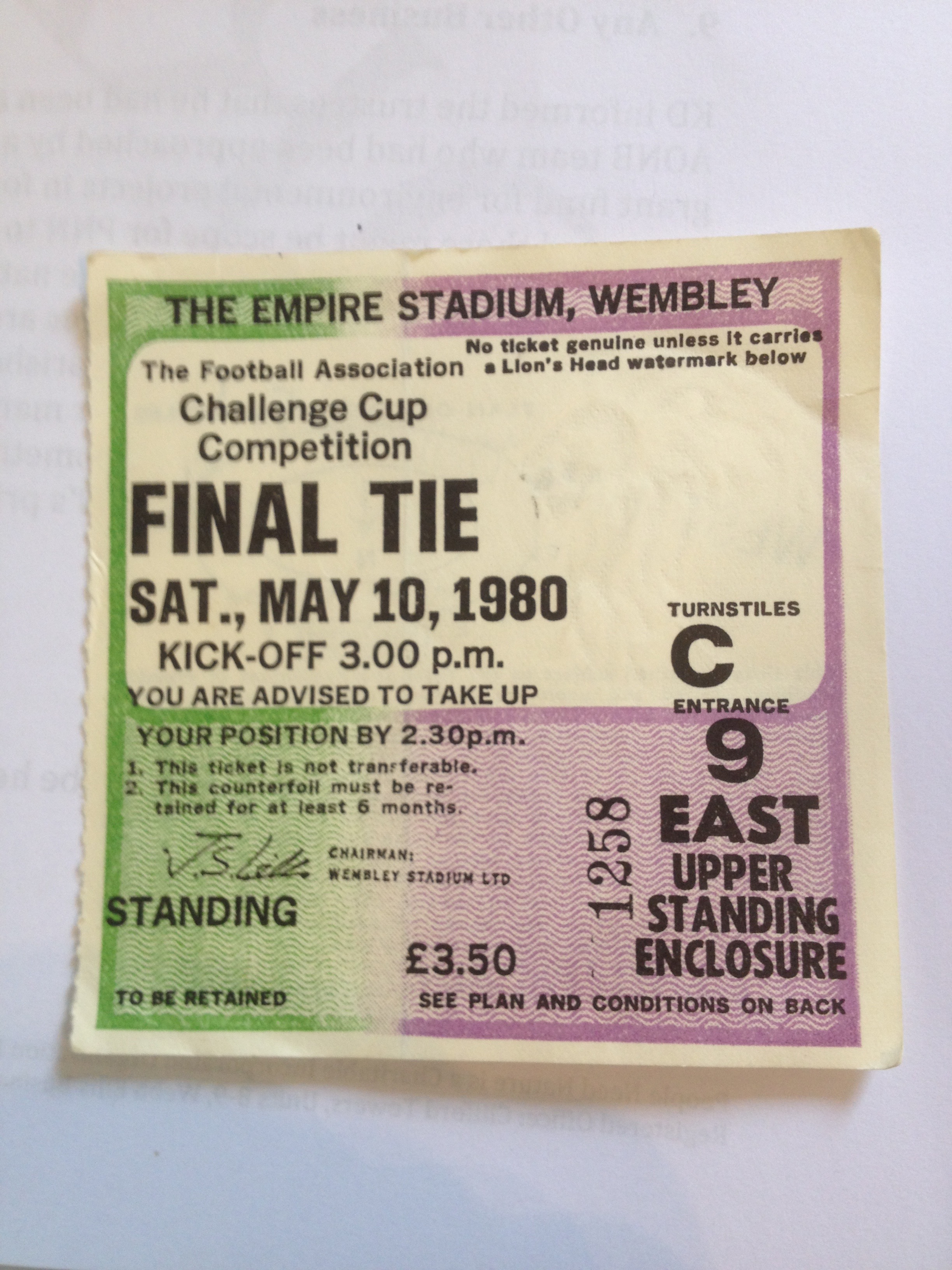
The high point for me was the cup run in 79-80. We went to all the matches except the semi-final replay and yes I still have my FA cup final ticket.

IMG_1120


When Trevor Brooking steered the ball past the Arsenal keeper Pat Jennings (from where we were standing it seemed like he had put it in with his knee, but we discovered later it was that rarest of things, a headed goal from Trev) the sound was incredible and the look on everyone’s faces seemed a mixture of sheer joy and disbelief that it should be Trevor Brooking of all people who should have scored in the FA cup final.

I was lucky enough to hold the FA cup that summer, as it toured around East London. It was brought to our local cricket club (where I played, very badly!) as the club chair knew West Ham people – it had ribbons of claret and blue tied to its handles, naturally. I still have the picture somewhere. It’s a very very heavy cup.

After I moved away from London my brother Simon continued to go to Upton Park with my dad, right up until the end – it brought them together, they shared moments of high drama (eg the Di Canio years) in a way I did not have – I suppose I was a bit envious. Simon also died a few years ago.

I occasionally watch a match on the TV but I’m not an avid follower. But the Boleyn Ground does feel like a part of my history, my background – part of what makes me who I am. I think that being exposed to the ugly and brutal far-right from a young age certainly influenced how I see politics and society and may well have played a part in developing my views about social justice and working for something you believe in.


Posted in Simon King, West Ham | Tagged , , , | Leave a comment

Earthwatch Natural Capital debate today: Does nature come with a price tag?

NY_stock_exchange_traders_floor_LC-U9-10548-6

It’s going to be the warmest day of the year so far (at least down here) so of course rather than go and enjoy the fantastic nature that a beautiful spring day in Dorset has to offer, I’m getting on a train and travelling up to London for the Earthwatch debate this evening.

The debate centres around on the knotty question

“Does nature come with a price tag”?

I get to kick off proceedings for the opposition, with an 8 minute introductory spiel. I’m not going to tell you what I say, obviously. If you have read any of my writings about natural capital, or its twin biodiversity offsetting, then you will know my views. If you haven’t, there are plenty of posts about both subjects elsewhere on the blog eg this one about a specific offsetting fiasco, or this one about Natural Capital patron saint Dieter Helm.

If you’re in London and have a free evening, please come along and join in the debate. If you can’t make it in person, the debate will be live online, and also filmed and put up on the web in a few weeks time.


Posted in biodiversity offsetting, Dieter Helm, Natural Capital | Tagged , , | Leave a comment