Election Blog 8: The aftermath

Remember waking up to the shock of the Referendum result in 2016? Today feels very different. Yes the Conservatives have won 363 (with 2 yet to declare), by taking seats off Labour in their traditional heartlands. They have a reasonable majority but it’s no landslide. Labour won 419 seats in 1997. The Tories won 343 in 1992 and 376 in 1987.

Thanks to our ridiculous electoral system, the Tories gained 30% of the total electoral vote, and have a healthy majority. 33% of voters did not vote. I’m increasingly of the view we should adopt the Australian system where it is compulsory to vote. “No taxation without representation” can work both ways.

Johnson has already admitted he’s won by “borrowing” votes from Labour, suggesting he knows this is a temporary shift as a result of two things – Brexit and Corbyn. Leave voters in Labour constituencies will have been horrified by Labour’s vacillation over Brexit and their position going in to the campaign was confusing, even if it was logical. Logical doesn’t win campaigns.

Perhaps more significant was Labour and floating voters’ distrust of Corbyn himself. He was elected leader by accident and he has shown his inability to be the leader Labour needed, at this critical moment. His own deep euroscepticism was clear for all to see, even if he reluctantly agreed that the party would take a different line – but he was certainly responsible in part for their confusing shifts and slides in position over the past four years. His utter failure to tackle the anti-semitism scandal will also have contributed to people viewing him as an unsuitable leader of a political party, let alone Prime Minister. And then there’s that long history of supporting radical (and militant) causes around the world. It’s what a devotee of international socialist revolution would naturally do. But most people would not want someone adopting that political stance to be their Prime Minister. So people didn’t vote Labour because Corbyn (and the cabal around him) was in power.

Of course there have been lots of dirty tricks and I’ve read that there was a massive social media campaign by the Tories in the last couple of days of the election. Hopefully we will find out the details but Facebook appears to be deleting the ads now so perhaps we will never know how effective it was in shifting votes in key constituencies at the last minute. With a decent majority there is now little chance of there being any kind of investigation into electoral malpractice, and certainly not the root and branch reform we desperately need of our electoral system and regulation of electoral campaigns and funding.

One thing which is now resolved is that Brexit is solely the domain of the Conservatives and they will now own whatever happens next. The Brexit Party has fulfilled its role, shifting the Tories towards the hardest possible Brexit and Farage will disappear off to the US dinner speaking circuit. Thank goodness for that. One thing that is still unclear is how the ultra-hard right European Research Group clique within the Tory party will behave now. Does Johnson have enough of a caucus, particularly among the new intake, to support his approach of a 11 month transition period and the “border in the Irish Sea” solution to Northern Ireland. Or is the ERG still large enough (or perhaps enlarged) to push for other forms of Brexit. Given that Labour will be in total disarray for at least a couple of years it seems unlikely that we’ll see anything like the bizarre coalitions that sprung up in Parliament over the last couple of years. Johnson has a clear run at whatever Brexit he wants to get done. And he’ll have to live with the consequences whatever they are.

On the environment, which let’s face it had a good campaign, I hope that some of the manifesto commitments made by the Tories stick. But the underlying reality still stands, which is that leaving the EU is bad for the environment – especially as Johnson has made clear he is moving away from the “level playing field” alignment with the EU. So we can say goodbye to the extra protections afforded by the EU directives – Habitats, Birds, Nitrates, Environmental Impact, Water Framework, etc etc. This is going to be painful. Will it make a massive difference to nature in the UK? difficult to say but the changes will be very significant in some places. EU law has held back housing development around the Heathlands of southern and central England for 15 years now (including here in Dorset). Those restrictions must be under severe threat as the housebuilders (who help fill Tory coffers at every election) look to capitalise on all that land becoming available, without having to spend anything on SANGs. There’ll be further relaxation of planning rules to allow development in the Green Belt and I would expect around villages  and towns. And a further accelerated sell of of public land (for housing.)

The fate of UK agriculture now rests in the hands of whoever becomes Trade Secretary and how keen they are on a US trade deal. Opening up our borders to imports of cheap food from the US and elsewhere will spell disaster to our farmers who can’t possible compete on price, however much they intensify. Equally a poor trade deal with the EU, or no trade deal at all, will cut off exports markets for Lamb and Beef, in particular. I’d also expect rules on growing GMO crops to be relaxed once we leave the EU.

Action on climate change will proceed in the slow land towards net zero by 2050, but once we are tied closely to the US, our enthusiasm for action (especially overseas) will be mitigated by whoever is in power there. Nevertheless I can see a big forestry programme getting going, with mass conifer planting on all that abandoned sheep land. I’m sure Confor will be grateful to Friends of the Earth for delivering their policy agenda for them. As a sop to the environment lobby, expect to see a handful of new national parks delivered by the Glover Review and some more introductions of lost animals; but with landowners being given free rein to cull them if they breed too successfully.

One question that is still to be resolved is whether Johnson and the Tory Party will shift wholesale to the positions adopted by the hard right  – the faux libertarians who occupy all those Think Tanks in Tufton Street. I’m talking about the “Singapore on Thames” vision, of a low tax low regulation society (although Singapore is much more complicated than that). This vision involves completely dismantling the welfare state created after the Second World War. I’m in two minds at the moment as to whether it will happen. Chances are that there are enough devotees of this political stance in the new Cabinet to push for it to happen. On the other hand Johnson (or rather his advisors) will be mindful of all those “borrowed” Labour voters, who are much more inclined towards a mixed economy. So there might only be baby steps for the moment, putting in place the measures needed to see a wholesale shift after Brexit is a distant memory.

If it’s any consolation, it was still a struggle to get Labour interested in the environment after the initial enthusiasm of the late 90s – and progress to reform the CAP was so glacial that I’d more or less given up believing any significant change was possible 5 years ago. We are still more likely than not to have a new agriculture policy which supports payments for public goods – and that’s worth campaigning for.

Nature still needs our voices to be heard, whatever Government is in power.


Posted in 2019 general election | Tagged | Leave a comment

Election Blog 7: Anatomy of a Dead Cat

It seems, finally, that this election campaign has come to life, despite all the Tories’ best efforts to keep it in the deep freeze – ok I’ll stop with the horror tropes now. Maybe (heheh).

It started with the most extraordinary event  – which Marina Hyde has effortlessly described (never a good idea to compare yourself with such giants – I tell myself) so perfectly. Boris Johnson now has “phone robber” added to the long list of names Stewart Lee has assigned him. Of course the story that Johnson sociopathically avoided having to comment on was the story of Jack who, with suspected pneumonia, ended up sleeping on the floor of Leed General Infirmary because there were no beds.

It’s like the Christmas story, but in reverse, with Boris Johnson as some dark Christmas character from German folkore like the Krampus or from the StruwwelPeter stories.

It was I think more than anything else the wonton casting-off of social norms and the fact that he was being filmed by an ITV camera crew as he did it, that caused the sensation, as much as the story of Jack itself. Anyway within an hour it was clear there was a major crisis brewing and the CCHQ disinformation unit – otherwise known as CCHQ had to spring into action. They needed a Dead Cat. A dead cat is a story of such craziness, such appeal to the media, that it will displace whatever awful story is already running.

First they tried the “we’re going to privatise the BBC” line while Johnson was dressed up like a pantomime Elf n Safety gorn mad character in a Sunderland factory. This didn’t cut through at all and indeed people were already commenting that it was so obvious that it was a blunder.


They needed another plan. Health Secretary Matt Hancock had been dispatched to Leeds General Infirmary  – well it’s not entirely clear what the plan was, perhaps to say sorry (to whom though?) – but he was there and as he left the building he was confronted by a tiny group of Labour protestors – literally about five people who were shouting at him. As you would. As his car left a man with a bicycle gesticultated at the car and Hancock’s special advisor walked into his raised arm. That was it. No altercation. No scuffle. A video released quite some time afterwards revealed the protestor saying to the Spad “you walked into my arm.” as if to suggest the Spad had said something like “you hit me.”

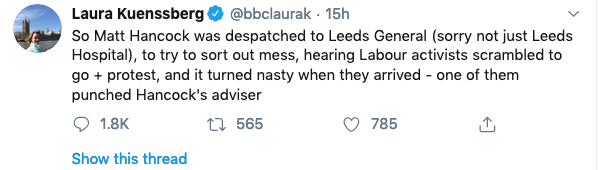
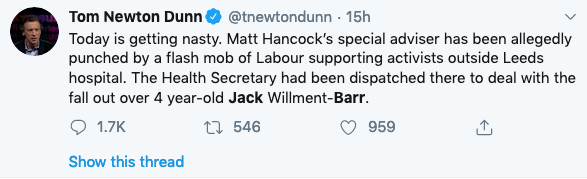
Within minutes Laura Kuenssberg, Robert Peston and Tom Newton-Dunn – who we shall call the client journalists, for the purposes of this charade, were tweeting that the Spad had been punched, and things had turned nasty.


We still don’t know how these three knew what had happened as none were on the scene. Newton-Dunn has been having a particularly bad week, after earlier publishing a story about the hard-left cabal around Corbyn, which turned out to include real Neo Nazis in its sources. The story was pulled after threats of legal action.

Anyway, the dead cat had been swung and had made contact.

What was interesting was who was amplifying the message – an awful lot of bot accounts on twitter. Hopefully someone will do an analysis as it could prove instructive – initial analysis here.

The “punch” story spread like wildfire – and within half an hour was on the Mail online as well as the deniable Tory/Brexit disinformation unit otherwise known as Guido Fawkes. By 5pm it was clear that the punch story had been exposed as a fake – BBC reporter Nick Eardley, who was actually there, confirmed on PM that there was no fight, no punch just an accidental collision. The story continued to run, but now there was a counter story all on its own – against Kuenssberg, Peston, Newton-Dunn and their client journalism, their willingness to swallow lines from “a downing street source” or ” senior conservative party source”, or whatever euphemism is in play at that particular moment.

By the 6pm news Kuenssberg’s report made no mention of the punch and she issued an apology on her twitter feed, but of course the damage had been done. Although actually the damage had not worked because the Jack story was still there blazing away at 10pm. Perhaps there was a secondary motive with the dead cat, which was to cast Corbyn supporters as violent leftist thugs hell bent on destroying the system – much as Newton-Dunn’s Neo-Nazi inspired hard left conspiracy story, had wanted to do.

Since I left the crime scene I see this morning that a new dead cat attempt started late last night, with claims that Jack Barr’s photo was staged and he couldn’t possibly had had pneumonia. This is how low the Tories are prepared to go. As I’ve said before it is a “no holds barred” contest. More on today’s dead cat here.

Is this all a storm in a tea-cup (or cat basket)? perhaps. But one thing is clear. Whereas we all knew that the Mail the Telegraph, the Times etc all the billionaire-owned media, are not to be trusted, now we can add client journalism in the broadcast media as those either willing or susceptible to being manipulated, happily amplifying dead cat stories to disinform and confuse the public, the voters.

This is not good news for our democracy. So we have to redouble our efforts to bring the media to account after all this is done and before it’s too late.


Posted in 2019 general election | Tagged , , , , | Leave a comment

Election Blog 6: zombie apocalypse

The week begins – a week where, it would not be too melodramatic to suggest, the future of the UK could head in such stupendously different directions depending on the outcome of the election on Thursday, that it would end up being two different countries. And in one case it could literally mean it ends up being two different countries, with a third piece handed over, or back, depending on your viewpoint, to another country.

In this very short series of blogs I’ve tried to examine the various parties’ views on the environment and their commitments to change things in that regard. It’s fair to say that the environment – or rather climate change – has figured very significantly in this election campaign. Most significantly we’ve had a bidding war between the parties as to who can come up with the most ambitious net zero carbon timetable. One spin off of this has been the “tree rush” with parties vying with each other to come up with the most unrealistic tree planting target. Although I haven’t discussed them we have also seen Labour publish a “plan for nature” and the Greens also commissioned a New Deal for Nature. I might come back to these, but Mark Avery has looked at them both if you want some analysis. Friends of the Earth has awarded Labour the prize for the “greenest” manifesto, which has irked the Greens. As to whether the various parties have donned green clothing in a cynical attempt to capture current interest in the environment… I will probably return to that question another time.

Looking at the campaign more widely, it has been characterised by dirty tricks, which is where I started this series, but also perhaps of greater concern, a lack of accountability on the part of the Tories and Boris Johnson in particular. He has avoided scrutiny by the public and the media. When he has appeared it’s always been on his own terms – carefully stage managed events so as to avoid difficult questions – either about his own character or his policies. In recent days he’s taken to cancelling public events on some transparently unbelievable excuse. He’s just not turning up. The media has to take some responsibility for this – especially the BBC which is at least supposed to be impartial. Most of the media of course supports Johnson so why would they bother trying to hold him to account? Far from it, some amplifying the toxic world of the extreme right in their quest to paint Corbyn as a dangerous extremist at the heart of a hard left conspiracy.

Channel 4 empty chaired (or ice-sculptured) him for the climate debate, but the really big no show was the Andrew Neil interview. Now regular readers will know my views of Neil but even I accept he is the big beast of political interviewing in this country. Never mind that he was Johnson’s former boss at the Spectator, or shares a lot of political views with him – in fact I’d suggest Neil is considerably further to the right than Johnson – in as much as Johnson has any cogent political positions on anything.

As well as Johnson avoiding  public scrutiny the Tory manifesto is remarkably thin on any details of policies or spending. Any semblance of a plan peters out towards the end of 2020 and I think this is deliberate. Because if Johnson gets in then we will be heading to a no deal crash out Brexit this time next year (leaving Northern Ireland half in and half out of the EU). All experts and the EU have said that there isn’t an ice sculpture’s chance in hell of concluding a Free Trade Agreement with the EU within 12 months, especially one where we are not aligning the “level playing field” on workers rights, the environment, etc. Conversely we know the USA is ready to start negotiating their FTA with us on day one. And they will come in very hard, on all the things they have been fighting the EU on for the last several decades ie demanding we allow in their food – chlorinated chicken, hormone beef & pork, GMO crops, which the EU banned. And charging more for medicines the NHS buys.

Couple that with the fact that the USA has just broken the World Trade Organisation dispute settlement mechanism. This means that trade wars, which of course Donal Trump loves, will no longer easily be negotiated into peace agreements. And that means the likelihood of the UK being drawn into a heated up trade war between the US and the EU will increase dramatically. The vote on Thursday could literally move us from one geopolitical sphere into another one – and Orwell’s vision of the UK as Airstrip One will be made flesh.

What can we expect then if Johnson does get in with a reasonable majority – say something between 20 and 70?

Forgive me if I indulge in a bit of speculation.

Obviously Brexit will proceed as he plans. After a year of further tumult we crash out without an EU trade deal, on 31st December 2020. This alone will drive a bulldozer through Johnson’s avowed spending plans – forget more money for the NHS – those 40 hospitals – or was it six refurbished ones? No one will remember the details by then. The Universal Credit roll-out will throw tens of thousands of the poorest and most vulnerable in society onto the edge or, or over the edge into homelessness. What will be done with them all? Perhaps a return to the workhouse is on the cards.

Naturally Scotland will push ever harder for independence – who knows, perhaps even a militant group might pop up, given the level of suffering Brexit will impose on this country which voted so overwhelmingly against it. Northern Ireland is far more likely to slip back into the dark days of the troubles, as both sides find they have been shafted by Johnson’s Brexit agreement.

Priti Patel will be free to fulfil her destiny as the most extreme Home Secretary in decades – rounding up immigrants (illegal, legal, what does it matter?), dumping them in detention camps. You know the score. Anyone wanting to use “public” services like schools and hospitals will need to show proof of status. New privatised police units will be seen regularly patrolling wealthy neighbourhoods (those that aren’t already gated and fenced), while sink estates descend into low level urban warfare, helped by a relaxation in the gun laws (you think the NRA won’t have a big say in the US trade agreement???). Capital punishment will return – and anyone who thinks they will be able to camp out for a few weeks on a bridge over the Thames will discover that right to protest was criminalised alongside trespass. You really won’t want to end up in the new mega-prisons, where gangs effectively enforce discipline.

Is there anything else left to privatise? Yes of course there is. Local Council services  – those few that are still in the hands of the public sector, will be outsourced. And as Council budgets continue to be squeezed tighter and tighter, anything that can be charged for will be charged for, so only the prosperous will be able to afford them. Want your streets cleaned? You’ll have to pay for it. Adult social care? Only available privately. Sorry.

The cliff edge will also approach for UK farmers.A double whammy of reduced subsidies and cheap imports will do for many farms. Those that can survive will intensify their management, squeezing every last ounce (yes Imperial Measurements Are Back!) of crop or unit of livestock from their land. Once free from the EU the shackles of Red Tape can be thrown off and there won’t be any staff to check on compliance of whatever paper thin regulations are put in place to replace them anyway. Where farmers have gone to the wall (eg the sheep industry long propped up by subsidies and tariff walls) land will be bought up cheap for heavily subsidised commercial conifer forestry. What were once denuded hills will become bright conifer green plantations. Still  – climate action! Maybe a few Lynx will find sanctuary in them, as with the death of the sheep industry, the single voice opposing their return goes quiet.

Cheap food of questionable safety will be allowed in under a zero tariff regime, but there won’t be any food safety officers around to check whether it’s safe or not, so outbreaks of food poisoning will go unreported or will spread out of control. And as Johnson morphs into our very own version of Viktor Orban, anyone trying to bring these things to the attention of the public will find their funding has been cut and a brick through their window for starters.

If I paint a rather dark picture of what the future holds, please accept my apology.  And of course I could be completely wrong. Let’s hope so.


Posted in 2019 general election | Tagged | Leave a comment

Election Blog 5: UKIP manifesto

I was planning to write the latest addition to my short and instantly forgettable election blog series, but then the first of the winter bugs came along and knocked me off my perch. I’m back on it again (sort of) and am inspired by the high point of any election campaign, that being the publication of UKIP’s manifesto.

To say UKIP is a spent force in British politics would be an understatement. But it is worth remembering that they managed to reach 27% of the vote in the 2014 European Parliament elections. And it’s reasonable to conclude that this incredible showing influenced both David Cameron and Ed Miliband, to commit to a Referendum on EU membership, in their respective 2015 manifestos.

How have the mighty fallen. Cameron ran away after cocking up the Referendum and is now hiding in a Shepherd’s Hut, stoking the wood-burner with remaindered copies of his autobiography. Miliband sits on the back benches musing over what might have been, if whoever came up with the Ed Stone idea had never been born; and UKIP.

UKIP. I always thought, at least from the time when Farage mounted a coup and took it over after the ’97 general election, that UKIP was a deniable asset of the extreme right wing of the Tory party (formerly known as The Monday Club). Its goal was always to get us out of the EU, other policies were irrelevant, except insofar as they would deliver that goal – immigration (as a proxy for racism) being the card they always played, year in, year out.

There was another faction operating over the same time period – we’re talking about 20 years ago, which also wanted out of the EU – though for a subtly different set of reasons. These were the Hayekians, the libertarians, which morphed into the Hard Right group of Think Tanks and their apparatchiks orbiting 55 Tufton Street, with their wealthy US billionaire funding. This group wanted the UK to be free of the shackles of EU legislation – directives which the UK were required to sign up to – on everything from workers rights, to environmental protections. One particularly influential source of funding was the Koch Brothers, who supported the Tufton Street conspirators very generously. They made their billions from fossil fuels and weren’t going to allow any quasi-commie EU legislators stop them from destroying the planet in the name of Big Profits.

The two factions have worked together over the past couple of decades, though I think it’s fair to say the relationship has been fractious. It’s been suggested to me that this fractiousness is just a cover and they are really one group. I am not convinced, but history will tell us in the end. That they split into Vote Leave (the Tufties) and Leave dot EU (the far-right) during the Referendum campaign is illustrative, even if they did evidently work together when it suited them.

Anyway, enough ancient history. Is there anything worth saying about UKIP’s manifesto? Arguably the best thing to do would be to ignore it. But that would be a mistake, because UKIP still represents a small proportion of the electorate. People really do believe the stuff they write.

The manifesto is a weird mix of state-authoritarian and low-tax libertarian and in that sense politically it makes no sense whatsoever. However, this accusation could equally well be applied to the Tory party manifesto, so that doesn’t get us anywhere.

On agriculture, UKIP is of course thrilled that we are leaving the hated Common Agricultural Policy. Everybody seems happy about this, aside from farmers, and agricultural policy experts who have been thinking very carefully about what the consequences might be if the replacement is even worse.

Aside from the bleedin’ obvious that leaving the CAP means we will have to produce a “tailor-made” policy (duh), UKIP’s first priority for UK farming is anti-microbial resistance.

“a wide range of grants with tackling anti-microbial resistance as a major priority.”

this is the top priority.

Following that UKIP are very concerned about “traceability and origins of raw materials”, “country of origin, method of production, transport and slaughter.”

They finish with the neat idea that they will ” incentivise more British students and young people to pick the harvest during their summer holidays rather than relying on foreign labour.”

No detail is provided as to the methods of incentivisation   – cattle prod? or perhaps just making a summer of hard manual labour a requirement for any EU student wanting to come and study in the UK.

On methods of slaughter, I’m not going to sully this piece with any comment about the rampant Islamophobia which reeks from this document, other than to say it’s there.

The agriculture section is mercifully brief, but Energy gets its own page. But this is mainly used to reconfirm UKIP’s climate denial position. Marine Plastic is a big problem and Deforestation (remember the far-right loves trees) but – and just to emphasise the point, it’s in bold so you can’t miss it “there is no climate emergency.”

UKIP would reintroduce coal burning power stations and fracking, because, of course, energy autarchy is the goal they seek. But this is where it gets weird. On the one hand UKIP argues there is no climate emergency, but on the other they argue that there is no need for action because the UK’s GHG contribution is so small.

Well, which is it to be? Climate Chaos either exists or it doesn’t. Why would UKIP want to invest in carbon capture and storage technology (they do), if CO2 isn’t a problem?

On the environment, UKIP is terribly keen on the Green Belt, but are desperate to build houses all over brownfield land. Has no-one pointed out to them how much of the Green Belt is brownfield land?Apparently it’s “uncontrolled mass immigration” which is the main threat to the Green Belt. who knew.

There’s the usual guff about allowing farmers to drain their land – they already can and do.

Apparently, after  leaving the EU UKIP “will uphold high environmental standards that protect our air quality, waterways, woodlands, farmland and other habitats.”

Well yes everyone’s saying that, aren’t they. But the truth is the standards will slip, whoever gets in power.

And Forest. UKIP loves forests, and trees. They “will protect our woodlands and end the sale and privatisation of woodland managed by The Forestry Commission and National Parks.” In this respect UKIP makes the same basic error as every other party – confusing woodlands with conifer plantations.

There isn’t much else to say, aside from UKIP’s position on Science. UKIP feels that science has not been kind to their world view. UKIP feels it is the only party that truly understands the scientific process and that all its policies are based on the best available science. They use some interesting examples to illustrate their scientific underpinning.

The first one is – yes you guessed it – ritual slaughter. Then it gets weird. Science is apparently causing too many road signs.

“Transport, where suspect ‘scientific’ studies have often been used to justify excessive signage, usage restrictions and road furniture which allegedly increase traffic flow and reduce congestion, and the over-zealous introduction of monitoring cameras and deterrents like speed bumps which allegedly improve road safety and reduce accidents, though common-sense, anecdotal evidence and other, arguably less partisan and more objective academic studies, suggest they frequently achieve the opposite.”

Yes, they’ve fallen over their own hurdle. It’s “common-sense, anecdotal evidence” which is what’s best, if you don’t like the science.

Then comes climate change. “Dogma is no replacement for objectivity, especially when there is so much at stake financially.” Well, yes – it’s difficult to argue with the sentiment.

But UKIP, never being more than a few metres away from a racist dog-whistle, then gets all confused again that maybe there is something in this climate change conspiracy after all, suggesting that the UK’s GHG footprint is “comparable to that of some single cities in the third world.”

Blame the poor!

This final point broke my irony meter. It could almost be a straight steal from any number of reports critiquing the climate denial movement:

“While considering published research, UKIP recognises that it is important to determine who fund-ed it, and what the aims might be of the funder, and also examine the record of the researchers concerned so as to determine if they too are likely to have an agenda. There have been instances when data has been falsified, or analysed only selectively, so as to support conclusions that fit the requirements of a lobbying group. That is not good or acceptable science and needs to be exposed.”

I’ll finish (as this is already way too long) with a final thought. UKIP will halt the rollout of 5G mobile phone technology until it can be proved that the waves are “fully safe for human beings, animals, plants and microbes.”

The clues are littered through this manifesto. The obsession with food origins and contamination, microbial resistance, litter, and now, to crown it – mutation of plants and microbes into new and terrifying monsters.

Yes, it’s Colonel Jack D Ripper explaining that the Commies are poisoning his “precious bodily fluids.”

And people will vote for them.


Posted in 2019 general election, UKIP | Tagged , | 2 Comments

Election Blog 4: The Manifestos

too radical for Corbyn’s Labour party

Now that all of the party Manifestos (and the Brexit Party’s “contract with the people”) have been published, it’s possible to make some comparisons between them  – what are they offering to the electorate, and particularly those who place the environment high up their list of priorities?

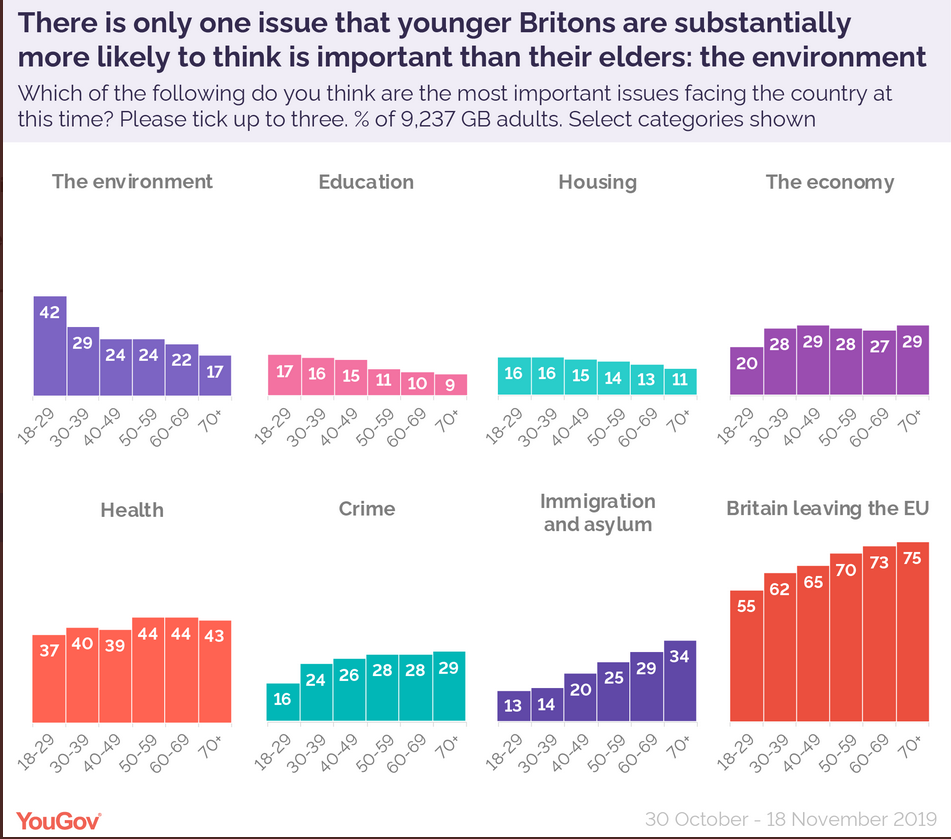
Interestingly, some recent yougov polling suggests the environment is second only to Brexit as the most important issue for young voters. And given that 1.6 million people (mostly young voters) have registered since the 10th November, what the parties are saying about the environment matters. Whether it will have an effect on people’s voting, considering that Brexit is still by far the most significant issue people will be voting on, is another matter.


Let’s start with the Brexit Party as we can get that out of the way quickly. The Brexit Party is already a spent force, having done it’s job, of forcing Boris Johnson to move to the hardest possible Brexit, thus occupying the ground TBP had made its own (albeit briefly). They have now returned to the sort of surreal nonsensical territory that UKIP previously occupied. Farage’s big headline one day last week was that he was seeking to work with Donald Trump on a global tree-planting campaign.

Bearing in mind Trump genuinely believes global warming is a conspiracy theory created by the Chinese, and Farage just doesn’t believe in it, it’s plausible that this is a dead cat story, intended to divert from something else – perhaps the fact that TBP has thrown in the towel. Indeed, despite TBP’s contract with the people claiming that they would have a massive tree-planting campaign to “capture CO2” they fail to mention climate change once. Do they have some other reason for capturing this gas? Elsewhere it’s much as you would expect – relax planning rules around housing (BXP chair Richard Tice is a developer).

Another BXP policy is to reduced tariffs on “certain” foods imported from outside the EU (the US perhaps?). This would very quickly destroy large parts of the UK farming industry, freeing up more land for Mr Tice and his friends to build houses on, I guess. You get the picture.

The Green party manifesto is normally pretty radical and this one doesn’t disappoint. They consistently push for a wholesale change in land taxation to introduce Land Value Tax – even for undeveloped farmland, it seems. An LVT charge based on 1.4% of the current land value would mean a hectare of farmland worth £10,000 would generate a tax charge of £140 a year. GP state exemptions would apply – hopefully they would apply to land with high nature or historic value, land owned by charities  – proper charities mind, not “tax- efficient” Trusts; and land where food is being produced under the most environmentally friendly practices – organic being an obvious example.

Labour’s manifesto is striking by the amount of public spending they are signed up to – £80bn a year, apparently. This sounds like is an unfeasibly large amount of money  but then again the NHS costs around £130Bn a year to run, so it’s not that big. And anyway a lot of the spending planned is actually investment.

But that’s not the point. Because the Tories have committed to very little extra spending in comparison and this is the comparison they will now drive home, with the electorate. I think it was a big strategic error for Labour to make this huge spending commitment at a time when people are still feeling the full effects of the last 10 years of massive public sector funding cuts. It creates space for the Tories to argue that they are now abandoning “austerity” and turning on the public spending taps, while still appearing they have that mythical fiscal discipline they always claim is the natural policy of the Tory party (it isn’t.)

Another interesting thing about the Labour manifesto is that they rejected the proposals from the “Land for the Many” working group. LFTM, produced some radical ideas about land-use and the way land is taxed and subsidised. The report was attacked relentlessly in the right wing press – every smear tactic known to hard-right thinktanks was deployed. It appears to have worked and scared the Labour party into backing away. This is a pity as there were some excellent proposals in the report.

I was pleased to see Labour intends to review the tax break on Red Diesel though. This was something I raised in the People Need Nature report on farmland tax breaks.

There is remarkably little in the way of new policy proposals in the Tory manifesto, and even fewer on the environment. A few interesting snippets have come to light in the costings document – namely that they will implement the Glover Review on national parks. But disturbingly for Defra, the costs of the Glover Review, setting up the Office for Environmental Protection, meeting air quality targets; and creating a new northern coast to coast path, will all come out of the existing Defra departmental budget. There will be no new money for the environment.

On agriculture, all the main parties have offered something similar as a post-Brexit farm policy, with most of the money going towards public goods. And everyone has said they will build hundreds of thousands of new houses a year – all on brownfield land! I would take both of these with a big pinch of salt.

There is every prospect that, whichever party or coalition gets in, there will be much more pressure (from the NFU of course) to adopt a productivist policy for food. While Gove was there or thereabouts, an environmentally focussed agriculture bill was in play. If we were to get another Owen Paterson in Defra, that would go out of the window.

As for housing, I can confidently predict that hundreds of thousands of new houses will not be built, regardless of who is in power, or how much more of an axe is taken to planning controls. This is because planning is not holding back the creation of new housing. Read Land for the Many – it explains very clearly what the reasons are.

Finally, I feel duty bound to mention the parties proposals for climate action. Tories have stuck with net zero by 2050 (which is far too late as far as I understand what the climate scientists are now telling us) and the Libdems by 2045 (ditto).  Labour abandoned their conference decision to go for net zero by 2030, now promising to get “a substantial majority” of emissions reduced by 2030. And they’ve certainly committed to spending a lot of money to reach that target.

Labour’s is probably the most sensible and realistic position to take on climate action, but I don’t think the public is yet sufficiently aware of the threat to their way of life, to be willing to vote for it.

UPDATE

one of the LFTM authors Guy Shrubsole, has been in touch to suggest that actually Labour has taken on board a lot of the recommendations from the report, albeit not the more radical ones.

Guy says

” there are plenty of our asks in there, from opening up info on land ownerships to supporting county farms, reviewing allotments act, reviewing whether business rates should be replaced with LVT, letting public authorities buy land cheaply again,  higher council tax on empty homes, tax on second homes, and an offshore property levy.”


Posted in 2019 general election, Uncategorized | Tagged , | 3 Comments

Election Blog 3: Tory Dirty Tricks

When I started thinking about the Election I thought that it would be good to write a series of blogs exploring how the environment was being treated, both in the Manifestos and in the Campaign. But, as has happened with Brexit over the last nearly four years now, other things keep catching my eye.

Once the Tories reveal their manifesto I will do some compare and contrast on environmental policies – suffice to say that offerings from the Greens, Libdems and Labour hold few if any surprises – aside from the fact that Labour in the end decided not to enter the Tree-Planting bidding war, and merely said they would plant lots of new trees.

The thing that has really come to the surface this week has been what I call Tory Dirty Tricks. Now you may think, isn’t that just what Tories do anyway? Well, yes… but this week has seen them take this to a new level of egregiousness. Of course, Propaganda is as old as politics – and all parties, all persuasions use it to some degree. I’m old enough to remember those billboard adverts telling us “Labour isn’t working” back in 1979, during that fabled Winter of Discontent. While the strikes were real, the label was itself a creation of the right wing media, and it resonated with the public, fed up with a Labour Government fighting with the Unions – who were supposed to be its friends.

Somehow billboards covered in pictures showing ridiculously long queues for the job centre, where it was obvious who was putting across the message, seem quite quaint by today’s standards. We’ve been treated with two examples this week of propaganda of quite another stripe – more akin to the sort of thing Cambridge Analytica’s parent company SCL does to swing elections – otherwise known information warfare or psyops.

Firstly during the Leadership Debate the Conservative Press Office twitter account rebranded itself as a fact checking website, and proceeded to spew falsehoods about Labour’s policy positions. This, as digital law expert and commentator Paul Bernal points out, is in direct contravention of Twitter rules on verified (blue tick) accounts. Further, Bernal notes that it undermines legitimate fact checking sites  – and this may actually have been the reason they did it. Twitter told them off but took no action to stop them.

As if spurred on by the fact that they got away with this brazen act of propaganda (way beyond what might be termed Fake News), the main Conservative Party account activated a campaign on the day Labour launched their manifesto. This was based on the hashtag #costofcorbyn, but it built upon a previous action on the 10th November, when the Tories launched a website called http://www.costofcorbyn.com – which various frontline Tory politicians promoted during the Sunday round of political programmes, when they spread the lie about Labour’s £1.2Tn spending plans. This website is actually there to grab personal data (Add you name to Stop Jeremy Corbyn!) so gullible voters  can be targeted with much more propaganda via email or micro-targeted Facebook ads (yes we’re back to Cambridge Analytica again)  – the website is there essentially as a “lead capture trap”, for gathering personal data. So far, typical Dominic Cummings.

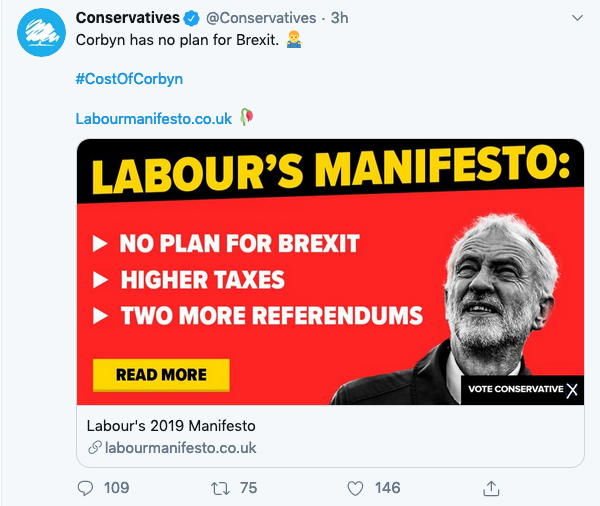
What happened yesterday was far more concerning, in that  the Conservatives created a fake website by buying a relevant web domain LabourManifesto.c.o.uk and using this to attack Labour and Corbyn specifically. Once you get to the website it’s made reasonably clear that it’s a spoof/fake. But the tweets that the main Conservative Party account put out all through the day yesterday did not make that at all clear. Far from it. It was obvious that they were trying to deceive. Here’s one of the offending tweets.


When I mentioned that I had reported this and several other tweets to twitter for misleading voters, various people suggested that it was obviously a spoof and all part of the electoral cut and thrust. This is nonsense. Social Media operates on the basis that people have limited time to scrutinise what passes in front of their eyes, and that much information (including ads) is absorbed subliminally. This is why so much advertising spend is now focused on social media, and is increasing every year. This is why advertising is such a huge industry!

We’ll see whether Twitter takes any action  – but I’m not holding my breath. No doubt further emboldened by the fact that they have once again got away with something that would never be allowed in a newspaper or tv ad, we can only guess what will come next.

Perhaps they have created some “deep fake” videos of Jeremy Corbyn building a bomb for the IRA. Or uttering some foul anti-semitic remarks.

It doesn’t really matter what the next move is. The point is that the Tories (so far only them of the main electoral contenders) have decided that there are no lines that cannot be crossed, all tactics are acceptable to use, because winning is all that matters. When you consider this in the context of suppressing the report on Russian interference in UK elections, the Parliamentary dirty tricks around prorogation; and abandoning efforts to get the Brexit deal through Parliament, in favour of this election, a clear pattern emerges.

The only thing that Johnson cares about is winning, even if that means undermining and damaging what is already a crumbling edifice of democracy – and democratic accountability, in particular. Obviously there are policies (which we shall see clearly once the Tory manifesto has been published) that everyone should be worried about. But actually I think these are less important than what’s happening now.

Because the idea that elections are “no holds barred”, any tactics can be used, will become the norm if we allow it.

As I wrote previously, I thought people argument’s in favour of a second EU referendum were deeply flawed, principally because nothing had been done to stop the widespread cheating and lying that epitomised the first one. That point still stands. But what is clear is that the Tory team running this campaign (many of whom worked in the Vote Leave campaign team) is using exactly the same approach as they did  in the Referendum.

Well… it worked for them last time, didn’t it.


Posted in 2019 general election, Social media | Tagged , , , | 4 Comments

Election Blog 2: Floods and Tree-planting

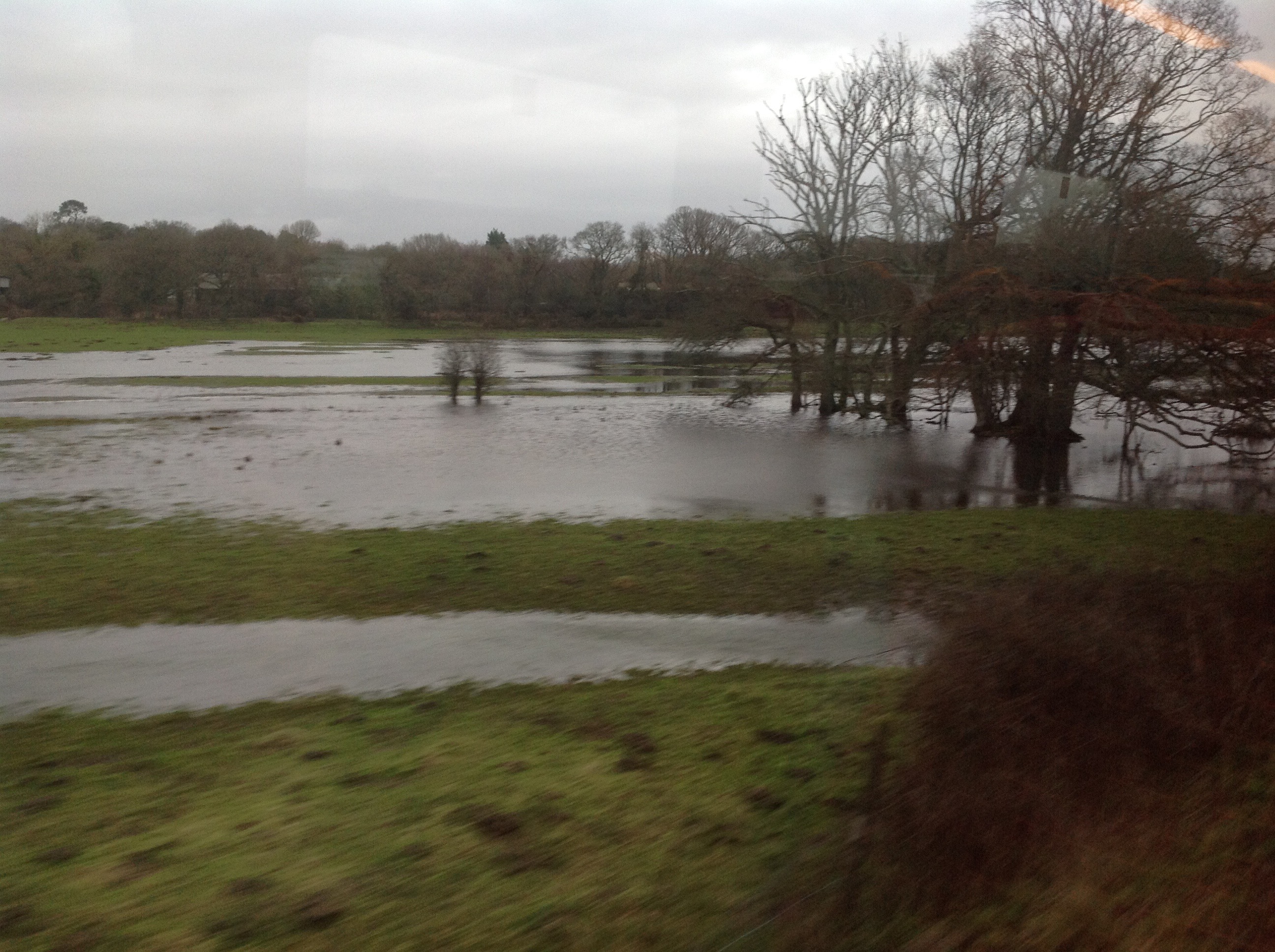
It has been a bit of a surprise to see the environment figure so prominently in the election campaign over the last week or so – usually it’s so far down the list of priorities, or perhaps more accurately the list of issues that generally interest the media, that it never breaks through the surface. Thanks in part to Boris Johnson’s decision to hold a General Election in December, it was the terrible flooding in Yorkshire and Derbyshire which grabbed our attention.

The focus of that attention was Fishlake, a ominously named village neat Thorne – of the notorious Thorne and Hatfield Moors – the large lowland raised bog which was mined for horticultural peat despite a long running campaign to save what was left of it for nature. I have seen suggestions that Fishlake was originally also part of the Raised Bogs of this area, which might explain its name (the lake left after the peat was dug out) and its low lying status. It’s still not clear exactly why Fishlake flooded this year, and not in 2007 when there was a much larger flood in South Yorkshire. But what was clear was how badly the Johnson team failed to react to the flood, turning up to meet the victims over a week late, and looking, as ever, as if he was only seeking a PR opportunity.

There were the inevitable calls to “Dredge The Rivers” from farmers whose farmland had disappeared under flood water. And the conspiracy theory – from the 2014 Somerset Levels floods  that it was the EU which had banned Blighty from dredging also reappeared and did the rounds. That the dredging went ahead in Somerset despite those dastardly EU dredge-police, seems to have passed that particular group of conspiracy mongers by. Quite apart from the fact that it is only likely to help in very limited circumstances, whether there will be any money available for the extremely expensive practice of dredging in post-Brexit Britain, remains to be seen.

Another interesting change in the debate has happened as a result of Brexit, namely around calls by farmers to be paid to hold flood water on their own land. It’s not clear why all farmers – especially ones which farm in the floodplain – should be expected to be paid when their farmland floods. After all, flooding is a perfectly natural event  – just as natural as, say, when it doesn’t rain for weeks on end, as happened last year. Both have an effect on the production of crops. Should farmers be paid for every incident when nature affects the growth of crops – such as a pest outbreak, or disease?

It needs to be thought through carefully, but in principle, the means for paying farmers to provide “public goods” like reducing downstream flooding of urban areas, was going to be made available through the new Agriculture Bill – you remember, the one which nearly made it through Parliament before Boris Johnson closed it down so he could have this election. Whether it comes back in anything like the same shape or form is debateable. The opportunity for farmers to be paid to reduce downstream flooding may turn out to have been just a phantom.

The NFU, bless them, were arguing for payments for flood storage, upstream catchment management, and dredging – the belt and braces approach. If the likes of Jacob Rees-Mogg and Liz Truss get into serious positions of power in the next Government, they will be looking to make a quick deal with the US allowing in their super cheap food. In which case all of this will be academic as farmers will be unable to compete on price, however many rivers are dredged. But the impact of Climate Chaos is now really starting to make itself clearly heard. Potatoes are rotting in the ground, because there has been so much rain as to make it impossible to lift them – or they are so wet that its preferable to leave them in the ground, rather than risk introducing rot to those already in stores.  I suspect pictures of farms surrounded by thousands of acres of flood water in Lincolnshire will become a regular sight. And what was once regarded as the best agricultural land in Britain will be grazing marsh, then salt marsh, then intertidal mud. Lincolnshire farmers may shout “build the wall” but it’s not going to happen. Still, all that’s for another election in a few years time.

On Friday last week we were treated to an auction between the Tories the LibDems and the SNP as to who could promise to plant the most number of Trees. I suppose this qualifies as an environmental story, albeit one from the Ladybird book of environmental activities. It’s easy to set targets for tree-planting and sound like you’re doing something for the environment. Michael Gove on Saturday’s Today programme pointed out that it was a Tory Government that had achieved the lofty heights of 30,000ha of new trees planted in a year, back in 1989.  What he failed to mention was that this was mainly thanks to planting commercial conifer plantations on the globally important peat bogs of the Caithness Flow Country in northern Scotland. Nor did he mention that it was fuelled by tax breaks for millionaires.

I was reminded of a small but significant action at the time, when Friends of the Earth Scotland arranged for a group of kilted Scotsmen (with Piper) to head down to Buckinghamshire and plant some conifers on Terry Wogan’s lawn, as a protest. Also worth mentioning at this point is that the “Environment Secretary” at the time of this environmental outrage, was none other than Viscount Matt Ridley’s uncle, Nick Ridley. There must be something in the water under the family estate, leaking out from all that coal.

Strangely this cautionary tale of the dangers of over enthusiastic tree planting targets did not make it into the coverage. Gove did make a rather pathetic claim that the EU was to blame for the Government not meeting its tree-planting targets though. Again, somehow he managed to ignore the fact that it was his predecessor Owen Paterson who had decided not to transfer across the maximum allowed amount from direct farm subsidies (Pillar one of the CAP) into Pillar 2 (which includes grants for tree-planting) back in 2013.

The Tories have claimed they will plant 30 million trees a year, and the Lib Dems 60 million! at 1500 a hectare that translates into 20,000ha a year for the Tories and 40,000ha for the LibDems. The SNP pointed out that last year only 1400ha of new plantation was achieved in England, compared with 11,200ha in Scotland. Taking individual responsibility is a key tenet of both Conservative and Liberal political philosophy – and that’s been reflected in the Tory attitude to tree-planting – hand out small packs of trees to individuals and community groups and let them find places where they can be planted. This usually means trees end up being planted in the wrong place, where they can damage or destroy wildlife and historic features  – or that they die for lack of water or poor soil. The same problem applies to small scale woodland planting supported by farm subsidies or grants. Farmers tend to plant trees where they won’t interfere with cropping or grazing – and these can often be the last places on the farm where wildlife survives – the scruffy corners, or small patches of agriculturally unproductive grassland – which happens to be rich in wildlife.

Good places to plant trees (or even better allow them to develop naturally) are in the upper catchments of rivers. Add in a few beavers and you create, for very little public cost, wooded wetlands which capture water and release slowly into the downstream rivers. The perfect was to reduce the risk of flooding. Knepp provides a very neat example of how an upper catchment willow carr can develop on former arable land.

PS Congratulations to Craig Bennett for being selected as the next Chief of the Wildlife Trusts.


Posted in 2019 general election, farm subsidies, farm tax breaks, flooding, tree planting | Tagged , , , | 13 Comments

Election Blogs 1: setting the scene


There’s an election coming! yes of course you know. But this could be the most interesting and bizarre election in decades. The old tribal boundaries between Left and Right are really breaking down, and it’s difficult to see how they will be reconstructed after 2019.

Staunch Labour heartland constituencies that voted strongly to leave the EU are unlikely to be persuaded by Corbyn’s ambiguous Brexit position. But will they really be able to vote Tory, or perhaps more likely for the Brexit Party. At the other end of the country (well England, anyway), are strongly pro-Remain Tory heartlands, such as those constituencies John Harris talks about in this article. Local Council and Euro election results show clearly  that the historic bonds to the Tory party are loosening. Will they break completely this time, with a wholesale shift to the LibDems, alongside former Tory now independent MPs? Will the Remain Alliance achieve anything in our creaking, no failing, First Past The Post system, other than larger opposition votes.

Added to this extra dimension of Remain/Leave, is the continuing rejection of the old Westminster parties in Scotland, and perhaps also in Wales, especially South Wales.  This is another former Labour heartland now looking like it may finally lose that old bond.

To add to the electoral strata of old tribal loyalties, the Remain/Leave split; and burgeoning nationalism (especially in Scotland), there is a profound distrust in politicians in general. While there has always been a healthy scepticism around politics at all levels, there’s no question that the voting public now view Westminster politics in an extremely poor light.

The Brexit Party in particular has exploited and fanned the flames of this distrust, making best use of the Betrayal Narrative, which I wrote about earlier. It remains to be seen whether Farage will pull back from his threat to field candidates in constituences where they could split the Leave vote. That peerage offer may be simply too tempting for the politician who has failed on seven previous occasions, to make it into Westminster via the electoral route.

It’s no wonder the Betrayal Narrative is working so well as a political strategy, when MPs are generally viewed as self-serving, money-grubbing and completely uninterested in the views or needs of their electorate. I don’t agree with this view  – many MPs serve the public – both their constituents and wider civil society, work very hard, sacrifice their home life; and now have to work under a constant barrage of abuse, even physical threats of violence. And it’s not just from the far right, but extremists on all sides.  Who would want to be an MP in these circumstances? This, among other factors, is creating a feedback loop, where MPs are selected from within the existing political parties, from within the very small Westminster bubble, and become ever less representative of the wider public.

I am not going to say much more now, other than that I am waiting for the party manifestos and when they are published I will write more blogs, with a particular focus on the various party’s commitments (or aspirations anyway) on the environment, farming, food and housing.

If you’re looking for predictions, forget it. And certainly don’t trust the polls, unless they are at or near constituency level.

And watch the weather, it could play a very significant role in this, the first December election in nearly a century.


photo by:  The joy of all things [CC BY-SA 4.0 (https://creativecommons.org/licenses/by-sa/4.0)%5D

Posted in Uncategorized | 9 Comments

The Brexit Charade

The Brexit charade continues to play out.

Increasingly shrill, even hysterical threats emanate from what we can only assume to be the new bunker built by Dominic Cummings’ dad under Number 10 Downing Street. The latest one, picked up and amplified by the Spectator no less, involves Cummings threatening EU member states with the Brexit equivalent of excommunication if they allow an extension beyond the Halloween deadline – but now we realise why this portentous date was chosen. In the coming days, expect promises of the dead rising from their graves, and the spirits of the damned being unleashed on Cummings’ enemies.

Does Cummings see himself as a Gandalf on his white charger riding to glory across the plains below Minas Tirith?  quite possibly. I see him more as Mickey Mouse in the Sorcerer’s Apprentice, playing with power he has no control over, causing a mess for others to clean up.

Whatever the state of Cummings’ delusions, it seems to me that Johnson is going through the motions of threatening a crash-out scary Halloween Brexit, while having no intention of actually doing it.

As yesterday’s Scottish court finding concluded, there was no need for the court to legally force Johnson to write the letter asking for the extension, as he had written to the court saying he would write that letter. Johnson might get his minions to lie to the Queen, and he may lie about giving favours to his friends, and he may well lie about just about everything else, but lying to a High Court would land him in very hot legal water. So it looks increasingly likely that Johnson will write the letter, and the EU will give a further extension, possibly with a caveat that it will only operate until there is an election or a second referendum.

What then could all this bluster, threats and invocations of the ghosts of Brexit past, present and future, mean? I think what Johnson and Cummings are doing is building the betrayal narrative. The betrayal narrative is a well worn tactic, where when something hasn’t worked out, it’s because of all the dark forces preventing it from happening. In this case it will be

a) Parliament

b) remoaners conspiring with the EU

c) traitors in the High Court

d) remoaner civil servants in Whitehall

e) the EU; and

f) the Irish.

The Irish have traditionally played the role of scapegoat in British political pantomime and there’s no reason why they won’t be brought on this time, possibly in a surprise last minute starring role.

This is all preparing the ground for the next General Election, when Johnson can position himself as champion of the people (his hero is Pericles – another champion of the people) fighting against the Elites.

Johnson – Eton and Oxford educated, scion of several European Aristocratic & Royal houses – fighting against the elites……..

anyway.

The narrative being built is that the elites, the establishment, the deep state and so on, are undermining Johnson – Champion of the People – in his quest for the Holy Grail. Sorry his quest for the one true Brexit. If only all these dark forces (and naughty French kniggets) weren’t conspiring to stop him, he would have found the Holy Brexit by now, and unleashed the golden light of freedom on the grateful people.

King Boris seeks the Holy Brexit


Ok I exaggerate for effect but the point remains the same. Which means that there is an election coming, and soon. Johnson will stick to his dream of a crash-out Brexit, or “Freedom Brexit” as I expect it will be rebranded. He has to do this even if he doesn’t believe it. Because if he moves away from the Hardest Possible Brexit, he will lose ground – to the Brexit Party.

Have you noticed how quiet Nigel Farage has been? He knows that Johnson is approaching the time of greatest risk, when, having been forced into requesting an extension beyond Halloween, he is vulnerable to being attacked as an apostate, a fallen believer. Farage’s Brexit Party will have to decide whether they want to accept the Betrayal  Narrative and cosy up to the Tories (and risk political oblivion); or reject Johnson’s betrayal narrative as a false one – and urge the Electorate to accept that the Brexit Party’s Betrayal Narrative is the one true narrative.

One problem the Brexit Party has, it that it has no policies other than Get Brexit Done. And Johnson has stolen that from them.

Regular readers may recall that I am a long standing student of the environmental policies of UKIP and now the Brexit Party. Remember the heady days of Dr Earth, for example? Or Stuart Agnew and his problems with gases?

I’ve been trying to find a few clues as to what TBP’s electoral position might be, on things like the environment and agriculture. Needless to say it’s a very confused picture.

TBP MEP Rupert Lowe for example wants farm subsidies to continue after Brexit – including a pay off to compensate for the effects of a crash-out Brexit. But then he would as he owns a very large Cotswold estate and trousers over £50k a year in Euro farm subsidies – oops!

Housing developer and Brexit Party chairman Richard Tice wants to see the UK grow much more of its own food  – from the current 60% or so, up to 80%. Increasing self-sufficiency to 80% would have a devastating effect on the countryside – as it did the last time the UK approached this figure through the 1980s. Then again Labour has also proposed this target.

Climate denialism is rife within the Brexit Party – as one would expect with the UKIP origins. One suggestion for new National Parks on the Welsh border included a ban on wind farms and solar farms within them, though it’s not clear whether TBP would re-open all of those Welsh coal mines.

Farage is on record as denying the reality of human-induced climate change. But recently he did suggest that “if we’re worried about CO2” (he isn’t) then the answer – lots of tree planting. Farage on last week’s Any Questions, responding to a question about the State of Nature report, suggested that “too many pesticides and insecticides” (insecticides are pesticides but never mind) were used in farming and “we have a problem with habitats, especially wetlands” (Farage is a keen angler).

Bringing all of these clues together gives us a few pieces of the puzzle. It suggests that TBP will reinstate an agriculture policy which pays farmers to produce more food, but possibly using fewer pesticides and insecticides. And there will lots of tree planting as well – and lovely clean rivers for angling. Wind and Solar farms will be banned, because there is no problem with climate change or need for renewable energy.

It’s a mess of course, because it’s just Tice, Farage, Lowe etc shooting off remarks without any further thought.

Given that the environment is now one of top issues for the electorate, according to recent polls (yes of course if you believe them), this would seem to be a big tactical mistake. And it’s certainly noteworthy how the Tories are pushing environmental stories on a regular basis – notably on animal welfare, and international wildlife trade. Expect much more of this as the election approaches.

Posted in Brexit, Dominic Cummings, The Brexit Party, Uncategorized | Tagged , , , | 3 Comments

Climate Action, food and farming: a seismic shift for the NFU?

Regular readers of this blog will be familiar with my critical views on the National Farmers Union, the NFU – over the years. So be prepared for a shock, brace yourselves and read on.

Or stop now if your cognitive dissonance klaxon is blaring.

The NFU has released its long-awaited vision for how farming (in England of course) can reach net zero – that is no net contribution to the unfolding climate crisis, by 204. I say vision rather than plan, because it lays out its stall without necessarily revealing the cost of each individual item. Some items are a bit sketchy, and some are fantasy, but we’ll come on to that. Considering the prevalence of climate denial within the farming community, this is a very bold move on the part of the NFU and in particular its newish President Minette Batters.

The NFU accepts that agriculture makes a large contribution (10%) to the UK’s domestic greenhouse gas (GHG) emissions. I say domestic, because of the way emissions are calculated. Country emissions ignore the GHG footprint of imported goods and services, as well as major contributions from air travel and international shipping. This means our domestic emissions may underestimate our total contribution to the global climate crisis by a large amount. Still, that’s another story. Agriculture’s emissions are mostly Methane – from ruminants like sheep and cows; and Nitrous Oxide, most of which is released from the soil when artificial nitrogen fertilisers are used.

The NFU’s solutions to addressing these pollutants fall into three categories –

  • techno fixes to improve productivity;
  • bioenergy with carbon capture & storage (BECCS); and
  • farmland carbon storage.

Of the total of 45 megatonnes of Carbon Dioxide equivalent (Mt CO2e) greenhouse gases emitted per year from farmland in England, a whopping 22 Mt ie half, is going to be dealt with via BECCS. By comparison NFU sees new tree-planting on farmland as delivering 0.7MtCO2e.

Starting with the technofixes, the idea is to produce more food with less environmental impact – something which is known as sustainable intensification. This covers a wide range of things, from precision farming using satellite-controlled tractors, developing GMOs; and creating food additives to make cows fart less. Sustainable Intensification has been around for quite a while now and has been enthusiastically adopted as an idea. The odd thing though is that farm productivity overall has not increased during that 10 years.


Perhaps, like communism, it just hasn’t been done properly yet. And is there really any appetite among the British public for GM crops now, any more than there hasn’t been for the last 20 years? So I think it’s fair to say the NFU is being optimistic in thinking it can get one quarter of its target delivered through this route, but of course we won’t know until it’s been tried.

One thing that I noticed wasn’t mentioned is shifting away from using fossil fuels to power farm machinery. As I wrote about earlier in the year, Red Diesel use on English farms generates 1.1Mt of CO2 per year – fuel that is heavily subsidised by the tax payer. Cheap fuel is no incentive to drive fuel efficiency or innovative tech. Redirecting this £550M a year into supporting low carbon farming, or research into electric vehicles and farm robots, might be a good idea.

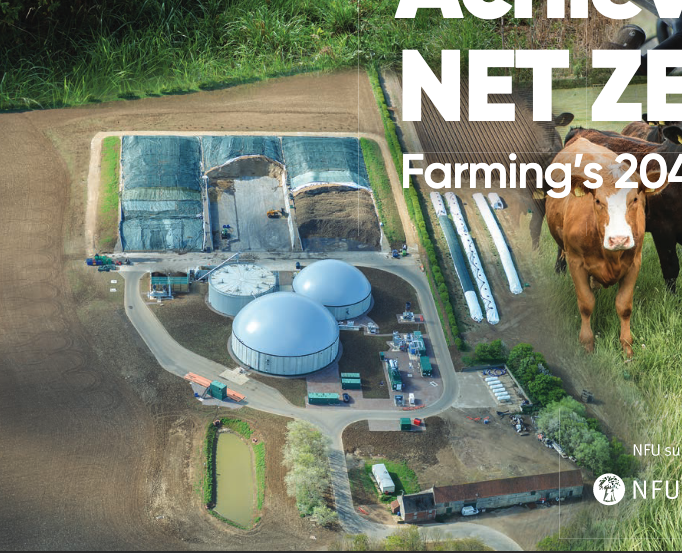
The NFU has nailed its colours firmly to the mast of Bioenergy and Carbon Capture and Storage – BECCS. What this essentially means is that farmers grow crops which are used to create energy rather than food. The report helpfully points us towards what this means in practice on its front cover – Anaerobic Digesters, or AD plants. There are now nearly 350 AD plants across the UK – mainly driven by crops such as Maize and increasingly hybrid Rye. These are very heavily subsidised and they also have a host of environmental and social problems associated with them.

I have written a number of times about the problems with AD and personally I do not believe they are part of the solution to climate chaos. Then there is Carbon Capture and Storage – where carbon dioxide is drawn out of the air and stored underground for, effectively, ever. This is an idea which has been around for a long time, but there is no functioning system for doing it. Like nuclear fusion, the tech always seems to be five or 10 years away. Interestingly the Government’s own advisor on climate action, the Climate Change Committee, also depend on future developments of BECCS as part of their strategy, though they do recognise the danger  – that giving over large areas of farmland to bioenergy production can displace other land-uses (food mainly) elsewhere, including abroad.

The NFU specifically state that they want to avoid sending our GHG footprint elsewhere in the world, so how will they do this? What area of England would need to be covered by bioenergy crops, to create a 22MtCO2e saving per year? At the moment around 50,000ha of farmland is used to grow bioenergy Maize and other feedstock like sugar beet and hybrid Rye – and the NFU has previously stated its vision of 200,000ha of England’s farmland under such crops. Germany currently has seven times as much farmland under bioenergy as the UK – perhaps this is the target. We need to know. I previously calculated that half the arable land in Dorset would be needed to provide gas (not electricity) for Dorset’s residents.

The last leg of this stool is carbon storage on farmland. There is very little detail in here other than wider hedgerows and a smattering of farmland tree planting. There have been various claims (elsewhere) that changing from arable cultivation to no-till or min-till farming has the capacity to capture lots of carbon in soils, but so far the evidence is not there – what it does suggest is that there is movement of carbon from the surface layers of the soil into deeper layers, and vice versa. Traditionally soil carbon has only been measured in the top 6 inches – providing a very partial picture of soil carbon storage.

Extensively managed grassland does store a great deal of carbon in its soil though – as much as 1ooo tonnes of CO2e per hectare, according to research recently carried out by the Duchy Business School Soil Carbon Project (Matt Chatfield pers comm).

Perhaps the most intriguing suggestion is 3MtCO2e from peatland and wetland restoration. Peatlands across the UK currently emit 23MtCO2e a year – an incredible amount. Peat converted to arable – in the intensive farmland of East Anglia, is the biggest emitter and I don’t suppose the NFU is proposing that this area be converted to wetland – although sea level rise will do that, probably before the century is out. Perhaps they are thinking about the peatland converted to intensive grassland which emits 6.3MtCO2e per year. Seeing half of the Culm grassland (yes it’s peat) that was lost to intensive pasture in the South-West of England restored to its former wildlife-rich glory would be a marvellous outcome for everyone, although presumably not the farmers who currently farm it (some of it already being used to grow bioenergy crops for the plethora of AD plants across Devon.)

You may feel I am being unduly critical – even dismissive – of the NFU’s vision. I actually think it’s amazing that the NFU has produced this vision at all and it’s a great thing to see them place an environmental issue at the heart of their work.

Perhaps the biggest omission from the report is to ask the question “what sort of food should we be producing in the UK?”. Because that underlies everything else. If we were to produce more fruit and vegetables, more pulses to provide protein for people, less meat, less dairy and fewer crops to feed livestock, that would change all the equations for methane and Nitrous Oxide. But the NFU is not yet in a position to consider those questions.

And I suppose that sums up the approach which the NFU has taken in this report – trying as hard as possible to find ways of addressing farming’s climate footprint, without changing what farming produces. This has caused the authors to perform contortions which necessitate applying  – well let’s say aspirational – approaches such as BECCS and other techno fixes, rather than reducing their climate footprint through dietary changes of their consumers. In a way this illustrates how farmers are so constrained in what they do by all the other actors in the food chain – from machinery and chemical suppliers, the big retailers, policy wonks and politicians; and, ultimately, the consumer.

Personally I would advocate a different approach;

Changing our national diet – through education, incentives and taxation. Sustain is doing great work on this and I would recommend you read what they produce.

Producing less and better meat – rare breeds of beef and lamb, which is only produced using grassland and other forage, not cereals or importing soya beans from Brazil or Argentina. Chicken and Pork grown from domestic cereals produced extensively in mixed farming systems.

A massive increase in the production of domestic fruit and vegetables; and pulses. This is probably going to have to happen anyway as the supply of cheap fruit and veg produced in Spain & elsewhere is cut off by Brexit.

Shifting agriculture to Agro-ecology. This means farming in ways which work with nature not against it. Organic farming, small-scale horticulture, producing fruit and vegetable for local markets and communities.

A hundred Knepps. Developing large area of extensively grazed wood pasture which act as carbon sinks, wildlife refuges, produce excellent quality meat and provide places where people can enjoy and benefit from nature. Think of 100 Knepps, but on public land.


Posted in agro-ecology, Anaerobic Digester, biofuels, biogas, climate action, NFU | Tagged , , | 2 Comments