For the Greater Good

Golden Cap

Golden Cap, Dorset: A public good

Yesterday’s Guardian (or it may have been the Observer) carried an interview with NFU President Peter Kendall, in which Peter observed sagely that climate change is now the biggest threat to British Farming – not through gentle warming, but extreme, volatile and unpredictable weather events.

Well said Peter – now let’s hear Lord Lawson, Christopher Booker, James Delingpole, Roger Scruton and all the other climate change deniers lay into that hotbed of communism the National Farmers Union (the Union bit obviously gives the game away).

Peter then goes on to explain why farmers therefore need all the weapons in the chemical and technological armoury to combat the reality of climate change – including naturally GMOs, neonicotinoids, fungicides etc.

Peter shows some awareness of our current environmental predicament by suggesting that if we have seen no declines in our wildlife or habitats over the next 20 years “that will be a pretty good achievement”. I agree – I think it will be an amazing achievement. But then he blows his bio-credibility by dismissing the results of the “State of Nature” report , saying how wonderful the countryside looks as he travels around it. I guess it depends on what you conceive of as wonderful countryside Peter – since you are an arable baron from Bedfordshire – acre upon acre of cereals would look wonderful to you. But it doesn’t deny the facts of biodiversity decline shown clearly in “State of Nature”.

Then we get to the really interesting bit. When asked about farmers who receive CAP providing any public benefit for the £3 billion a year subsidy they receive, Kendall said this:

“”I think helping farmers manage volatility, extreme weather, climate change and the global distortion of agricultural markets is equally a public good. The danger of saying that the environment is the only public good, is that we pay people not to farm and that really does fly in the face of feeding 63  million people here in the UK.”

Now what is and is not a public good is a matter of debate and undoubtedly there are continuums of public good-ness. Farmers providing habitats for biodiversity (or at least the biodiversity society wants) is a pretty pure public good. It is more debateable as to whether food security at any cost is a public good, given that we are very much a part of a global market in food and can and indeed do buy food from across the world to eat: it doesn’t have to be grown here.

I looked up the seminal report on Public Goods and the Commion Agricultural Policy – produced by IEEP. It’s very long but worth reading if you’re interested. They include in Public Goods things like biodiversity, water provision (quality and quantity), flood prevention, landscape quality, fire prevention and soil health.

The issues are whether goods are non-rival and non-excludable. Non-rival goods are those where, if they are consumed by one person, they are still available to others. Non-excludable goods are those that, if available to one person, others cannot be excluded from the benefits. Clearly food in and of itself falls outside both of these definitions, as it can only be consumed once, and is only available to whom the person the farmer sells it . Food security is slightly more complicated – but would only be seen as a public good if there was a food shortage looming in Europe, which there is not.

Kendall suggests that helping farmers by paying them subsidies to mitigate the effects of  price volatility caused by climate change and market distortions are public goods.  He seems to have mixed up “farmers” with “the public”.

Helping farmers financially to buffer the effects of market volatility fail the tests of public goods – if the payments are made to farmers, they are not available to the rest of us (therefore not  non-rival).  Do we as society benefit from farmers protection from market volatility? Cast your mind back to the Butter Mountains and Milk Lakes of the 70s and 80s. These were directly created by exactly that logic – farmers must be paid to produce as much as they possibly can, just in case of some cataclysmic event that might lead to global food shortages. Not surprisingly these were phased out, on account of the damage they caused and their not being needed. No Peter we don’t need any more intervention buying thanks.

Paying farmers to carry out farming in a way that helps society adapt to or mitigate the effects of climate change would be a public good. Examples of this might be reducing (or removing) the use of nitrogen fertiliser, because of its role in releasing the most potent greenhouse gas nitrous oxide. Or providing public support for very low intensity livestock farming (which also have biodiversity benefits), because of the major role wildlife-rich grassland soils have in sequestering and storing Carbon. But paying them to buffer the effects of climate change on their businesses? We would all like that wouldn’t we.

I know some of you will rail against any validity in a neoliberal economic model and I make no comment on the rights or wrongs of using a “public goods” model. But if we are going to use this approach, then we need to defend what “public goods” actually means, from those who would happily redefine it for their own benefit.
Posted in agriculture, anti-environmental rhetoric, biodiversity, carbon storage, climate change, ecosystem services, European environment policy, farming, grazing, neoliberalism, public goods, soils | Tagged , , , , , , , , , | 2 Comments

Very like an Ant

Argentine Ants were introduced ( technically called Human Mediated Dispersal see for example here ) into Europe from their native distribution in South America and have formed a single supercolony stretching an amazing 6000km along the Mediterranean Coast. There are also other supercolonies in California and Japan.

These ants generally inhabitat urban areas  and prefer warm, moist conditions. In tropical and temperate climates they are regarded as a serious pest both in terms of impact on native biodiversity but also economic costs associated with being a pest of houses and agriculture.

This little ant has clearly taken full advantage of us humans. It has hitched a ride using human trade routes to make its way around the world. Once in a new location it gradually expands, and for reasons still not entirely clear, colonies coalesce and expand rather than defending small territories.

It’s in the top 100 invasive species in the world list.

Like the diminutive Argentine ant, Humans Homo sapiens have spread around the world – though we are able to cope with a wider range of environments than the ant – we can colonise very cold, very warm, very dry and very wet climates – with our extraordinary ability to adapt ourselves and adapt our environments to cope with pretty much all conditions.

We are also able to live together relatively peacably in supercolonies (think of the Megacities springing up across the world) like the Argentine ant, at least for the most part.

Unlike the Argentine ant we weren’t introduced by any agent other than ourselves. I suppose on that basis the spread of humans across the planet could be another example of Human Mediated Dispersal (HMD) but it’s stretching a point.

Are we an exotic (ie non-native) invasive species? I would argue that we have spread “naturally” rather than been introduced, so we can’t be treated as exotic or non-native. Has our spread affected other species, mostly to their detriment? Certainly it has so perhaps we do need to think of ourselves as an invasive species.

We look at the spread of the Argentine ant and see all the problems it causes – we kill it if its in our homes or in our crops, and wring our hands at the other species it affects (or take remedial action.)

Now consider an advanced alien civilisation – living in a patch of the galaxy nearby – they have spread out into many star systems, have resolved the challenges of interstellar travel and can see very clearly into the Earth’s atmosphere. What would they make of what they saw?

Would they consider us to be equivalent of the Argentine Ant in Europe – an invasive species that threatens to break out from a current lone colony to create a supercolony spreading through the Solar System then eventually out into the galaxy.

Or would they see us a a very successful native species doing well in its native range, with no danger of us becoming an exotic invasive?


Posted in ants, biodiversity, invasive species | Tagged , , , , , , , | 3 Comments

Dams and Dredging Update

Coincidentally, following Monday’s blog I received an email from Natural England yesterday. They informed me that


“A member of our Land Management Team has investigation the situation and we appreciate your concerns about the work undertaken.

 The farmer was working in good faith with the Environment Agency. We have investigated it and will be offering the farmer advice and support to manage his ELS agreement to encourage better practice.”

I leave you to draw your own conclusions from this story.

Thanks to Jo Cartmell for pointing me towards this link about the Beaver (with video).

Posted in agriculture, Beavers, deregulation, Dredging, ecosystem services, Environment Agency, environmental policy, farming, Floodplains, management, Natural England, regulatory reform | Tagged , , , , , , , , , , , | 2 Comments

On Dams and Dredging


ditch clearance

Dredging a main river in May

On May day this year, it was a lovely morning, and being between jobs, I decided to go out for a walk along a local river flooplain.

The hedges were alive with newly arrived and resident birds, and I heard whitethroat, reed warbler and blackcap on my walk. Birds were singing furiously setting up their territories. The hedgerows were covered in spectacular blossom and there were many butterflies on the wing too.

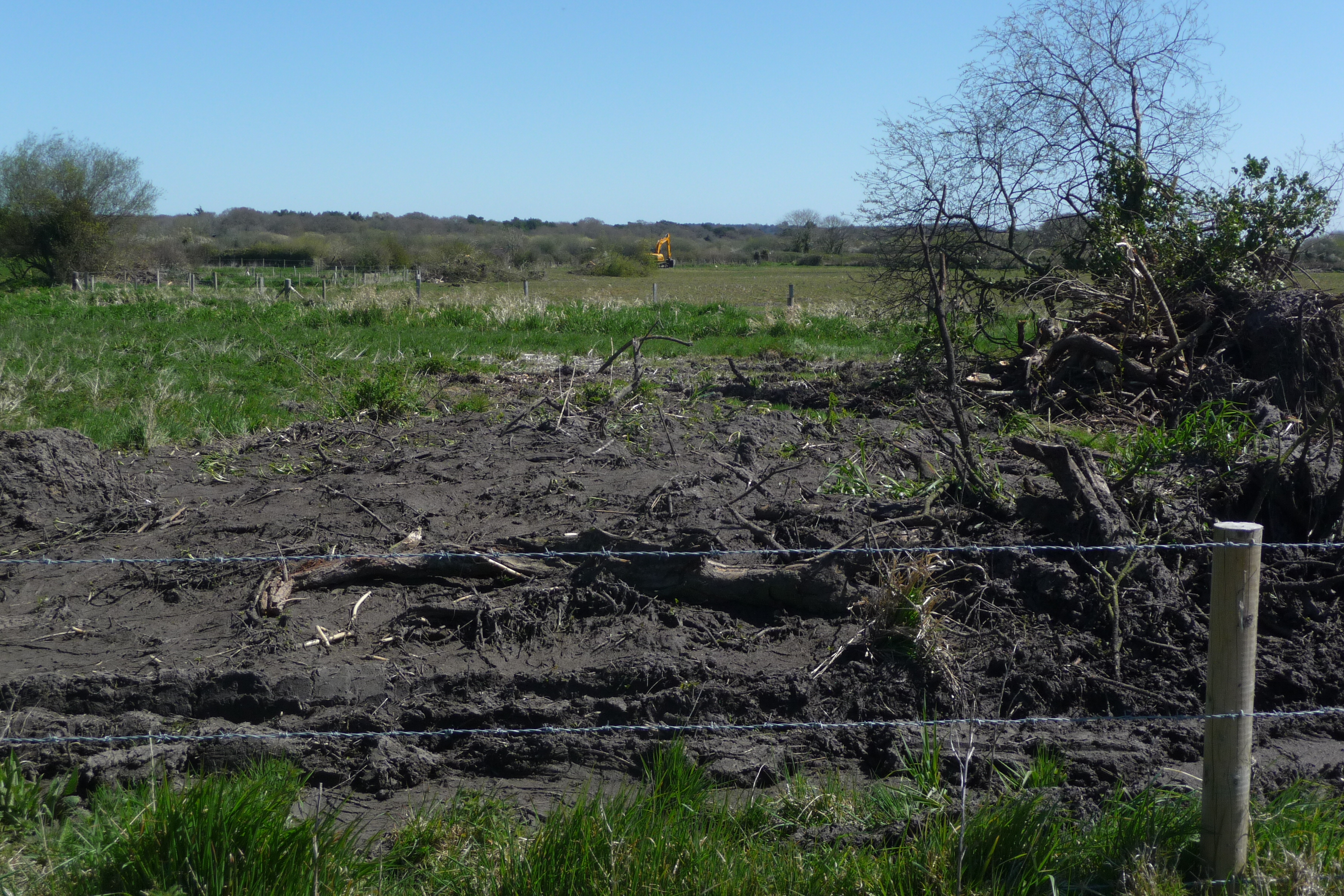
As I crossed the floodplain I was greeted with the scene in the photo above. Large bushes (mainly Goat Willow and Sallow) had been recently removed by a large digger from the river bank, made into a row about 50m long and burnt. There were also great piles of silt along the path. I could hear and see the Slew in the distance – as it continued along the river channel clearing the vegetation.

I was fairly concerned that the work was being done at the wrong time of year, having seen and heard all the bird activity. So I contacted Natural England and the Environment Agency to see whether this work needed approval, and whether approval had been gained.

To their credit EA sent someone out pretty quickly to talk to the farmer. They also informed me that the channel in question was Main River, so consents such as a flood defence consent were needed. It also transpired that a flood defence consent had been applied for by the farmer – I guess he must have known he was going to get the consent so started work anyway.

Here’s the reply from the EA:

“The landowner  had been involved in carrying out works within 8mtrs of the ‘main river’  as part of an Flood Defence Consent application filed on  March 2013.

 During our visit we were able to distinguish two parts of essential maintenance works he had intended to carry out. The former being scrub clearance and removal of fallen trees that normally does not require consent as such, but to do so is considered best practice because we can gauge any impact or give pre-works advice, the latter involving a degree of bank repairs, infilling of cattle drinks and some silt/gravel shoal works which has yet to take place as part of his FDC being granted coincidentally at the time of your report.

 In order to confirm that the  works were carried out in the spirit of ‘maintenance’ and therefore not regulated as part of his FDC I had was accompanied by our river habitat advisor  also based at this office. His comments from our inspection are as follows:

 “Re: Farm

 I can confirm that following the site visit this afternoon I do not consider the works that we observed on the bank side and in one location within the channel to constitute a potential offence of ‘hydromorphological harm’ as defined under the Water Resources Act 1991 (Amendment) Regulations 2009.

 Bank works

The areas of bankside works varied in extent from  ~10m to ~ 50m and in these places a number of trees that were impinging on the channel have been removed, together with surrounding scrub vegetation.  There was no visible impact on the vertical bank structure, other than very localised areas where a tree had been removed and in these cases the bank had been reformed and compacted to match the adjacent profile.  The areas where these works had been carried out had been made good with the top soil redistributed to level the bank slope to match the adjacent unimpacted bank.   While these works will have resulted in some loss of diversity within the riparian zone, I do  not consider the works of sufficient scale or permanence to result in a deterioration in the WFD status of this waterbody.  I would expect these areas to largely revegetate over the coming summer with annual growth, leading to potential scrub and tree growth in future years.

 In Channel

In one location it was evident that gravels had been removed from within the channel over a ~ 10m length of bed.  This was reportedly done to remove a gravel berm on the right bank that was redirecting flow to the left bank and causing bank erosion.  This has locally lowered the centre of the channel bed by ~ 20-30 cm the effect of this is to increase flow velocity in this section of channel.  The relatively small scale of the gravel removal, and the ready supply of material from upstream means that the nature of the bed and substrate (WFD quality element) will not change fundamentally and affect WFD status of the water body.

 The resultant flow pattern is not unrepresentative of what is seen throughout this part of the River and it is likely that the area of bed that has been lowered will aggrade naturally following high flow events as the readily available gravels are transported from upstream.

 Throughout the reach where works have taken place there was no evidence of recent silt deposits smothering gravels”.

Firstly I think it is excellent that not only did EA visit the site so quickly, but also that they provided me with such a comprehensive report of their findings. It was unfortunate to say the least that they inadvertently revealed my personal details to the landowner.

Their view was that removal of mature scrub and even trees from the side of a river channel did not even require consent. That I guess is their perspective as they are looking at the ecological value of the water body, not the ecosystem.

Natural England sent me a standard holding reply to my initial email, then another holding reply in June. I haven’t heard anything from them for a month. I don’t know if they even visited the site.

With this in mind I was interested to read that the Blueprint for Water Coalition was very worried about proposals to move towards allowing landowners to dredge river channels without consent. Blueprint believe this will lead to a ” “triple whammy” of damage to wildlife, increased flooding and potential legal challenges for landowners.”

The issue of who has ultimate oversight of floodplain management is a fraught one, because, as with every other landform, multiple land-uses can be conflicting.

Re-wilding floodplains

Re-wilding has probably the greatest immediate potential within flooplains. And the main reason for that is – of course The Beaver. Amazingly a “wild” beaver has been seen on the River Otter in Devon. How did it get there? Are there more than one – could it be a a family?

If Beavers really did return to the wild – and I think it would be fantastic if they did – where would that leave landowners like the one I encountered in May? Would they feel impunity to remove Beaver dams on the grounds that they were creating flooding problems?

Beaver dams create wetlands which reduce downstream flooding by increasing the storage capacity of the upper floodplain. That wouldnt mean much if you were a farmer watching your potato field turn into a pond.

What if a beaver turned up on a Nature Reserve and started dam-building. That might lead to the loss of high value wetland or wet grassland, or even wet woodland habitat. How would the conservationists there feel – would they be inclined to intervene and move the poor Beavers on.  Beavers have a particular penchant for Aspen I understand. Aspen has a rich and threatened invertebrate fauna associated with it. How would the entomologists feel if a Beaver appeared and started felling Aspens that supported the last population of a particular Aspen-living fly.

Yes, while the concept of re-wilding in theory may be simple, the application in practice is not.

(reminds me of one of my favourite Not the Nine O’Clock news sketches with the late great Mel Smith “When I caught Gerald in ’68 he was  completely wild; Wild – I was absolutely livid!”

Posted in agriculture, Beavers, biodiversity, deregulation, Dredging, ecosystem services, Environment Agency, environmental policy, farming, Floodplains, management, Natural England, regulatory reform, rewilding | Tagged , , , | 1 Comment

The Conservation Cringe

Heard of the Cultural Cringe? As someone who is half English and half Australian I have an inkling of what it is about, a cultural inferiority complex derived from colonial times when “Colonial” culture was looked down on. Gladly those times are gone (are they?).

Thinking about George Monbiot and the Re-wilding debate – with his branding of current conservation practice as “The conservation prison” and “The Naturalists who are terrified of nature”   started me thinking – is George suffering from a conservation cringe?

Is this actually all about feeling an inferiority complex about other countries which have “wild nature” whatever that is, that have rich and complex ecosystems full of – well charismatic megafauna – Lions, Tigers, Wolves and Elephants, to name but a few. I think it might well be.

The truth, whether sad or not, is that we live on a small island that was scraped almost nature-free by ice and floodwater just an Augenblick ago in ecological and geological terms. When nature returned, so did people – people who had most likely already killed off some of those megafauna who never came back (Mastodons, pigmy hippos). People who immediately set about transforming the British landscape long before the Neolithic farming culture arrived. The Wildwood? A romantic fiction. Mesolithic people used fire to create hunting chases to kill off yet more megafauna. Mesolithic People  cut down the forest to build houses and fishing platforms.

Yes we can all look to the Tropics and wonder at their unrivalled biodiversity – but then places where evolution has continued for millions of years without being scraped away by ice would be much richer and more complex, wouldnt they. We can make up stories about how “natural” these places are, although these also hark back to Colonial times when the natives and their impacts on those landscapes were an inconvenient truth to be ignored or denied. We can all dream of that prelapsarian Eden and get out the psychic scourges to ease the pain of The Fall into the purgatory of a world where humanity has become the greatest invasive species of our time (all time?).

OR we can accept what has happened, what has been done, by us. And we can try and think about a new path that brings humanity back closer to the rest of Nature, celebrate the Semi-Natural and develop a new understanding of our place within Nature. I think I would prefer this approach, partly because it is rooted in reality – and involves less psychic masochism.

Posted in anti conservation rhetoric, biodiversity, Cultural Cringe, George Monbiot, Mesolithic, rewilding, self-willed land | Tagged , | 13 Comments

From Prosperity to Action in 25 years

In 1989 Margaret Thatcher’s Government published Roads for Prosperity. This White Paper set out plans for  “The largest road building programme since the Romans” with plans for a 12 lane M25, an outer M25 from Harwich to the M4 near Reading, an 8 lane M1 and other schemes. It was clear that the Tory Government at the time were taking no prisoners and it was no coincidence that the following year saw the Poll Tax debacle and Mrs T’s demise.

Roads for Prosperity  led to major conflicts between the Government and the Environment movement, spawned Reclaim The Streets and led a series of conflicts – Twyford Down in 1992, Wanstonia in 1994 and Newbury in 96-97. These bruising bust-ups contributed to a big rethink about major road-building, and many of the more hare-brained schemes in RfP were abandoned.

The Highways Agency was formed as an Executive Agency of the Department for Transport in 1994. I guess the plan was to place all the responsibility on a body at arms length from Government so if thing went pear-shaped they could take the blame.

Nearly 25 years later A new Command Paper has been published “Action for Roads”. The language is very different – from the title onwards. This report is full of “decarbonisation” targets, “greening the road network” and so on – it actually reads in such a way that Department for Transport is now more environmentally aware than Defra.

The Highways Agency is rightly praised for its excellent work managing road verges for wildlife – they are streets ahead (sorry) of Local Authorities many of whom continue with their mindless and expensive verge cutting regimes. The list of schemes to be developed is not as hare-brained as RfP, though there are many controversial ones still in there.

The biggest proposal within Action for Roads is that the Highways Agency will be hived off into a publicly owned company. The argument goes that it will be freed from Whitehall “Red Tape” and so be more efficient. Some have suggested this is the first step towards privatisation.

Where would privatisation leave the HA’s exemplary environmental record? A public body is publicly accountable, via Ministries and politicians, to the electorate. Privatisation means accountability lies with shareholders, who are only interested in maximising share value, and clients via contracts. The public cannot rely on goodwill for a privatised Highways Agency to continue to deliver public benefits when cost drives every decision.

There are echoes of the Forestry Commission sell-off here, and the ongoing disposal of MoD land. This is another agency with responsibility for public land being sold off to the private sector.


Posted in biodiversity, climate change, deregulation, Forestry Commission, public land, regulatory reform, road verges, transport | Tagged , , , , , , , , , | Leave a comment

coming soon….

This week I started working for an excellent local ecological consultancy Footprint Ecology.

I’ll be there 3 days a week for the next 3 months or so.

So I will try and blog on monday and thursday. Next blog will definitely be tomorrow.


Posted in Footprint | Tagged , | Leave a comment

Self-willed Land and the Conservation Prison

This morning, I enjoyed once again reading George Monbiot on what’s wrong with UK nature conservation – this time on Martin Harper’s blog.

George as you would expect barred no holds, and laid into RSPB for culling buzzards, and promoting deforestation of the uplands. He also repeated the argument that we place nature in a prison by favouring open early successional habitats, rather than the Atlantic Rainforest.

And he returned to a central theme in his book “Feral”, which is the concept of Self-willed land. The idea has been put to me thus by Ginny Batson, in an earlier comment on this blog. This is blog is partly my response to you Ginny (sorry its late.)

The will of the land (or life), is the green fuse of all life. With or without humans, right now, life would continue to adapt and evolve, so I would argue in that sense that the land (in all its complexity) does indeed have a will. Yes, we are integral to nature, not separate, and with our will & understanding of environmental science, the state of environmental decline and our union with the land, it’s exactly why we should not dominate. That doesn’t mean to say we have to spare and NOT share (purported by GM’ers). It means we can spare (make space) AND share (agroecology). We have a duty (because of the intrinsic value of all life of which we are a part) to make conscious decisions that will have positive consequences on, say, climate and biodiversity as well as social justice, welfare (inc non-human life)…etc.


Modern conservation in the West has been influenced by the work of Pinchot (neat summary http://www.ithaca.edu/history/journal/papers/sp02muirpinchothetchy.html) although both Muir and Pinchot were essentially anthropocentric in argument. Muir for human soul, Pinchot, essentially, for humans as consumers. Problems on both sides! And so, here we are, the Planet is now seriously Under Pressure despite their influence. There is good reason to look at a more ecocentric or biocentric outlook whereby non-human life is viewed as having a value all unto itself. Nature for nature’s sake, as well as ours.


On re-introductions, to be honest, I’m still grappling with the ethics of it all…. ‘by human hand.’ But it certainly seeds the imagination of what ‘could be’ as opposed to ‘what is’.

I  looked up Self-Willed land and also found this website.

Here I discovered that self-willed land is a modern translation of the old English word Wilderness. Like so many other things, we have exported an idea to the States, and it has returned in an evolved form. It was also interesting to note that the idea of Self-Willed Land is closely linked to the Earth First movement in the states.

I wonder whether these ideas would have developed here in Europe, in the absence of our American colleagues? The reason being as Ginny said, conservation in the States was born in the crucible where Muir and Pinchot clashed. Their conservation history is different from ours, because their landscapes were seen as  and celebrated as wilderness. Ours were recognised as having a long history of modification by millennia of agriculture. Theirs were shaped primarily by the actions of hunter gatherer societies, ours by farmers.I sometimes wonder whether subconsciously conservationists are actually in two camps, the wannabe hunter gatherers, and the wannabe farmers.

We mustnt forget that there is also a darker history to wilderness  – the expunging of native American cultures and societies and the removal of their history from colonial American history. Wilderness has dark political undertones when it’s the result of genocide. Native Americans were removed from National Parks in the US to ensure that the land became wilderness. We need to tread with care.

What does self-willed land mean? If as Ginny suggests, there is some form of consciousness in the land, then the debate becomes akin to the animal rights debate – animals with some form of consciousness have rights because they feel pain. Can the land feel pain?

My late father was a zealous atheist, a follower of the Apostate Dawkins. I don’t have his certainty. I’m a governor at a C of E school. I’m not Christian myself, and I don’t have a belief in a greater power. But I do respect my fellow Christian governors and teachers. I love sitting in ancient churches and get a wonderful feeling of tranquility even meditative calm. I  guess that’s the idea!

It strikes me that the notion of the land having a will is a religious one, a new Animism. Animism was the original religion – a belief that all natural objects (and indeed human artefacts) have a life, a will, a power. This is where the word Fetish comes from – an object being imbued with supernatural powers.

The only problem with this is that Religious beliefs require faith and faith is something beyond debate. I can’t make a rational argument against the idea of self-willed land because it is not a rational position, it’s a position of faith.

In that respect I don’t find it a useful notion when grappling with scientific concepts such as  functional ecosystems, trophic cascades, or reintroducing large extinct megafauna. And I doubt very much that it would have any traction with policy makers or politicians.


Posted in agriculture, animism, biodiversity, churches, environmental policy, George Monbiot, rewilding, self-willed land | Tagged | 12 Comments

Who Owns Nature?

“Possession is nine tenths of the law” is a truism – and one which multinational fishing corporations must have felt applied to them. They possessed Common Fisheries Policy fishing quota, and that meant, as far as they were concerned, that it belonged to them.

Yesterday the High Court thought otherwise. In a landmark ruling the Court decided that no-one owns the fish in the sea. This happened thanks to the combined efforts of Defra minister Richard Benyon and Greenpeace – yes, an unlikely combination but those are often the ones which deliver fundamental change. The Government can now take back fishing quota that was freely handed out to the big boys in 2006, and redistribute some of it to the little fishing fleet of inshore waters, without compensating the corporations.

On the same day an important report was published,  by the technocratically named Adapation Sub-Committee of the Committee on Climate Change. The report Managing the land in a changing climate made a series of recommendations, but the one I wanted to pick out today is the idea that to protect the UK’s carbon stores, landowners should stop managing peatlands unsustainably. The ASC recommended the usual mix of regulation and incentive to achieve this, and also suggested developing a voluntary market in carbon, to encourage businesses to offset their carbon emissions as part of their Corporate Social Responsibility actions.

024

sphagnum moss doing what they do best, storing carbon.

Does anyone else think it odd that where wildlife lives in salty water it belongs to no-one, but when it’s little sphagnum mosses living in freshwater, diligently storing carbon dioxide for the planet and for our benefit, these (and their carbon) belong to the landowner, and can be bought and sold in the market, just like – well, fish.

Posted in agriculture, biodiversity, carbon storage, climate change, ecosystem services, fishing, regulatory reform, soils | Tagged , , , , , , , , , | 1 Comment

All creatures great and smelly

A fundamental question that conservation keeps returning to is share or spare? Should we create spaces where nature is predominant – for example, nature reserves and at the extreme end “self willed” land. Or should we promote a harmonious interplay between people and nature? Bats in churches are a good example of the latter. Here’s a transcript of some discussion in Westminster last week, about bats  in churches. Find the whole debate here

Bats in Churches

1. Mr David Nuttall (Bury North) (Con): What recent assessment the Church Commissioners have made of the effects of bats in churches; and if he will make a statement. [163103]

The Second Church Estates Commissioner (Sir Tony Baldry): A small number of bats living in a church can be manageable, but parish churches are finding an increasing number of bats taking up residence in large roosts. There are significant costs in financial and human terms to those who worship in these churches, and to the wider community. The present situation is simply unsustainable.

“” Mr Nuttall: I am grateful to my hon. Friend for that reply. As a church warden, I know that many members of parochial church councils live in fear of bats taking up residence in their church buildings, because of the damage bats cause and the difficulty they have in removing them because of EU rules. Will my hon. Friend give the House some idea of what costs can be incurred by churches that have to remove a colony of bats?


Sir Tony Baldry: My hon. Friend makes a good point. Parish churches have to raise the money for bat litigation at considerable cost to their community, and that can prevent their own mission and ministry. The sums of money can be large. For example, the church of St Hilda’s in Ellerburn in the constituency of my

4 July 2013 : Column 1053

hon. Friend the Member for Thirsk and Malton (Miss McIntosh) has spent a total of £29,000 so far, which is a significant sum for a small congregation to finance. As yet, there is no resolution in sight, but I was grateful to the Under-Secretary of State for Environment, Food and Rural Affairs, my hon. Friend the Member for Newbury (Richard Benyon) for indicating in a recent debate in Westminster Hall that there might be a prospect of St Hilda’s, Ellerburn at last receiving a licence from Natural England to resolve this issue.

Kerry McCarthy (Bristol East) (Lab): I must say that I rise with some trepidation on this topic, given the explosive response from the Second Church Estates Commissioner to my gentle question in a Westminster Hall debate last week. Since then, I have been told that the Bat Conservation Trust and the Church Buildings Council were having productive conversations on the bats, churches and communities pilot project funded by Natural England until February this year when they stalled. Will the hon. Gentleman use his good offices to bring the two together to continue those conversations?

Sir Tony Baldry: My concern with the hon. Lady’s approach and the Bat Conservation Trust is that they seem to think that this is an issue that can somehow just be managed. I have to keep on saying to her that this is not an issue that can be managed. Large numbers of churches are being made unusable by large numbers of bats roosting in them. Churches are not field barns; they are places of worship. Following my debate in Westminster Hall, I had a number of letters from clergy up and down the country saying how distressing it was for them, before they could celebrate communion on Sunday, to have to clear bat faeces and bat urine off the altar and the communion table. That is not acceptable.

Miss Anne McIntosh (Thirsk and Malton) (Con): May I take this opportunity to thank my hon. Friend the Second Church Estates Commissioner and the Under-Secretary for helping St Hilda’s, Ellerburn? It is a matter of urgency that the congregation can reclaim their church from the bats.

Sir Tony Baldry: Absolutely. My hon. Friend makes an important point. [Laughter.] This is not a joking matter. This is serious and people have to understand that. I am grateful for the attention paid to this issue by the Under-Secretary. We are making real progress, but we need to ensure that places such as St Hilda’s, Ellerburn can continue to be places of worship and are not closed as a consequence of bat faeces and bat urine. ”

This might look like simply a story about bats and church congregations, actually it’s illustrative of plans to revoke European Environment Policy. All British bat species are protected under European Law, the highest protection afforded to any biodiversity in the UK (and Europe.) Before doing anything to a bat roost, a bat survey must be undertaken and a licence obtained to carry out works.

Will the fury of the Church give more ammo to The Government’s aims to do away with a big chunk of European Environmental Policy? Perhaps – although it was interesting that Owen Paterson threatened to use to maximum effect the European-derived rules on Environmental Assessment (the EIA Directive), to stop HS2 from going ahead.  Remember this is the same Directive that Paterson’s cabinet colleague Eric Pickles vowed to weaken last year. Come on lads – sort yourselves out!

Simon Hoggart in the Guardian picked up the story in his inimitable way. The church was less than amusing on the subject earlier this year, calling the Bat Conservation Trust a “Bat Welfare” group.

Now it may be that bats are using churches because so many other buildings are now unsuitable for them, it may be that bats have always used churches and churchgoers were less squeamish in the past. Should churches have to live with bats and their wee and poo?

In true Anglican style perhaps I can suggest a compromise. The Church Commissioners oversee how the large area of farmland owned by the CofE is managed. Currently all too often this farmland is just managed to maximise profit (not exactly what Christ taught but thats another topic). How about the CC agreeing to manage a portion of their farmland (near to known important bat roosts) in a bat-friendly way – not using artificial fertiliser or pesticides, low intensity cattle- grazing in permanent pasture – its not complicated. They could also create some artificial bat roosts on same land. This would help provide alternatives for bat populations and the might choose to leave teh churches of their own accord.

Churches also often have large unused spaces eg in their roofs. It’s not beyond the wit of man or woman to create bat-friendly areas within unused spaces in church roofs and restrict them to these areas. Natural England could help fund this work in return for the land-use change the Church Commissioners would agree to.  NE and English Heritage have produced useful guidance on doing this.

Interesting that you never hear EH complaining about bat poo damaging their old buildings. Perhaps they will start to when they’re hived off into a new charity.


Posted in agriculture, bats, biodiversity, biodiversity offsetting, churches, deregulation, ecosystem services, environmental policy, European environment policy, farming, greenspace, Owen Paterson | Tagged , , , , , , , , , | 2 Comments