A Story of dispossession and emigration: The Clearance of Bourblaige

IMG_0158

The Highland Clearances Memorial

We have recently returned from an amazing trip to Australia. It’s strange that I had to travel half way around the world to find out some things about my Scottish ancestors. On my mum’s side, although they all ended up in Australia, her four grandparents were descended from two English families (one transported to Australia for a crime he was later pardoned for, the other who went as part of a family who chose to go, when one of their cousins was transported), a Welsh family (who went of their own accord) and a Scottish family.

My Scottish ancestors were Stuarts, but not royal ones! They were crofters, eking out a  living on the Ardnamurchan peninsula overlooking the Sound of Mull in a place called Bourblaige. Bourblaige was “oppressed with too many tenants” according to an 1806 Estate survey. The owner of the Estate, James Riddell, decided in 1828 to evict the residents of Bourblaige, combine its land with other adjacent settlements and create a large, very large, sheep ranch.

Yes, this is the Highland Clearances. Reminiscences at the time attest to the brutality meted out on the hapless crofters.

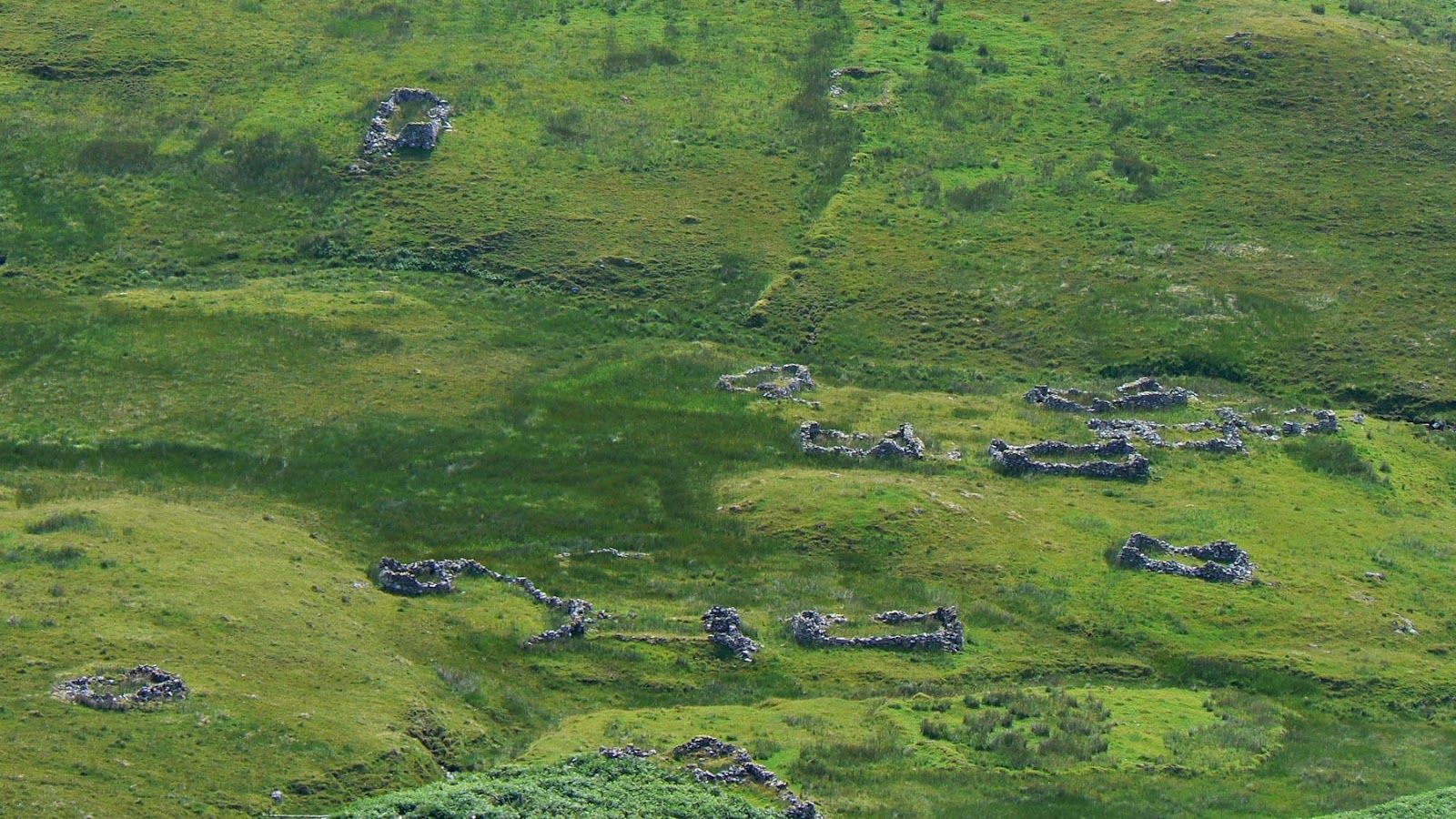
1 bourblaige photo

Bourblaige as it is now, deserted and ruined.

Photo by Jon Haylett, used with thanks and permission under the Creative Commons Attribution/Share Alike Licence v3.0 . From the Kilchoan Diary blog http://kilchoan.blogspot.co.uk.

This description comes from the excellent Kilchoan Diary website entry for Bourblaige:

The evictions were carried out with considerable cruelty. There is a story that one crippled old woman who barricaded herself into her cottage had her front door walled up by a stonemason, imprisoning her until she agreed to leave. Looking at the buildings, few of their drystone walls stand above a metre high, suggesting that those who carried out the evictions went to some lengths to knock them down.

I found another description of the clearance:

To clear Bourblaig, the laird’s men ‘shot the dogs, and they shot the goats, and they drove away the cows. And Then They Took the roofs off. It Was in the wintertime That They Did it. Plows were pulled through the potato pits so That They Would spoil in the frost. And the people Walked to Swordle (on the north coast) through showers of snow. A wee girl was carrying the riddle (for separating the winnowed oats). A girl aged six weeks was carried out of Bourblaig, and it did her no harm being carried, as she bore eight children, all who reached maturity. ‘

It’s worth noting that in Clachans such as Blourblaige the farmland was farmed communally in a similar way to the mediaeval Open Field system in England. On more fertile land, fields known as Runrigs were cultivated in strips and the strips were allocated randomly each year, so one family could end up with a good strip or a less productive one. On more infertile land, small plots known as Lazybeds were cultivated. Bracken and Seaweed were both used as soil improvers and fertiliser.  For centuries barley and oats were grown in the fields, and cattle were the main livestock animal. The introduction of the potato to the Highlands in 1755 saw the population grow significantly.  Transhumance was common, with stock taken to summer grazings on high ground.

Though ownership of the Ardnamurchan estate passed through the hands of several prominent Scottish Families (Campbells and Murrays) through the centuries the way the land was utilised had not, and the Stuarts of Bourblaige quietly continued their existence, until the Riddells acquired it in the 1770s.  James Riddell Bt, was superintendent of the Society of British Fishery and a Fellow of the Society of Arts and Sciences. He was clearly an upstanding member of society and I imagine was keen to see his newly acquired estates being put to productive and profitable purposes. Riddell was obviously enthused by the new opportunities afforded by sheep ranching and this led to the crofters, effectively the same as the commoners of pre-enclosure act English parishes, being evicted.

Having been evicted from the land, the Stuarts moved to Acharacle. 10 years later, in 1839, they sailed for Port Jackson, Australia.

Is this anything other than a bit of personal family history? In a way it is just that. But it also means something very important to me personally. It is the story of  a community, living relatively lightly off the land, not taking too much, and taking little if any profit. This long established way of living is then peremptorily discarded by the wealthy landowner, keen to exercise power, implement new ideas of the economy. The new science of economics, created in large part in Scotland, encouraged landowners to take profit from the land, to work it hard and degraded it, regardless of the feelings of either the community, or the nature that lived there.

While subsistence farmers such as Crofters and Commoners may have long gone from the British Countryside, the economic arguments that lead to nature being discarded in as equally callous a manner have not.

Have we come so far, in the intervening 200 years?


Highland Clearances Memorial photo by secretlondon123 [CC-BY-SA-2.0 (http://creativecommons.org/licenses/by-sa/2.0)%5D, via Wikimedia Commons
Posted in Australia, history, Scotland, Stuart, Uncategorized | Tagged , , | 3 Comments

Save Lodge hill for its Scrub and its Magazines

pill box

military history: a one man concrete pill box at Chattenden (c) Miles King


I am naturally rather depressed that Medway Council unanimously voted in favour of the planning application to build 5000 houses on Lodge Hill and Chattenden Barracks, on the Hoo Peninsula in Kent.

Reading the articles on the BBC, in the telegraph and the guardian, hasn’t really helped. At least the Guardian mentioned the grassland. The BBC and Telegraph didnt even bother to mention it. It’s as if somehow magically species like Nightingales can exist without the habitats or landscapes which they depend on. The Telegraph mentions that deer have reduced the density of shrubs they inhabit, as if they lived in the park amongst the Photinias and Cotoneasters.

It’s Scrub! Scrub is why there are so many Nightingales at Lodge Hill – SCRUB! Scrub which if left to its own devices becomes trees and woodland, and Nightingales no longer live in it.

Land Securities own Consultants now recognise 26 ha of valuable grassland at Lodge Hill – I am sure this is an underestimate. I reckon there is over 30ha of unimproved mildly calcareous unimproved grassland there. This would make it one of the largest surviving contiguous areas of unimproved “lowland meadows and pastures” habitat in England. It’s astonishing that such a large area of unimproved grassland lay undiscovered for so long. It makes me wonder what other undiscovered wildlife gems are still out there in the military estate.

The value of Lodge Hill lies not only in its unimproved grassland, or its Nightingales. It partly lies in the dynamic mosaic of different habitats that Lodge Hill’s fascinating military history has created. There are intimate mosaics of scrub (SCRUB not shrubs) and flower-rich grassland that are rich in birds plants and invertebrates.

But its value also lies entirely outside the realms of nature.

Lodge Hill and Chattenden are awash with military history. And military history is social history, especially in an area like the Hoo Peninsula, which has played such a critical role in defending Britain over the past several hundred years.

The Chattenden Magazines alone are extraordinary. Surrounded by a 12 foot wall, still entered through a locked security gate, it houses a series of magazines, or bunkers built into the hillside within a blast proof casemate (is that the right word?).

Built in 1875/6 by convicts living on prison hulks in the Thames Estuary (that’s another story) the bunkers were used to store massive amounts of gunpowder for the guns of battleships; and later, torpedoes. The ordnance was loaded onto a military narrow gauge railway to be delivered down to the ships. Within this walled garden of ordnance, lies more unimproved grassland, of quite a different nature from the areas within Lodge Hill.

The Royal Naval Armament Depot Lodge Hill itself also holds the remains of other Magazines that were used to store cordite and guncotton  – the massive charges that propelled shells up to 18 inches diameter over distances as great as 17 miles. Sadly these magazines are all in a state of advanced disrepair now and will likely demolish themselves if the developers don’t get there first.

As the home of the Royal Engineers training school, Lodge Hill also shows evidence of having been the place where the first attempts at trench warfare were trialled. In this of all years, it is incumbent on us all to remember the sacrifices of the generation that died of suffered during the first world war; and to remember those places which still hold the evidence of that conflict.

It’s not just about the Nightingales, the Dyer’s Greenweed, The Duke of Burgundy, the scrub or the Magazines. It’s not about birds versus houses as some would like it to be seen.

This is about what values are important to us as a society.

Are we prepared to forego the short term economic gain from selling off this public asset for private profit – and a minuscule contribution to the public coffers; or are we prepared to decide that we want to put public resources into protecting our wildlife and our history, recognising these things as vital elements of our common wealth;

Are we prepared to say that sites like Lodge Hill should remain in public hands and not be seen as merely economic assets to be traded on the market like apples or ipads?

Posted in grasslands, Lodge Hill, public goods, public land, SSSis | Tagged , , , | 5 Comments

Stick to the Knitting

knit-tree

“I think the Knitters have left you a message Minister”

It’s just as well there is less than a year left in this Parliament – and so very little if any time for new legislation or policy development. This is particularly true in the Charity Sector.

Not content with banning Charities from saying anything remotely political in the run up to any Election (the muzzle goes on on the 19th September for next May’s General Election), David Cameron has replaced the thoughtful and helpful former Charities minister, Nick Hurd, with Brooks Newmark MP.

Newmark has been rightly toasted over the media open fire  for his positively Paterson-esque remark that Charities should “stick to the knitting” and stay out of politics. This was at an event organised partly by the Cabinet Office, entitled People Helping People: The Future of Public Services. Newmark later claimed he meant Party politics. But the Lobbying Act has already effectively banned Charities from even commenting on party politics.

One wonders whether Newmark believes that public services, or indeed people helping other people, are entirely unrelated to politics. Perhaps he does.

Newmark has actually managed to achieve something special in this remark. Not only has he deeply offended the entire voluntary sector with this patronising crassitude; he has also ridiculed those who do knit for charity. Knitters make a massive contribution to charity – they have their own website. There are knitters for all causes – I particularly liked knit a message to your MP. Perhaps Newmark will receive some messages from knitters. I hate to think what those messages might say, but they probably won’t appear in Hansard.

Still – you have to shed a wry smile at Cameron’s choice of  Charities Minister. He clearly has a wicked sense of humour.

Newmark’s background is in investment banking – he was a Vice President at Lehman Brothers – remember them? They were the massive American Investment Bank that cooked up all sorts of clever plans and schemes to make money magically out of nothing. This  led inexorably to the US sub-prime mortgage crisis, which in turn caused that good old global economic recession we’re all still mired in. After he left Lehman he had an, I am sure, very successful career in corporate finance. He’s worth a few million of course.

He’s also written a number of reports for the neoconservative “Think Tank” The Centre for Policy Studies and its website lists him as an Advisory Council member. This one was set up by “the Mad Monk” Keith Joseph in 1974, to create policies for Margaret Thatcher’s neo-conservative revolution of the 80s. The CPS is climate change denying, pro fracking and all the other things you would expect. Bizarrely, or indeed not, the CPS has links with Frank Furedi’s libertarian Living Marxism Network, about which I have written before. Furedi wrote a report for the CPS in 1999, about the growth of litigation culture.

Now it becomes clear why Newmark has been made Charities Minister.

In a 2006 CPS report entitled “Charities: The Spectre of State Dependency” The CPS was alarmed at the level of “lobbying” done by charities and recommended that such lobbying be prohibited (p37). 7 years later the CPS have achieved their stated aim to ban political work by charities and they have their man in at the ministry.

With charities, if you want to know who funds them, you can look up that information on the Charities Commission Website where you will find a reasonable amount of information. For Think Tanks like the Centre for Policy Studies, who are, as you can see, highly influential (influencing in a very political sense) it is much more difficult to see who is funding them, who pays the piper whose tune they dance to.

CPS income in the year to September 2012 is a healthy £573000. The CPS receives funding from a charity, called the Institute for Policy Research (IPR). It has given the CPS £1.8 million between 2005 and 2013. That must be a sizeable chunk of its funding.

One advantage of using a charity in this way is that donations received by them can be substantially boosted through Tax Relief. I explained how this works here.

We know that Lord Vinson of Roddam co-founded the CPS. He is also a major funder of the IPR. Vinson has given the IPR £330,000 between 2005-13. It’s not too difficult to join the dots and see CPS founder (and Tory Peer) Lord Vinson giving significant funding to CPS via the Charity the IPR, who get tax relief at 40% and add it on to the grant to CPS. Note that IPR only gives money to neoliberal or neoconservative causes.

Vinson was very recently revealed as a funder of the Global Warming Policy Foundation. I’m sure he will be disappointed that the naughty boys and girls at GWPF behaved so badly that the normally comatose Charities Commission actually took action and insisted they split their overtly political and highly negative lobbying away from their charitable activities.

It is also apparent that CPS, like their fellow neoconservative travellers the IEA,  have received funding from the tobacco industry for many years. I’m sure it’s just a coincidence that in 2011 a CPS acting director signed a letter attacking Government restrictions on tobacco control.

So there you have it. Our new Tory Minister for Charities made a fortune in investment banking and private equity investment, and has close links to a neoconservative Think Tank funded by Tory millionaires via a charity that only funds neoliberal/conservative Think Tanks.

It would seem that as far as our new Charities minister is concerned, if you’re a politically minded Tory Millionaire, it’s fine to use a charity to channel your money (plus an extra 40% Top Rate Tax Relief paid) to your favourite, highly influential Politically connected Think Tank.  But if you’re a knitter, don’t expect your contribution to be used for anything political.


photo thanks to the excellent https://streetartscene.wordpress.com/tag/radical-lace-and-subversive-knitting/ website.


Posted in Charities campaigning, Charities Commission, neoliberalism, Think Tanks, Uncategorized | Tagged , , | 4 Comments

Panic Ploughing

The BBC revealed yesterday that grasslands had been ploughed up, thanks to the European Commission’s Common Agricultural Policy proposals on “greening” – oh, the irony  – to protect grasslands from being ploughed up.The EC had made the fatal mistake of giving a 2 1/2 year advance warning they were thinking about (but in the end didn’t) bringing in stricter rules to protect grasslands.

I raised this story with Defra and the press back in 2011. Defra rejected that there was any problem. Indeed the EFRA Select Committee raised it as a concern with Government nearly 3 years ago and their report was published in June 2012. This from the exec summary

Similarly the requirement to retain permanent pasture is likely to have unintendedand perverse consequences. The

measure would not only fail to deliver environmental benefit but also act as an incentive to remove environmentally important semi-natural grassland“.

At the time NFU was publicly imploring its members not to plough up old meadows. In private on the message boards of farming internet forums all were agreeing ploughing up unwanted grassland was the best thing to do. Indeed, their professional advisers were advising them to do just that. As the Guardian piece mentioned, Strutt and Parker’s advice was “You may want to keep your grassland area to a minimum between now and 2014, or ensure that grassland is rotated before the five-year point, to prevent it becoming permanent pasture and landlords should also give consideration to what their tenants are doing”. No ambivalence there.

Fast Forward 3 years. The Minister, George Eustice, was interviewed by Sarah Montague on the Today programme.  Eustice said “Anecdotally, there were comments in 2012, which maybe sparked a bit of panic ploughing”. He went on to say that only 1% of permanent grassland had been lost per year; and that the Govt were doing really well because half of all surviving wildflower meadows were SSSIs. Finally he reassured Radio 4 listeners that everything was really just fine, as “72000ha of grassland is protected in SSSIs” and 700,000ha of grassland is protected through the Campaign for the Farmed Environment.”

Eustice only says what his officials feed him. Why should he know any better? It’s worth noting that 1% of permanent pasture equates to 39,000ha a year. So we are looking at loss of around 100,000 ha of grassland since the EC announced their intended protection measures.

How many wildflower meadows are left? It’s a difficult one as the definitions are not as easy you might think. But it’s around 7000ha of the very best for wildlife. Half of which are protected by SSSI designation. How many were lost as a result of the panic ploughing? It’s impossible to say, because not all of them are known about, and for those that are, many do not get visited from year to year. it’s only on a return visit that a surveyor might discover the meadow has been ploughed up in the meantime. And this exactly what the Wildlife Trusts found when they investigated what had happened to wildflower meadow wildlife sites over the past 10 years. In Worcestershire, the county of wildflower meadows, 75% of wildflower meadows had been lost between 1975-2000. Another 25% were lost in the last 10 years.

Of course it’s a nonsense to suggest that the CFE protects wildflower meadows. CFE is a voluntary unpaid initiative, set up by the farming industry in a largely successful attempt to see off moves towards a more regulatory approach to farming and wildlife under the previous government (note to CFE – your work is done, no need to worry about anything pro regulatory for now), driven by the ongoing disappearance of Farmland Birds.

Roger Harrabin’s piece for the Beeb mentioned Keresley meadow which had been sprayed off and destroyed by a farmer in Warwickshire. The local community were extremely upset as they regarded it as a community asset. The farmer claimed it was just “a worn out old pasture”. The community tried to get Natural England to apply the EIA regulations for agriculture. I have blogged about this so many times….. needless to say, the meadow did not meet the EIA test – well it wouldnt, because it would have to be SSSI quality to be protected by the EIA Regs.

The NFU have been somewhat stung by the criticism of farmers and have unusually launched a rebuttal. Their main point seemed to be that the Warwickshire farmer was not an NFU member! And presumably was therefore not acting like their members? I think not. He was doing exactly what any NFU member would have done in the circumstances ie following the advice of his agronomist, agent etc. Indeed he did approach NE to check whether the meadow fell within the EIA regulations, presumably confident in the knowledge that it would not.

NFU then trotted out their usual palliatives – the wildflower meadows were all lost long ago (as if it happened in a fairy tale) “since the pre-war period” and it was all different now. They reassured everyone that the EIA Regs are there to protect wildflower meadows and that there was nothing to worry about. In fact the NFU has repeatedly campaigned to have the EIA Regs killed off.

Where does this leave us?

Despite the great work being done by Plantlife (Saving our Magnificent Meadows) and The Prince of Wales (Coronation Meadows) and The Wildlife Trust’s vanishing grasslands campaign, we still have a long way to go. Meanwhile Meadows continue to be lost, year in year out. Why?

It’s worth considering this esoteric fact. During the First World War, Britain shipped nearly 2 1/2 Million Tonnes of hay abroad, mostly to France. The hay was so important, there were fierce debates in the Cabinet, over whether the holds of ships should carry hay or ammunition. The hay won. Hay was the fuel which drove the Imperial Army, indeed it drove all the armies of the War. The First World War was a horse-powered war.

A rough calculation indicates that 600,000 acres of hay meadow were needed just to feed the Army’s horses.

Posted in Common Agricultural Policy, deregulation, George Eustice, grasslands, meadows, NFU, Uncategorized | Tagged , , , , | 2 Comments

50,000 views

This blog has passed a bit of a milestone today – it has reached 50,000 views. I know it’s not much compared to some of the big bloggers like George Monbiot or Mark Avery, but for me, doing this in my spare time, I’m really pleased to have got here.

So with the heady scent of hubris swirling around me, I thought it would be a good moment to take a look at the most popular posts of the last year.

Number one by quite a long way is last December’s blog about the new Natural England chair Andrew Sells, with 1796 views.

Number 2 is Keeping a Level Head, one of my blogs about last Winter’s flooding on the Somerset Level, with 1587 views.

I’m delighted that Held to Ransom: Solar Farms, green or greed, which I wrote only 6 weeks ago, is already up to number 3 in the blog-charts, with 1460 views. This one is still getting 15 views a week so I expect it will climb the chart before too long.

Lost in the drainage Maize, the previous blog about the Somerset Levels to Keeping a Level Head, is at number 4 with 1320 views.

A political blog that had been gestating for quite a while, the unholy alliance between UKIP and the marxist libertarians, is at number 5 with 1121 views.

At number 6, my most recent blog (of many) on biodiversity offsetting, about the Thaxted wildflower meadow case, proved popular with 1086 views, 954 on the first day.

One of my most personal blogs is number 7, about my late brother Simon, which has received 1023 views. Simon died a year ago last week and is still very much in our thoughts.

A story Simon would have enjoyed (as an angler and wildlife expert), and one that no doubt would have stimulated a long conversation with him, was that of Defra’s plan to evict the Beavers of the River Otter, and the appalling stance taken by the Angling Trust. I blogged about this in June and it is currently number eight with 1018 views. I will return to this story soon.

At 9 is the first blog about the Somerset Levels, On the Level, which I wrote on World Wetlands Day. This has 934 views.

Finally in the top ten is my review of George Monbiot’s book Feral, which I published a year ago tomorrow. This has steadily accrued views over the past year and is up to 835.

So that’s the top ten. I’ve really enjoyed writing these blogs, and it’s become a bit compulsive to be honest. I have really missed writing over the past 6 weeks, but it seemed the right thing to do (to have a proper break).

I will continue writing regularly, as much as I can, fitting in with the day job, volunteering and the family.

So it just leaves me to thank everyone who has read my blog over the past 15 months, and special thanks to the commentators, regular or occasional.

Which were your favourites, and which ones did you think were rubbish? Let me know.


Posted in blogging, Uncategorized | Tagged | 4 Comments

The Cockle of Rebellion

Agrostemma_githago_002

Corncockle

Some of you may have noticed I have not been posting for the past 5 weeks or so. We have been to Australia to catch up with family and have a good holiday. It was an amazing trip and I will be writing about some of the things we saw and did over the coming weeks, possibly months.

It’s good to be back of course, especially as the silly season seems to still be in full swing. Take this story for example, which actually popped up shortly before I left, back in July.

Project promoted by BBC spreads poisonous wild flowers across Britain

It seems the BBC has been trying to poison the bodies of plucky Brits, not just their minds with their lefty propaganda – at least that’s the case if you believe the Mail and the Torygraph (which really should know better.) What’s going on?

The Mail reported a little story back in July that a National Trust warden had found corncockle growing on his patch in Sunderland – and was very pleased to see it “in the wild”.

The Big Lottery Fund has given Kew gardens £10M to encourage people to grow wild flowers. The project is called “Grow Wild“. Now whether this was a good use of gamblers money is moot, but that’s another matter.

Grow Wild thought it would be a good idea to send out seeds of the Corncockle, and encourage people to plant these attractive wild flowers in their gardens, and anywhere else appropriate.

Someone somewhere (a hack no doubt) discovered that – shock horror – corncockle seeds are poisonous. Indeed if you were foolish enough to eat a corncockle stem – perhaps mistaking it for a runner bean, with which it has absolutely no similarity, it would also give you a tummy ache.

The power of social media transformed this innocuous fact into a media-driven whirlwind of hysteria. These vicious and lethal wildflowers that have somehow been released into the wild and now being hunted down and eradicated as I write.

The Telegraph excels itself in this stupidity to the point that I wonder whether there is any dark ironic humour in their piece – for example

In Wootton Bassett, Wiltshire, council groundsmen have already been called in to eradicate a patch of corncockles planted in a park by well-meaning Girl Guides.”

Note this is Wootton Bassett – a town resonating culturally now as the sepulchre where the bodies of servicemen lost in wars of the Middle East are received back to the mother country.

The BBC has found itself entangled in this web of confusion and fear by merely reporting on progress with Grow Wild” in their insipid Countryfile strand. It’s a typical Countryfile piece in a way – reporting on a project which is cosy and friendly and all about the community doing something positive for nature, without addressing many of the real issues affecting it. How the Countryfile editors must be wondering where are those “countryside” stories that will upset nobody. Newflash – there aren’t any, get over it.

There is a more interesting story, in the shadows around this piece of silly season nonsense, and it’s about our relationship with plants and nature.

Corncockles are extinct in the wild in the UK – a rather ignominious state, given how common they were until relatively recently. They were originally introduced to Europe from their homelands in the Middle East, around 6000 years ago during the Neolithic. As a species that is pre-adapted to live with arable crops, they did very well in arable fields. They are not strictly climbers, but they are quite good at using a crop to grow up to, or even beyond the height of the crop canopy. They were a very well known arable weed for millennia, often found growing with another very common weed, Cornflower. Because their seeds are a similar size to crop seeds, they were a common (notorious) contaminant of crops, especially Rye, and were resown with the crop. Also, their seeds have a very long life in the seedbank, perhaps over a hundred years. So they can lie undisturbed until some cultivation happens and up they pop. Archaeological evidence indicates they arrived in Britain during the first millennium BC.

Eating Cockle-contaminated bread, especially Rye bread (or porridge), was an everyday occurrence from the Neolithic until the 19th century, as archaeological evidence attests. No doubt some did die from the toxins in the seed, though they those that survived benefitted from the presence of a natural ant-helminth githagenin, which kills intestinal parasites, another ubiquitous health problem of that time.

In Shakespeare’s time Corncockle was one of the most pernicious of weeds – known to such an extent he used it metaphorically: Coriolanus argues with the Senate over their desire to give the people a gift of free corn. Coriolanus likens the gift to a farmer encouraging Corncockle to grow instead of Corn.

In soothing them we nourish ‘gainst our senate

The cockle of rebellion, insolence, sedition

Which we ourselves have ploughed for, sow’d and scattered

By mingling them with us, the honour’d numbers;

Who lack’d not virtue, no, nor power

but that which they have given to beggars”

Coriolanus Act 3 scene 1

Could wearing a Corncockle actually have been used a symbol of rebellion in the 16th century?

19th century advances in agriculture – such as the threshing machine griddle, improved seed cleaning and Corncockle were no longer spread with corn seed. Their long decline to extinction in Britain had begun. WIth the introduction of mechanical and chemical weed killing techniques they rapidly declined, along with many others of our arable weed flora. They have been extinct in the wild for decades, although occasionally pop up after cultivation from that seed bank.

It’s also worth noting Corncockle and it’s arable weed familiars, Poppy and Cornflower, especially this year. The battlefields mimicked arable cultivation such that there were incredible displays of arable weeds during and after the First World War. This gives us our emblem of our lost generation the poppy, while in France it is the Cornflower. It could just as easily have been the Corncockle, which we now wear to signify remembrance.

Instead, we see the media vilify this flower, embody it with notions of poison and threat, forgetting or in ignorance of it’s history. For god’s sake Girl Guides in Wootton Bassett could be poisoned by it! It obviously has to go.

And so, not content with getting rid of this exotic traveller from the Middle East once, we have to do it twice, akin to driving a stake through the heart of the beheaded vampire.

This aversion to nature could be called ecophobia. It is everywhere – having come back from Australia, they have it real bad.

Immunologists now recognise that many allergies suffered are caused because part of our immune system is adapted to tackle intestinal parasites like worms. Now we have rid ourselves of these parasites, our immune system searches around for something similar to tackle, for example certain types of food, or parts of our own bodies.

It occurs to me that the Corncockle story  is something similar – we have an innate fear of some things in nature – for good reasons, such as not being eaten by a predator or bitten by a snake, or eating a poisonous plant. We have now rid ourselves of almost all of those primal risks from nature, but we still retain the psychological apparatus, so we have to invent other things to fill that space. The deadly Corncockle insinuating itself into our public and private spaces fits that bill perfectly. We have to consciously reject this visceral response and replace it with another more positive image of nature.

So let us celebrate our relationship with the Corncockle, sow Corncockles whereever they may prosper, re-wild our stale sterile public spaces with colour and a little bit of danger.

Let Girl Guides across the country sow Corncockles where they may go, and wear your Cockle of Rebellion with pride.

Photo by H. Zell (Own work) [GFDL (http://www.gnu.org/copyleft/fdl.html) or CC-BY-SA-3.0 (http://creativecommons.org/licenses/by-sa/3.0)%5D, via Wikimedia Commons


Posted in arable weeds, ecophobia | Tagged , , | 3 Comments

Where does Owen Paterson go from here?

Owen Paterson reveals that he sees himself as St George fighting the environmental lobby dragon, or Green Blob as he has called it. He feels that his sacking is a “kick in the teeth” for several hundred hugely wealthy landowners and the NFU.

Paterson will no doubt continue his personal crusade against science-led policy on climate change, Bovine TB and other things. But from where?

Will he retreat to the backbenches and adopt a Churchillian position of leading the re-armers against the green-appeasers and apologists he sees in the Cabinet, woefully ignoring “The Gathering Storm” of green fascism emanating from Brussels?

Will he become the new chief Exec of the Global Warming Policy Foundation’s military arm, now that the Charity Commission has decided GWPF has been naughty doing political lobbying while masquerading as a charity and has to be split asunder.

Will he be knighted for services against the Environment as a Treasury Operative in deep cover by his handler, the mysterious master operator behind the scenes (code name Gideon).

Or will he resign from the Tory Party and stand for UKIP in the General Election?

Whatever, his mates in the anti-environmental lobby, or the Neoconoids as I have branded them today will no doubt rally around to support their wounded hero. Expect a particularly stinky outpouring of anti-green effluent from the likes of Christopher Booker, James Delingpole, Richard North, Nigel Lawson, Lord Monckton and of course Paterson’s own brorther in Law Viscount Matt Ridley et al, in the pages of the Telegraph and Spectator.

Neoconoid n. A virulent neoconservative agent known to be acutely toxic to all forms of wildlife, nature, the environment and those who care about it. Symptoms include green blobs appearing under Tory MPs skin. It can also produce an intense itching pain in the rectum.


Posted in anti conservation rhetoric, anti-environmental rhetoric, Neoconoids, Owen Paterson | Tagged , | 6 Comments

Farewell Owen Paterson: your work here is done

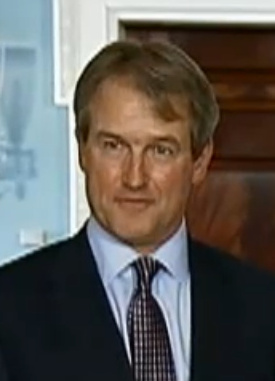
Opatz

And so the rumours have finally been confirmed, Owen Paterson has been asked to stow away his wellies for the last time and return to the back benches.

It may seem incredible that Paterson only became Secretary of State against the Environment in September 2012. How much damage can be done by one man in so little time.

What will he be remembered for?

  1. The Farcical Badger Cull – against his own and independent Scientist’s advice.
  2. Emasculating Natural England and the Environment Agency such that they became Defra’s poodles.
  3. Appointing Andrew Sells, housebuilder and treasurer of the Policy Exchange as Chair of Natural England.
  4. The ridiculous attack on “Red Tape”, and moves to deregulate anything that could possibly be deregulated, regardless of the function it played. This led inexorably to the Horse meat scandal.
  5. The hollowing out of Defra, which started under his predecessor but hastened under Paterson.
  6. Blaming the Badgers for not being there to be culled “The Badgers moved the Goalposts”
  7. A front man for Global Biotech Industry pushing GMOs. Calling opponents of GM “wicked” and accusing them of causing children to be blinded. “It’s just disgusting that little children are allowed to go blind and die because of a hang-up by a small number of people about this technology.” This was later found to be totally untrue.
  8. Standing up for the right for farmers to use Neonicotinoids, as evidence piled on evidence of their widespread toxic effects on wildlife.
  9. Being a placeman for the NFU, pushing their facile “UK farmers must grow as much food as possible to feed the world” lunacy.
  10. Being a gung ho supporter of Biodiversity Offsetting, regardless of whether it works or not,or has precisly the opposite effect ie “a licence to trash’. Infamously claiming that you can replace an ancient woodland by planting thousands of trees.
  11. Ignoring Government scientists, preferring instead to peddle the shall we say idiosyncratic views of Viscount Matt Ridley, the Rational Optimist.
  12. Denying the existence of human-induced Climate Change.
  13. I’m sure to have missed some – please let me know.

Are there any redeeming features?

Well – there was a moment during the CAP reform process when Paterson, from a neoliberal perspective, was arguing that farmers should only receive subsidies in return for public goods such as flood prevention, carbon storage and wildlife conservation. Still, the moment past, and instead we got a the worst case of greenwashing in decades of CAP reform, greening.

Paterson also hinted that intensive agriculture might be making a contribution  to flooding in places like the Somerset Levels, before setting the EA to dredge every river.

I for one will miss him – if only because he provided such good topics to write about.

Who will replace him at Defra? It doesn’t really matter. After the summer break, it will be conference time before the troops are called to muster in preparation for the Election. There won’t be any new legislation and it will be just be a case of tying up loose ends.

Is it a coincidence that Paterson’s partner in crime, Matt Ridley, is the nephew of the late Nick Ridley, the last most damaging Environment Secretary?

Posted in corporate lobbying, deregulation, GMOs, Matt Ridley, Neonicotinoids, NFU, Owen Paterson | Tagged , , , , , | 11 Comments

Held to Ransom: Solar Farms – green or greed?

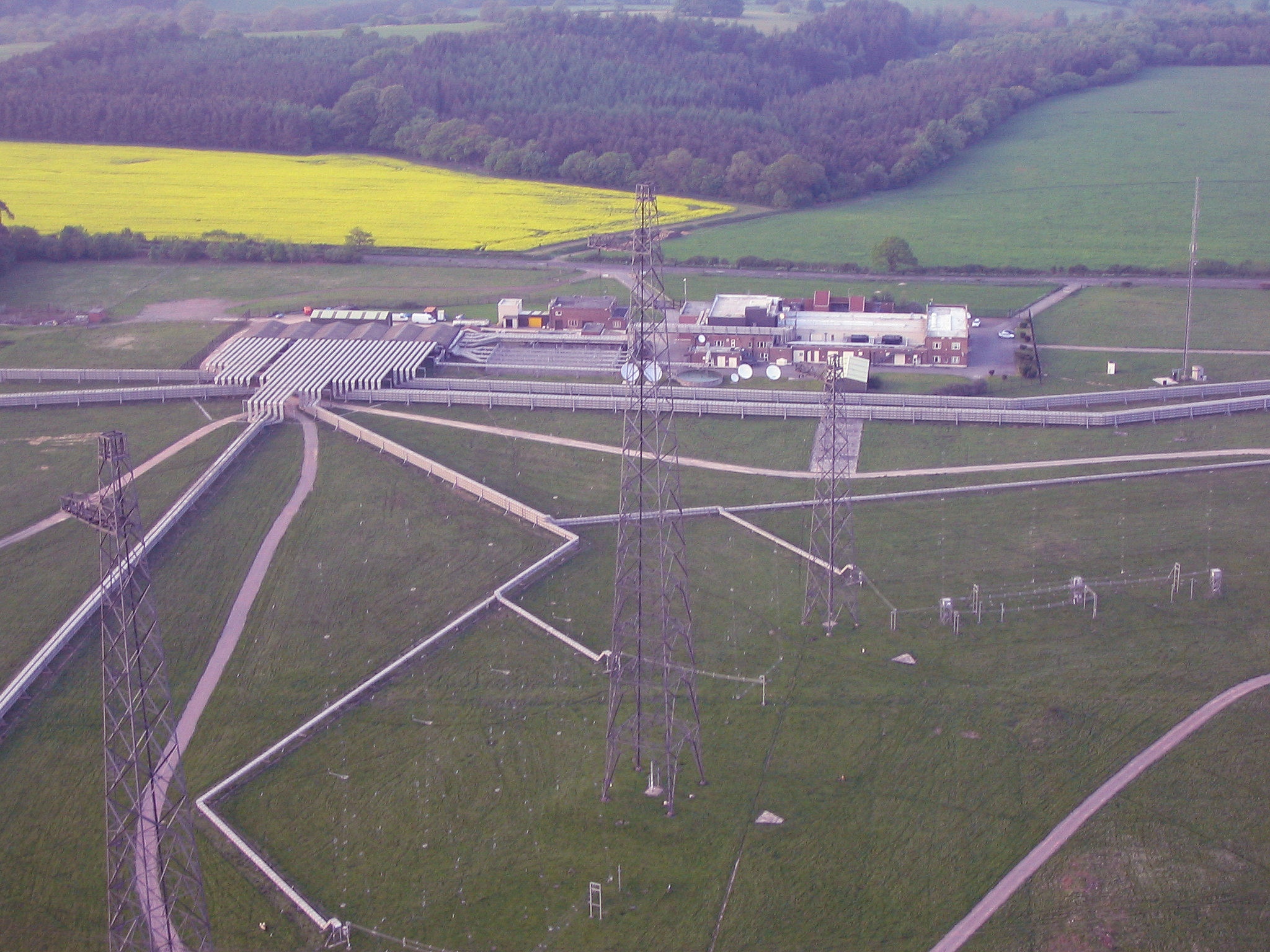
View_of_Rampisham_transmitter_site,_Dorset,_England

Rampisham Down Transmitter Station from Hot Air Balloon

Despite the sun shining upon us for much of the late Spring and Summer, the Solar industry has not had such a happy time of it.

Eric Pickles has decided he doesn’t like solar farms, possibly because of their impact on the landscape, possibly for some other reason. His failure to decide why he doesn’t like them caused his move to block a Suffolk Solar farm to be thrown out by the high court.

The bigger threat to Solar Farms comes from the Government’s proposal to withdraw Renewable Obligations support for 5MW or larger Solar Farms as of April 2015. The Solar industry are lobbying to have the proposal abandoned.

Solar Farm Best Practice for Biodiversity

The Solar Trade Association, perhaps stung by criticism that there are Solar Farms popping up everywhere spoiling the view (or worse) has come up with 1o commitments to best practice. Commitment 2 states that “we will be sensitive to national….conservation areas, and we welcome opportunities to enhance the ecological value of the land”.

To show their sensitive side, the Solar Industry have come up with some best practice guidance for biodiversity and solar farms. The BRE National Solar Centre Biodiversity Guidance for Solar Developments, has – I am somewhat surprised to see, been endorsed by a wide range of conservation NGOs. If I had been asked to endorse a piece of industry promotional material, I would have wanted to be very clear that I was happy about what it was saying.

The BRENSC guidance says a lot of good things about enhancing agricultural land that has lost its value for biodiversity, when building  Solar Farms. So far so uncontroversial. It’s what it says about existing high biodiversity sites that is more interesting. For instance should a Solar Farm ever be built on a  Special Protection Area (Birds Directive)? The STA says SPAs are “very unlikely to be appropriate” for Solar Farm development, though even this is caveated with “depending on the designated feature”.  I can’t really think of any SPA designated feature where a Solar Farm would be appropriate. Since the qualifying features for which SPAs are designated are wild bird populations, none to my knowledge benefit from having large glass panels on posts stuck in their habitats, along with the artificial lights, security fencing, buildings, tracks and all the other infrastructure of Solar farms.

For SACs and SSSIs it only says “unlikely to be suitable”. Why differentiate between SPAs and all other designations? Are birds more likely to be upset by having a Solar Farm built in their Special Protection Area? Would bats find it easier to navigate through the array of panels than birds? Would habitats benefit from having thousands of glass roofs and metal posts stuck into them? No,  I think it’s more likely that the RSPB drove a harder bargain when negotiating about whether their logo would appear on the booklet, than the other NGOs.

For Section 41 species and habitats – these are the Priority Habitats and Species or Habitats and Species of Principal Importance, basically the UK habitats and species which are highest priority for conservation,  the guidance says that the presence of these features “should guide the appropriateness of solar developments to avoid harm to these interests”.

For SNCIs (Local Wildlife Sites) and undesignated semi-natural grasslands it says that an ecologist should be consulted “to avoid damage to such sites.” This is confusing though because all undesignated semi-natural grasslands would already qualify as Habitats of Principal Importance, as do many SNCIs.

I think this is all exceptionally weak and mealy mouthed. For an industry that seeks at every opportunity to portray itself as “green by default” it should be setting a high standard when it comes to impact on wildlife. The guidance should be unambiguous and say that solar farms should never be developed on sites with statutory protection, or on priority habitats unless it can be shown that there will be no impact on their natural value. For SNCIs there should be a strong presumption against development of Solar Farms, indeed many local authorities already have similar policies for other forms of development, within their local plans.

How can all these NGOs sign up to an industry document that states in black and white that SSSIs are only “unlikely to be suitable” for Solar Farms – come on NGOs. How would they have reacted to a proposal from, eg, the House Builders Federation, to sign up to industry guidance on housing that stated that SSSIs were “unlikely to be suitable” to housing development?

Return To Rampisham (Ransom)

The Solar Trade Association which produced the biodiversity guidance has amongst its membership British Solar Renewables, which you will recall, proposes developing a Solar Farm on Rampisham (locally known as Ransom) Down in Dorset. Rampisham  was designated as a SSSI on account of its large area of unimproved acid grassland. Indeed BSR were recently part of the Solar Trade Association’s publicity event “Independence Day” and held an open day at their Crossways Solar Farm here in Dorset.

I might be misunderstanding this, but if BSR are a member of the Solar Trade Association, and the STA requires its members to abide by the 10 commitments, which includes being sensitive to national conservation  areas (such as SSSIs) then isn’t BSR in direct breach of this code of practice?

That’s the trouble with voluntary codes of practice; they are just voluntary – will anyone police them?

British Solar Renewables’ first Solar Farm is on its founder, Angus MacDonald’s, family Farm, Higher Hill Farm, on the hills above the Somerset Levels. This array is just about 5MW in size, and would have cost around £5M to build, perhaps a bit less. It earnt BSR nearly £500,000 last year in electricity production and solar subsidy. So for this farm at least, the return is 10% per annum – pretty good by anyone’s standards.

In 10 years the Solar farm has paid for itself, and for the remainder of its active life it is generating clear profit. You can see why BSR were so enthusiastic to install a much larger array at Rampisham, to such an extent that they were happy to ignore or deny the environmental impact. Although MacDonald won Best Cider Orchard at the Bath and West Show this year, the remainder of Higher Hill Farm appears (from Google Earth) to be in intensive maize production. Perhaps this Maize is sold into the “ecofriendly” biogas market at a large profit. And of course it’s just another area of Maize contributing to the problems of the Somerset Levels.

Current proposals for Rampisham indicate a 24MW output, which should generate an income of nearly £2.5M a year. Even if BSR paid through the nose for Rampisham, the electricity and subsidy will still have paid for the land and construction costs and be in straight profit in 12-15 years. With the guillotine potentially coming down on subsidies for large (>5MW) Solar Farms next April, you can see why BSR are so keen to get their planning permission for Rampisham as quick as possible (despite the fact that it is now a SSSI).

Now that Rampisham is an SSSI, BSR are trying to persuade the local planning authority that their Solar Farm won’t damage the SSSI interest features, because they will space the panels out a bit more, tip them up so they create less shadow, and put some clear glass in the panels to let the light through. They are even doing some experiments to see just how biodiversity friendly these new panels are.
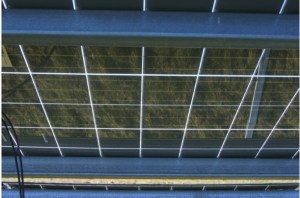
holey panelsjpeg

the new grass-friendly holey solar panels are still very opaque (this view from underneath, from a BSR report)


Now you or I might think it blindingly obvious that if you cover a large area of unimproved grassland with what are effectively a combination of roofs and windows, it might alter the floristic composition of the grassland. But no, BSR’s planning consultants argue that there is no evidence to support NE’s view that the Panels will have an adverse impact on the SSSI grassland.  It’s true, in the same way as there is no scientific evidence based on experiment, that unimproved grasslands would suffer any damage from being covered in custard, or used for the UK annual lawnmower-racing championships. Or having alien spacecraft land on them.

BSR have set up a “test plot” to test their new holey panel and have already been monitoring them for a whole 39 days.  They have erected three arrays, each with 40 solar panels (10 x 4). Then they are going to monitor the light, moisture and so on under and around the panels. They will also monitor the vegetation under the panels and nearby in unshaded areas. Given that the grassland on the site is quite varied over the whole site, I would have thought a proper experimental set up would have reflected this and included a number of replicates on different grassland types, covering slope, aspect, soil depth etc. 4o replicates perhaps? 3 seems wholly insufficient.

In 39 days of continuous recording they have found that the soil moisture under the panels is 47% higher than in the open,  while soil temperature is 16% less under the panels. In other words under the panels it is cooler and damper. They have also been monitoring sunlight in the frequencies that plants use. They have found that shade directly under the panels receives 20% of the light compared to an unshaded spot, 34% at the back edge of the panels,  and 88% between the panel rows.

So let’s just summarise their findings. Under the new holey panels, it’s

  • much damper,
  • quite a bit cooler 
  • much darker

than in the open. And this is during the critical time of year for plant growth, the late spring and early summer.

Now if I were thinking, what would happen to a grassland that became 4 times shadier than it had been, nearly half as much again damper, and 20% cooler, I might think it would turn into something very different. Much more bryophyte growth for starters, and I would expect it to get grassier, with fewer herbs.

Needless to say, in 39 days they haven’t found any change in botanical composition of the grassland under the panels, or indeed between the panels. But then they have only monitored the vegetation plots once, so they wouldn’t find any change anyway.

I was very surprised that these monitoring plots will be excluded from grazing. Why? Surely grazing is a critical element of grassland management, whether under panels or in the open. At the very least plots should be monitored grazed and ungrazed. How would livestock react to the panels? They might prefer grazing under the panels, or they might prefer grazing away from the panels, or they might not differentiate between the two. Who knows? Would sheep not take shelter under panels in the rain? Would they preferentially poo there? There are many impacts which would result from placing solar panels on unimproved grassland, far beyond how much light gets through them. None of these are being assessed in this experiment.

Despite all these limitations, BSR ecological adviser John Feltwell has felt the need to carry out a technical assessment to  review the results of the monitoring programme set up by BSR. Presumably he thinks this review will lend the experiment scientific credibility. He has decided that the experiment is not only very scientific, but is already showing results. After 39 days.

His scientific review rapidly heads off into the long grass though.

A baseline condition predicted to occur on site, in the absence of solar development, would be that the site would be overrun by Bracken, a succession process that has already started.”

This remember is supposed to be a technical assessment of the experiment. Feltwell seems keener to tell Natural England the site will only get managed if BSR get their Solar Farm. Indeed he is only repeating what BSR owner Angus MacDonald said at the SSSI confirmation hearing.

Now one could argue, from an ecological perspective, that, in the absence of any grazing, the site would eventually develop into Oak and Beech woodland on the plateau with some Ash woodland on the slopes. One could argue that, with the reintroduction of extinct megafauna, Rampisham Down could develop into a dynamic mosaic of mature woodland, woodland glades and rides naturally maintained by passing elephants. Or one could argue that Rampisham Down could continue to be managed as a Downland (a clue in the name) through the grazing of domestic livestock, as it has been for millennia.

From an ecological perspective, one would not normally include externalities such as Solar Farms being built, nor nuclear waste facilities, rocket launching stations or Theme Parks.

Remember the data which showed the area under the panels getting darker, cooler and wetter?

Feltwell dismisses the findings of the first 39 days of monitoring, on account of

1. It being too sunny – “the normal weather at Rampisham is generally cloudy” he states. Actually Rampisham is one of the sunniest spots in the whole country (over 1600 hours a year), which is exactly why BSR want to build a massive Solar Farm there.

2. Recordings were made around Midsummers day when incident light onto the unshaded areas was at its greatest. In other words the days were too long.

While this is true, it doesn’t deflect from the reality that at the height of summer, when the plants are growing and flowering, they will be in the dense shade of the panels and they will be cooler and darker than otherwise. In any case it was quite within BSR’s powers to set up the experiment to run at another time of year,  – or over perhaps a whole year, or even several years, before pontificating about what the results might mean.

Regardless, Dr Feltwell concludes that based on 39 days of physical data, which he has ignored,

“there is evidence there is a trend towards evidence indicating less harm to the suite of plants that comprise the notified SSSI flora than might otherwise have been found with traditional panels.”

This is of course arrant nonsense. Not only does it make no grammatical sense, but it makes no ecological sense. There has been no measurement of change in the floristics of the grassland under the panel, near the panel or flying past the panel on the back of an aerial pig. There is only one data point. Where is the trend?

Even if after several years of monitoring it had been found that there was a difference between the grassland under the holey panels compared with the traditional ones, this also has no bearing on the important question – will erecting hundreds and thousands of solar panels on an SSSI grassland cause it damage? If it is just a little bit less damaged as a result of the new improved flower-friendly panels, it is still damaged.

What is even more extraordinary is that former Director of Kew gardens Professor Ghillean Prance, puts his name to a foreword to this travesty. Prance states that “Rampisham Down is a severely damaged area of grassland.” and that Solar Farms “increase biodiversity rather than diminish it.” It’s a pity Prance didn’t turn up to the SSSI confirmation hearing – I would have enjoyed debating these points with him. Prance is a very devout christian and feels a strong ethical duty to protect the environment, a duty derived from his faith. I guess those ethics don’t extend to unimproved acid grassland.

Perhaps Prance is a purist re-wilder; and that all unimproved grasslands, heathlands, lowland raised mires, fens and blanket bogs are severely damaged habitats; and that only Holocene Forest is the real undamaged habitat of Britain. Or perhaps he believes that the Holocene Forest was also severely damaged habitat, on account of the Elephants and Rhinos that were hunted to extinction in the Pleistocene preventing them from returning at the end of the last Ice Age.  I think we should hear what Prof Prance really thinks. We know the bible is his “final authority“. What does it have to say about unimproved acid grassland?

I sense that the ecological consultants tasked with jumping through these hoops, Landmark, are squirming with embarrassment at all this. They were asked to undertake a literature review of the evidence that solar panel shading causes damage to grasslands. Naturally there was no literature to review – and sensibly they concluded there was no evidence that making solar panels a bit more transparent would make any difference to their impact on the grassland.

They were also asked to investigate opportunities to enhance the Rampisham grasslands. They suggested a move from sheep grazing to cattle grazing. I think this is absolutely right, Rampisham has been only sheep grazed for years and the sward has reacted to that grazing. Cattle would open up the sward and create bare ground for flowers to seed into. Unfortunately cattle and solar panels do not mix. Cattle like to rub against any upright fixture in an area where they graze. They would have no trouble rubbing against the panels and probably break quite a few. This is why The Solar Trade Association guidelines promote sheep grazing, not cattle.

SSSIs under Threat

Rampisham is one of two key cases live at the moment which, depending on how each of them conclude, will affect the future of all SSSIs in England. The other one is Lodge Hill in Kent. Both sites are under threat from development, and the key question is how the balance between protecting nature and promoting economic growth in the National Planning Policy Framework will be interpreted.

The NPPF enshrines the Mitigation Hierarchy, whose first commandment is “thou shalt avoid doing damage to very important wildlife sites.” If that damage is unavoidable, because there is nowhere else for that Solar Farm or that housing development to go, then move onto the next test, mitigation. In both the Lodge Hill and Rampisham Down cases, they can both be built elsewhere.

The other key issue is “does the benefit of the development outweigh the harm?” This is of course an “apples and pears” argument, as the benefits, in terms of economy (jobs, company profits) and environmental ones (CO2 reduction) are not even remotely comparable with the loss of biodiversity (tangible and intangible values, including intrinsic value) and landscape (tangible and intangible values).

If you would like to object to the proposal at Rampisham Down please make a comment to West Dorset District Council here  BY THE FIRST OF AUGUST.

I have submitted a response using the online form, which should be published in the next couple of days so you can see what I have said.

More Dorset Solar Farms

Two more Dorset solar farms have been proposed recently, including one at Manor Farm, Verwood, directly adjacent to the 28ha Homeland Solar Farm,  which has already been built. Homeland was where the proposed environmental benefit was to create a wildflower meadow on former heathland, next to a heathland SSSI, SAC and SPA. At least Good Energy revised their proposals to mention heathland – though only in passing. The main emphasis is still on “wildflower meadow” creation, though the photo show a cornfield mix. I guess I’m being pedantic again  – splitting hairs over things like the difference between heathlands, wildflower meadows and arable weeds. Still, overall I think there will be a benefit for wildlife, given that it was previously arable land.

Manor Farm Solar Farm, right next door, would be on former intensive dairy land so it seems almost certain there will be an environmental benefit. The two new proposals together cover 102ha of farmland, or 240 acres in old money. The Manor Farm ecological management plan notes that wildflower seed will be sown in areas that are not shaded by the panels, and just a grass mix is sown under the panels

“wildflower mixtures will be sown between the panels, rather than underneath panels, to ensure they receive adequate levels of sunlight to facilitate growth and establishment”. It still bothers me that on an area that was heathland until relatively recently, there is this insistence on creating wildflower meadow. Manor Farm does include a pitifully small area heathland creation (0.25ha).

I think we need as many solar panels as we can possibly install – on roofs. There must be millions of hectares of roofs in this country – almost all of them could have panels. Economies of scale would mean that large roofs would be cheapest to put panels on – big warehouses, factories, shopping malls.

I would even be happy to see some solar farms be developed, and contribute to habitat creation – but keep them away from our few surviving valuable wildlife sites please.


Photo of Rampisham Down from Wikimedia Commons  “View of Rampisham transmitter site, Dorset, England” by Foxmeadows – Photo from hotair ballon arround 2005. Licensed under Creative Commons Attribution-Share Alike 3.0 via Wikimedia Commons.
Posted in biodiversity, British Solar Renewables, Rampisham Down, Solar Farms, Uncategorized | Tagged , , , | 33 Comments

Paterson refuses top Scientists’ briefings on Climate Change: where does he get his views from?

It was a massive shock – to no-one at all – that Owen Paterson has refused to take a briefing on climate change from the Chief Scientists of the Met Office, Department of Climate Change or even Defra. This amazing piece of information was gleaned via a Freedom of Information request by Friends of the Earth.

Yesterday FoE dumped a load of wellies abandoned at Glastonbury Festival, on the doorstep of Nobel House, Defra’s headquarters, in a symbolic gesture indicating that Paterson should be “given the boot”.

This refusal to be briefed happened specifically in the days preceding the publication of the IPCC 5th assessment “summary for policymakers” report last September.

On the 29th September Paterson spoke at a Tory Party Conference Fringe Event.

He said

“People get very emotional about this subject and I think we should just accept that the climate has been changing for centuries.

“I think the relief of this latest report is that it shows a really quite modest increase, half of which has already happened. They are talking one to two and a half degrees.

“Remember that for humans, the biggest cause of death is cold in winter, far bigger than heat in summer. It would also lead to longer growing seasons and you could extend growing a little further north into some of the colder areas.

“I actually see this report as something we need to take seriously but I am rather relieved that it is not as catastrophic in its forecast as we had been led to believe early on and what it is saying is something we can adapt to over time and we are very good as a race at adapting,” he said.

Now it is possible that Paterson thought all this up himself, in the absence of briefings from Chief Scientists at DECC, DEFRA and the Met Office. However, there is another possibility. This piece of writing was published on the 17th September.

Warming of up to 1.2 degrees Celsius over the next 70 years (0.8 degrees have already occurred), most of which is predicted to happen in cold areas in winter and at night, would extend the range of farming further north, improve crop yields, slightly increase rainfall (especially in arid areas), enhance forest growth and cut winter deaths (which far exceed summer deaths in most places). Increased carbon dioxide levels also have caused and will continue to cause an increase in the growth rates of crops and the greening of the Earth—because plants grow faster and need less water when carbon dioxide concentrations are higher.

Spot the similarities:

  • Longer growing seasons
  • extend crop growing area further north
  • fewer winter deaths
  • winter deaths far exceed summer deaths

So, who could this author be – is it Paterson ghost-writing someone else’s blog?

No – it’s his brother in Law, Viscount Matt Ridley, described by Conservative Home with prescience as Paterson’s personal Think Tank. As Mark Wallace said in that article, having Ridley around to explain complicated things like Science

“gives him a handy route to overcome flawed analyses sometimes presented to him by civil servants.” 

That’s one way of putting it.

Another way is that Paterson turns to his clever brother-in-law for advice because they both deny human-driven climate change is real or a problem; and it’s easier to listen to someone you agree with, than have to listen to pesky Chief Scientists telling you stuff you don’t want to hear. I can picture Paterson sitting there with his fingers in his ears going “La La La can’t hear you”. Paterson’s views coincide exactly with Ridley on other matters, including GMOs and Fracking. Coincidence?

Let’s not forget Aristocrat and Eton/Oxbridge educated Ridley was chairman of  the Northern Rock board when it failed in such a spectacular fashion that it helped trigger the worst British economic recession in nearly a hundred years and led directly to the dismantling of the State that his brother in law and mates are presiding over.

Paid £315,000 a year for his Northern Rock chair post, he was lambasted for being asleep at the wheel while Northern Rock went on a massive borrowing spree just when global money markets collapsed. Curious why Northern Rock took on a scientist as their chair? His daddy, the 4th Viscount, was chair of Northern Rock from 1987 to 1992.


Posted in climate change, Eton, Matt Ridley, neoliberalism, Owen Paterson | Tagged , , | Leave a comment