I have written many times (eg here, here and here) about Viscount Matt Ridley. Ridley styles himself as “The Rational Optimist”, is brother in law of former Secretary of State against the Environment Owen Paterson, and was chair of the Northern Rock bank, when it collapsed in 2007 and was bought by the taxpayer for £3Bn. In addition to that cost, the UK taxpayer, through UK Asset Resolution, still owns many billions of pounds of Northern Rock mortgages, which may still have to be written off. Remember that when you hear this Government complain that it was the last lot who “got us into the financial crisis”.
I knew Ridley was a major landowner in Northumberland and derived an income from coal mining. But I only now realise just how major and just how large an income. Ridley owns the Blagdon Estate in Northumberland, just north of Newcastle. It’s clearly a very large estate, though Ridley is coy about exactly how many thousands of acres he owns.
Blagdon Farming Limited received in Single Farm Payment £196k in 2013, which would equate to around 1000ha of eligible farmland. In addition they also received £41000 from Rural Development grants.
This very friendly piece in his local paper tells us that the Blagdon estate covers over 12 square miles. This means Ridley owns over 3100ha or nearly 7500 acres. As you can see from the Blagdon website, Ridley has also diversified his estate so he also receives income from businesses using buildings on the estate, as well as his many tenants.
While the income from CAP payments and tenants may appear to be quite a lot, it is a mere drop in the ocean compared to his main income stream, coal.
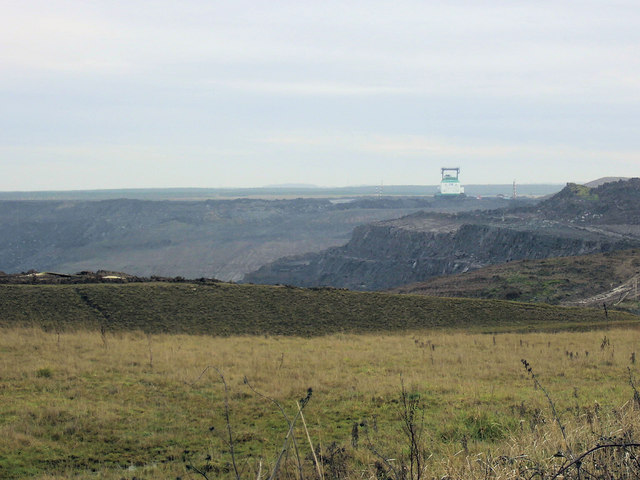
Ridley owns a number of active coal mines, most notably Shotton opencast mine and Brenkley lane. Shotton currently covers 342ha with 6 million tonnes of coal. It is still expanding: the latest extensions will yield another 550000 tonnes of coal. Brenkley lane is 244ha with 2.9 million tonnes of coal to be extracted. Other Blagdon mines, such as the Delhi mine, have already been worked out.
So, altogether Ridley is removing nearly 10 million tonnes of coal from his estate over the next 5 years. That equates to emissions of around 28.6 million tonnes of CO2, with around 900g of CO2 produced for every kilowatt hour of energy produced. I don’t know how much profit Ridley is making from his coal but it must be massive. To put this in perspective the UK produces about 3 million tonnes of coal per quarter, which equates to 60 million tonnes over a 5 year period. So Ridley’s mines are 1/6 of the entire UK coal production.
The Government estimated that the UK as a whole emitted 570 million tonnes of CO2 (including equivalents from other greenhouse gases such as methane and nitrous oxide) in 2013. So Ridley’s open cast mines once they are worked, will contribute the equivalent of 5% of the UK’s entire greenhouse gas emissions last year. As they are being worked over a five year period, we can roughly estimate that Ridley is responsible for 1% of the UK’s climate impact per annum.
Now of course Ridley is not himself using all the electricity produced from his coal – it is being used to provide energy for domestic business and industrial uses, including providing energy to our homes, so in that respect we must all take a burden of the responsibility for the CO2 his land is emitting.
And he might argue that if his land did not produce the coal, it would be imported from elsewhere in the world, or it might be replaced by coal with a lower energy density. Ridley also argues that as an advocate for gas, he is arguing against his own income stream. This is what he says on his website
“I have a financial interest in coal mining on my family’s land. The details are commercially confidential, but I have always been careful to disclose that I have this interest in my writing when it is relevant; I am proud that the coal mining on my land contributes to the local and national economy; and that my income from coal is not subsidized and not a drain on the economy through raising energy prices. I deliberately do not argue directly for the interests of the modern coal industry and I consistently champion the development of gas reserves, which is a far bigger threat to the coal-mining industry than renewable energy can ever be. So I consistently argue against my own financial interest.”
This is typical Ridley stuff and contains from dubious claims.
The UK Fossil fuel industry, according to the radical anticapitalists at the OECD, received £4.3Bn subsidy in 2011, including £85M for coal. As Ridley mines 1/6 of the UK’s coal, it is reasonable to assume that he received a sixth or £14M of coal subsidy from the UK taxpayer. In practice it may be smaller than this, as it will be shared out along the entire production chain from mine-owner to electricity producer, but it will still be a tidy sum – considering he is producing the most polluting fuel of them all and we are committed to reducing our greenhouse gas emissions by 80%.
As for his championing the development of gas reserves, he conveniently forgets to mention that one of the biggest gas reserves is sitting in unworked coal seams – and projects are already underway to extract gas from coal without removing it from the ground.
And while he claims not to argue directly for the interests of the modern coal industry he then says
“It’s the fashion these days to vilify coal as the root of all environmental evil, but I think that’s mistaken. Coal and the technologies it spawned made it possible to double human lifespan, end famine, provide electric light and spare forests for nature. Because we get coal out of the ground, we do not have to cut down forests; because we use petroleum we don’t have to kill whales for their oil; because we use gas to make fertilizer we don’t have to cultivate so much land to feed the world. This country can compete with China on the basis of either cheap labour or cheap energy. I know which I’d prefer.”
If that isn’t an argument in favour of the modern coal industry I’d like to know what it is.
It is not really that surprising that Ridley leads the way in climate denial in the UK: as a scientist (not a climate scientist but a biologist) he lends credibility to the likes of Lord Lawson (who was disastrous as a Chancellor), or the claque of climate denying journalists that include the likes of James Delingpole, Christopher Booker and Charles Moore. It is also worth noting that Ridley is profitting from the demise of the deep mine coal industry – an industry that was destroyed following a plan, The Ridley Plan, devised by his uncle – the Environment Secretary Nick Ridley.
As the modern day King Coal, one might suggest Matt Ridley has an extremely large vested interest in stoking climate denial.
Thanks to DesmogUK for starting me on this particular trail
Photo by George Hurrell [CC BY-SA 2.0 (http://creativecommons.org/licenses/by-sa/2.0)%5D, via Wikimedia Commons




 a new nature blog
Can we stop the 6th Great Extinction?
Here’s a longer version of the piece that has gone on Comment is Free today.
Scientists suspect we are entering the sixth global mass extinction. How can we tell, and if we are, what can be done?
The august journal Nature recently published Life – a status assessment. It’s a graphic portrayal of the vast number of species disappearing from the planet. This is difficult as scientists don’t know how many species there are, with estimates ranging from two to 50 million. Most taxonomic effort is focussed on a few groups – birds, mammals or amphibians; very few new species of birds or mammals are found these days. For fungi the situation is rather different; less than 50,000 have been named, out of an estimated total of 600,000 to 10 million species. The scale of the challenge is astronomical.
For those species we know about, the picture is grim: Globally, 41% of amphibian species are facing extinction; 13% of all birds are at risk as are 22% of flowering plants. For fungi, nobody has a clue as only between 0.05 and 8% of fungi have even been identified – to know something is disappearing it needs a name. IUCN, celebrating their 50th year, have a target to name 160,000 species by 2020. Developments in DNA analysis provide opportunities to “bar-code” nature short-circuiting the long process of traditional taxonomy.
It’s now possible to collect a sample of invertebrates from a forest, whizz them into a soup and send that off to a lab where species are identified by their DNA.
The reasons behind this mass extinction are manifold, but all stem from human activity. Humans are “the ultimate invasive species” spreading from Africa to every corner of the planet (and beyond) in 100,000 years. In doing so we have removed the habitats of other species, or affected them by moving other invasive species around, causing pollution and driving climate change. We do so at our peril, because humans came from nature and we utterly depend on it for our survival.
If it is possible to stop this mass extinction, humans need to take rapid and radical action. Here are five actions that I think will be needed:
1. Give places back to nature.
3% of the oceans and 15% of land fall within “protected areas”. In practice many of these offer no protection to nature: The Great Barrier Reef Marine Park in theory protects 15% of the world’s coral reefs. In practice, dredgings are dumped in the park to keep Queensland’s ports clear for shipping Coal, Iron ore and LNG. More protected areas are needed, and they need to be properly protected.
Coal carriers loading at Gladstone Harbour, Queensland, next to the Great Barrier Reef Marine Park. © Miles King
2. Change the way we view nature.
Nature is not another asset class to be traded on the world’s financial markets. Yet we see Governments and businesses keen to implement biodiversity offsetting, where biodiversity lost to development is “traded” through a type of money called conservation credits. Most would consider it heinous to develop a market in tradeable credits for children’s happiness – so why is it deemed acceptable to trade biodiversity? Humans have an absolute requirement for nature – for the food we eat, the oxygen we breathe, but also for the inspiration it provides, the sense of wellbeing, meaning, joy and solace it brings to us all. We need to develop new ethics that transform the values people ascribe to nature and the way we relate to it.
3. Our economic system is not capable of valuing nature
The neoliberal obsession with economic growth and profit is a major driver of this mooted global extinction. Gross Domestic Product (GDP) is the main way economists measure economic growth. Economists talk of “market failure”, when the external costs to nature of human activities are given no monetary value.
A farmer can grow a profitable crop of maize, ignoring the costs of cleaning up the nearby river contaminated with silt, nitrogen fertiliser and pesticides; or the homes flooded further downstream. These costs are externalised and are either not addressed or are paid by the taxpayer. Gross Domestic Product (GDP) counts the economic value of the crop, the cost of cleaning the nitrogen from the water and the cost of clearing up after the flood all as contributing positively to GDP. This is makes no sense on any level.
We need to radically transform the way nature is valued through economics.
4. End public subsidies that damage nature
Perhaps the largest causes of nature destruction in Europe over the past 40 years are the Common Agricultural Policy on land and the Common Fisheries Policy at sea. These have paid farmers to replace places rich in nature, with places almost entirely devoid of it; and paid fisheries to empty the seas. All this has been paid for by taxpayers. It is time to abolish the CAP and the CFP and replace them with systems that only support farming and fishing practices that either do no harm or actively restore nature. Practices that continue to cause unnecessary damage to nature should be taxed or outlawed.
5. Consumption, Population and Inequality
The planet cannot sustain our current consumption of finite resources and as our population expands, other species disappear. There is a near free market in the products of wildlife crime, in that the laws of supply and demand operate without much hindrance; the wealthy can afford to pay ever higher prices for poached products, such as ivory. Elephants have a right to exist, and their existence enriches all our lives. Yet the ivory buyers have no care for Elephants, nature or for society.
As wealth is concentrated in corporations and the top 1%, key decisions that affect the future of nature are left to a tiny number of individuals, who act neither in the interests of society, or of nature. It is also the world’s poorest people who depend most on nature, so their lives are most affected when nature is damaged.
In the long run nature will survive, as it has the previous five extinctions. It is we, Homo sapiens, who will join the myriad other species disappearing in this mass dying, unless we radically change our relationship with nature.
Share this: