With the funeral rapidly approaching on Thursday, I have now created a facebook page for everyone to post their memories of my brother Simon.
The link, as far as I can tell (being a FB newbie) is here .
Thanks
With the funeral rapidly approaching on Thursday, I have now created a facebook page for everyone to post their memories of my brother Simon.
The link, as far as I can tell (being a FB newbie) is here .
Thanks

Juniper – almost gone
While I may be painted by some as a reactionary fighting against the forces of progress (in the form of the re-wilding movement), I have been thinking about this stuff for quite a long time. Reading George Monbiot’s rant about the Lake District in today’s Guardian, reminded me that about 12 years ago I wrote an article for ECOS in the middle of the Foot and Mouth Disease Crisis. This was at a time when George was staunchly defending the smaller (upland) farmer against agro-industrial hegemony. How things change.
Here’s the article….
Any Room for Scrub?
As the Foot and Mouth Crisis stubbornly fails to yield to the Government’s containment policy it is timely to consider whether this is an opportunity to restore upland landscapes to a balance of habitats, including grasslands, heathland and scrub. Is scrub so bad?
Scrub – the very word strikes fear into the hearts of gentlemen, farmers and anyone who really “cares” about the countryside….Conservation Volunteers cut the nasty spiny stuff down to protect the last scraps of southern England’s former downlands from the ever encroaching tide. Meanwhile Lottery millions are spent clearing birch, gorse and pine scrub off lowland heathlands as part of the Tomorrows Heathland Heritage project. And all to the good – scrub encroaches onto land of high nature conservation value, such as unimproved lowland grassland, lowland fen, or lowland heathland and replaces a high value habitat with one generally of lower value for wildlife. It’s also true to say that in these contexts a small amount of scrub is a good thing – where would the Dartford warblers be without gorse brakes? Would the Duke of Burgundy butterfly disappear without the southern mixed scrub on limestone? With undergrazing as the main management problem of grazed lowland habitats at the moment, it is fair to consider scrub, having the upper hand, as in need of control. It may surprise some though to learn that lowland Hawthorn scrub may be an international important habitat in a European context (see JNCC report “The nature conservation value of scrub”). Incidentally, I sit writing this in the heart of the Dorset chalk, having spent time last year organising scrub control on downland SSSIs – and yes, since you ask, it is all growing back vigorously.
Amidst the sturm und drang that was the media reportage of the Foot and Mouth crisis, it was with little surprise that NFU officers were heard baying at the moon of scrub encroachment and land abandonment in the hills of Cumbria. More worryingly, Lake District National Park officers and National Trust Land Agents joined in this particular wave of scrub-induced paranoia, barking that the very ecology of the Park was under threat from Foot and Mouth – not the virus itself – the threat emanated from scrub growing as a result of a reduction in sheep, those beasts who toil tirelessly to maintain and protect the wonderful landscape of the Lake District. Where were the voices of English Nature, or the voluntary sector, stating that overgrazing – by sheep – was probably the most significant threat to the ecology of the Lake District – and that an increase in scrub would actually be of great benefit to the area’s biodiversity. Well, to be fair they were not heard this far south in the country, but no doubt they were heard at a more local level. The national media displayed all the naivety that one really expects these days, swallowing the NFU/MAFF (RIP) /agro-industrial complex propaganda hook, line and sinker. Step forward balanced reporting and….take a back seat for a while will you, just till the election….
As David Harpley mentioned in passing in ECOS 22(1) the Lakeland landscape Wordsworth knew was not one where the fleeced foragers were king, and billiard table grasslands dominated the fells. The Lake District was as much an industrial landscape as an agricultural one, with all the intricate mosaic of habitats and land-uses one would expect from so many competing land-uses. And of course it was a peopled landscape, not one where contemporary players of “Spot the Human” are rewarded only with views of kagoul-clad ramblers or struggling farmers, rounding up sheep on quad bikes, ready for slaughter. Those pre-ranching hills supported fell sheep (the famous hefted Herdwicks among them) and upland cattle and of course working ponies (industrial strength). They also supported coppice woodland and scrub. Scrub existed on those hills long before sheep, long before agriculture of any kind. Indeed, scrub had economic value, providing forage and shelter for animals, firewood for domestic and industrial use, bracken for bedding, fruit and nuts for food (especially during hard times).
Gradually, and with acceleration during the last couple of decades, sheep numbers have increased on the Fells at the expense of other habitats, particularly upland dwarf shrub heath, upland scrub and upland woodlands (for a detailed analysis see English Nature’s report “State of Nature –the Uplands Challenge”). This process has been driven by the CAP through the EU sheepmeat regime, particularly the Sheep Annual Premium Scheme (headage payments), which pays hill farmers to stock to ecologically unsustainable levels. The sheep nibbling has effectively transformed a mosaic of habitats into a vast area of species-poor acid grassland. No room for the Black grouse, which depends on heather moorland, and no room for Juniper, which is an integral component of upland scrub.
So, with Foot and Mouth now (mid-June) in decline until next Winter (?), with just the odd hot-spot flaring up here and there, and with MAFF consumed by DEFRA the new Department of Environment, Food and Rural Affairs (whither the urban/suburban environment one might be tempted to ask), is there the slightest chance that this opportunity to restore the Lake District to a more environmentally rich landscape will be taken? Probably not, is my undeniably cynical view. Scrub in general is not afforded the priority it deserves within conservation circles, so how can it possibly be given credence elsewhere? If the Lake District National Park Authority cannot appreciate that Juniper scrub is hanging by its finger nails in its last English stronghold, and continues to decline, thanks in the main to overgrazing by sheep, is there any likelihood that the situation will be reversed?
This could be a great opportunity to restore the upland landscape with a combination of low intensity pastoralism and habitat restoration. I am not arguing for a return to wilderness, wildscapes, wild land or natural land in the Lake District. My argument is for a tilting of the balance away from sheep ranching, through reform of the subsidy system. No doubt others will provide more detailed proposals for fundamental reform of the hill farming subsidy system (see Geoffery Sinclair’s article in this ECOS). Whatever these mechanisms may be, the outcome should be a significant net reduction in grazing pressure on the upland fells. Grazing is an essential component of the upland landscape, but the maximum gain (social and ecological) will come from a move to low intensity grazing by hefted sheep, hardy traditional breeds of cattle and perhaps ponies too. After all those consumers still eating meat increasingly want quality not quantity, and more of them than ever want their food to come from sources where ecological and social damage are not part of the product. And if all this means paying more for our meat, then we should remember the true cost of cheap meat on the supermarket counter.
What would we get with this reduced level of grazing? Well, one issue which will need addressing is the ubiquity of mat-grass Nardus stricta. This grass has benefitted from many years of intensive sheep grazing and has replaced much heather moorland, upland scrub, wetlands and other more species-rich grassland types. With reduced grazing pressure, mat-grass may dominate without intervention. Mechanical clearance or controlled burning may be necessary in some places. Elsewhere, where dwarf shrub heath still persists, and in rarer cases where juniper scrub survives, these habitats should slowly return on their own. Juniper seems to depend on changes in grazing pressure (such as Myxomatosis in the 1950s) to provide opportunities for seedlings to get established; germination and initial growth of seedlings depends on grazing to create a short sward, but seedling and adult junipers suffer from damage and often death by being browsed and grazed (Wilson and King, 2001).
All this restoration will create employment and require funding. Perhaps the farmers who will be looking to leave sheep farming, or reduce their flock sizes could be funded through the rural development programme to work with the National Park Authorities, English Nature and the voluntary sector on this large-scale habitat restoration. These are the people who have the greatest local knowledge, who know where the best sites for habitat restoration will be and the techniques needed for that restoration.
While the heartbreak of the mass culls, pyres and families losing their livelihoods will love long in our memories, this will hopefully prove to be a turning point where upland landscape restoration starts, with a little bit of scrub.
Bibliography
Mortimer, SR, Turner, AJ, Brown, VK, Fuller, RJ, Good, JEG, Bell, SA, Stevens, PA, Norris, D, Bayfield, N & Ward, LK (2000). The nature conservation value of scrub in Britain. JNCC Report No. 308. © JNCC, Peterborough 2000 ISSN 0963-
English Nature (2001). The state of nature –the upland challenge. English Nature, Peterborough.
Wilson, P and King, M.P. (2001) A report on progress with implementation of the Species Action Plan for juniper Juniperus communis during 2000-2001. Plantlife, London.

The Feral Shore
I have promised myself, and some of you, that I would write a review of Feral by George Monbiot.
I enjoyed the book, at least in parts. Although I will try and refrain from Ad hominem criticism (which Monbiot is clearly sensitive to given his wounded reaction to Aggie Rothon’s review on Mark Avery’s blog), I do feel that comment on the style of the book, as well as its content, is justified. Especially when Monbiot uses “celebrity” quotes from people who have no idea of the validity of his arguments, to sell his book.
Monbiots early book “Poisoned Arrows” had a profound influence on me, as I read it at the time when I had chosen to make conservation my life. On first reading I enjoyed Monbiot’s Feral forays into his colourful past (dangerous mining camps in Brazil, living with the Masai in Kenya), coupled with his breathless descriptions of battling the elements (and grey mullet) in Cardigan Bay. But on reflection, it struck me that these were the writings of someone perhaps going through a bit of a mid life crisis, wanting to rekindle his youthful adventures. I concluded that George was “raging against the dying of the light” and projecting his own awareness of the inevitabilty of age and mortality, onto the ultimately fateful (and fatal) relationship between humanity and the rest of nature. In a way I wish he had explored these feelings in a more philosophical way, rather than channelling his anger and frustration against sheep. Poor sheep – as any sheep farmer will know, they need no encouragement to kill themselves in imaginative ways. I hope they don’t read George’s book.
Although I understand Monbiot’s intention in interspersing his tales of derring do, with the meatier content of his argument, I think they are a distraction. They also seem a bit macho to me, and I was thinking about skimming through the book again to see how many women he had spoken to or quoted from conversations with, in the book. I don’t think there are any. And this reflects the nature of his argument. Monbiot is clearly a hunter at heart, though he rightly decries the mass conversion of uplands into hunting domains for grouse or deer. I think it’s clear from his prose that he loves the thrill of the hunt and the kill – and I am certainly not criticising him for that. His realisation of “ecological boredom” supports this view that he needs stimulus, of an extreme kind – an adrenaline junkie perhaps. This comes through in his style, but I don’t think it strengthens his arguments. Of course there is nothing wrong with using emotion when making an argument, but only when your philosophical basis is robust.
And this is where I have a big problem, because there is a great contradiction at the heart of Feral. On the one hand the overwhelming philosophical basis for Monbiots srgument is that nature should be left to itself – the notion of self willed land (which he has developed into a “self-willed land lite” on the back of a great deal of thinking by Mark Fisher) implies at the very least that the land – however that concept may be constructed (for of course it is itself a construct of the human mind, as far as we can tell) chooses its own path, and anything we do is causing it to stray from its own path. That places humans in the position of observer, which is demonstrably untrue – especially given our impact on the world, over the past 50,000 years.
On the other hand though Monbiot takes up the opposite position, in that he advocates the introduction of extinct species in order to make the land more natural, but by doing so he breaks his own tenet, and denies the self-willed nature of the land. It”s not as though he is talking about reintroducing species that have only become extinct in recent centuries – such as the lynx or wolf. No – he is suggesting, I think in all seriousness, that Elephants should be “re” introduced.
Elephants, if you discount the Mammoth, last occurred in Britain over 100,000 years ago in the last interglacial. Not only this, but the species that occurred here, The Straight Tusked Elephant, is globally long gone (about 40,000 years ago) and there isn’t really anything equivalent around now. This species of elephant was enormous, bigger than the African Savannah Elephant, yet it is thought to have been a forest dweller, though this is more speculation than anything else. Whatever, Monbiot isn’t at the moment suggesting we should reinvent the Straight Tusker, but instead is opting for introducing a proxy, the Asian elephant. This tortuous and ultimately academic argument has taken Monbiot from the position of advocating no human intervention for nature at all, through to introducing a species of mega fauna that has never been native here, because it’s the closest equivalent to a species that was native but has been not been here for over 100,000 years.
Why has he got himself into such a knot? Because he believes that megafauna are the panacea to the future of nature in the UK. He has adopted this position in part because of the theory of Trophic Cascades. Trophic Cascade theory tries to show how by removing apex species, usually predators, causes populations of others species lower in the food chain to grow, to the overall detriment of the whole ecosystem. This theory appears to have some similarity to reality in marine systems. In terrestrial systems, the cause celebre is the reintroduction of wolves into Yellowstone National Park. The Wolves, through creating a climate of fear, have caused deer populations to alter their behaviour, leading to regeneration of forest. All well and good. However, Trophic Cascade theory has never been applied to European ecosystems, let alone those modified by millennia of human activity. Furthermore, the Yellowstone example is only partially complete, because there was another hunter present in Yellowstone for at least 15000 years, namely humans. Has there been any work investigating the impact on the ecosystem of removing human hunting activity from Yellowstone? If there has, Monbiot has ignored it.
I think there is a cognitive bias operating here. On the one hand wolves, bears and elephants are somehow given a talismanic status – that by bringing them back, some lost magic will be returned to ecosystems. But human activity, even activity precisely on a level with that of megafauna (ie hunting) is denied legitimacy as part of these ecosystems. And farming – well that is portrayed as The Fall from an Arcadian paradise, if you’ll excuse me mixing up ancient mythological tropes.
This megafaunaphilia is common amongst conservationists. Look at how much support charities working on conservation of megafauna receive, compared to the little things. WWF bring in millions every year with heart rending stories about Tigers and Pandas. `Consider how much support organisations working on algae or fungi, or detritivorous invertebrates receive – these are the true ecosystem builders. Even plants are generally ignored unless they are trees – totemised by the cult of the megafloraphiles.
Monbiot has turned this on its head, arguing that Trophic Cascade theory shows us that we can restore our damaged ecosystems by inserting the right megafauna, or their proxies. Unfortunately the truth is more complicated, complicated by the 6 millennia of agricultural land-use, and several millennia of previous landscape management for hunting. It wouldnt matter how many wolves or elephants were brought back, if the soils and water that all terrestrial ecosystems depend on are loaded with nitrogen and phosphorus, artifically drained or poisoned with persistent biocides. These chemicals fundamentally alter soil properties, preventing fungi from interpolating between soil chemicals and plants. The Wolves would have no influence over such relationships.
Equally, in the uplands, millennia of peat formation following Neolithic (or even Mesolithic) forest clearance, mean trees with large roots cannot get established. The Forestry Commission discovered this when they set about converting the uplands into tree factories. They had to invent special ploughs to plough through the peat, and create ridges where mineral soil was dry enough to plant trees. And then added fertiliser. Natural regeneration on peat soils, leads to deep bracken litter, then shallow rooted trees like birch. This is as close to the Wildwood, as Disney’s Snow White is to Macbeth. More likely is that introduced species that can cope with the conditions would prevail, such as Rhododendron and Gaultheria. But if the land is self-willed, surely it has chosen these species and who are we to remove them? Once again the contradiction at the heart of the thesis pops up.
I actually agree with Monbiot that the uplands are generally denuded and we should reduce the grazing pressure considerably. However, I would argue that this should be done in order to improve the quality of High Nature Value upland farmland, which always was dynamic and depended on a mosaic of open habitats, scrub and upland woodland. We should also not forget the significant impact that industry had on the uplands in past centuries – Dartmoor is a classic post industrial landscape, covered by the remnants of Tin workings, not a wilderness. The Lake District and Peak District are both pock marked with mineral workings for lead, arsenic and other toxic metals. These workings have given rise to extraordinary wildlife communities, surely worthy of conservation, as testament to the history of people working the land, and natures resilience to their impacts. When I read about how Wind Turbines are despoiling pristine upland landscapes, I find it depressing that so-called intellectuals can have so little understanding of the dynamic nature nd history of our landscapes.
I also sympathise with Monbiot’s railing against conservation orthodoxy/dogma. We have got ourselves into a pickle with SSSI conservation objectives, features of interest and condition assessments. And yet it is also true that the legislation that has spawned this bureacracy has been at least partially successful in preventing even greater losses of wildlife that would otherwise have occurred. Similarly the bureaucracy that has mushroomed around the Biodiversity process has strangled what ambitious vision there might have been 20 years ago, and we do all need to look again very deeply at what we are trying to achieeve.
Having said that, the idea that we should just forget about trying to conserve the biodiversity that we have got (or have recently lost) and concentrate on creating a new/old “back to the future” facsimile of the Lost World of the Mesolithic wildwood, does not strike me as an improvement – actually its a distraction.
Thanks to the Biodiversity Convention, now over 20 years old, every country now recognises that it has a responsibility to conserve its own biodiversity, and also to reduce impacts that its activities have on other countries’ biodiversity. We just have to accept that, thanks to history (human and climate), we don;t have much biodiversity in the UK. I have written previously about a conservation cringe, that there is a sense of shame that we have so little native biodiversity.
Should we should just forget about it – that somehow it’s the “wrong” biodiversity? Well if that’s the case, who decides what is the “right” biodiversity. I guess Monbiot thinks he does. And again by placing himself in the position of a Roman Emperor, choosing by the wiggle of his thumb, which nature survives and which dies, he denies the self-willed nature of the land he professes to advocate.
But this is a problem for conservation beyond George’s own predilections. Farmers choose which nature they want on their land – these days it seems to be mostly wildbird and pollinator mix helping RSPB find homes for cuddly nature. Conservationists choose which particular taxa they like and work furiously to conserve them, sometimes in opposition to other groups conserving things with the opposite needs. There is a desperate need for an integrated approach that all can sign up to – sadly conservation in England at least, under extreme pressure, seems to be balkanising at the moment.
Monbiot does belatedly recognise that there is value to conserving the vestiges of our wildlife-rich agricultural landscapes, though he would rather we call them cultural reserves, not nature reserves. I think he has a point, we do need to recognise that the nature we are trying to conserve is all semi-natural and we should celebrate that fact. Because the semi-natural is the creation of humanity interacting with the rest of nature – recognising this will do far more to bring people back to valuing nature, for whatever reason: creating new “self-willed land reserves” on some Welsh mountain will just further emphasise the self/other divide between people and nature, that predominates in our post modern neoliberal world. However, what is clear now is that nature cannot survive for any length of time in small isolated islands of semi-natural habitat, in a sea of intensively managed lowland landscape.
But Monbiot seems to be looking at conservation through the wrong end of the telescope, criticising mindsets that predominated 30 years ago. He decries Landscape Scale Conservation, as more of the same ( but bigger) while the re-assessment of priorities that the BAP created seems to have passed him by. This is perhaps not surprising, given his starting point is work by Clive Hambler which was written over 20 years ago. Things have moved on.
And yet there is so much nostalgia operating within conservation – nostalgia is something the British excel in, especially the English. We have to remember where we came from, without seeking to ape it. Processes that created landscapes that we now value for their wildlife – whether it be traditional agriculture, woodland management, or small scale industrial activity (including in hte 20th century) have mostly long ceased. We cannot create any new brownfield habitat because of sensible laws about preventing toxic industiral waste products from entering the environment. Where will the species that depend on brownfields go in the future? If ever there was an example of self-willed land, brownfields rich in wildlife are it. Yet now we have to prevent succession in order to keep these sites suitable for the vanishingly rare open habitat species they support. Should we just forget about them?
Ultimately nature will continue long after humanity has become extinct or evolved into something else. It is typical human hubris to think otherwise. It is us that depend on the rest of nature, not the other way round. We need to value and celebrate our relationship with nature, bring nature into our lives, without feeling the need to make homes for all nature. We need to re-engage with nature, not distance ourselves from it. Re-wilding adventures are humans interacting with nature in another way. I like them and I think there should more of them – but not instead of conserving nature where it is now and findings ways to create places where it can flourish in the future.
My friend, Simon King
It must have been about twelve years ago that I first met Simon, I was an Area Bailiff for RMC Angling and I had been asked by Ian Welch (the then Boss) to check a few permits, this could be anywhere within the then RMC portfolio of waters.
And it just happened to be on the confluence between the Old River Lea and the Relief Channel, where I decided to do a quick ticket check.
It was raining if I remember rightly and Simon had set up his umbrella so that I had to tap on the top, to ask to see his ticket?
Simon was on a “high” when he told me he had just had a 6lb Chub, a new P.B. and I was less than diplomatic when I replied; there are loads of 6’s in here mate, that of course was before the big fish kill.
Some where there is an article that Simon wrote, in which my statement upset Simon a little bit, it was not meant too, it was an honest statement of the huge populations of Big Chub and of course Barbel then in Fishers Green at that time.
It started raining harder and as the rain got heavier I settled under his umbrella and we had a long chat about the Chub and Barbel that lived in the Old River and the Relief Channel.
Through our initial conversation I explain that I was in the RMC Specimen Group as Records Officer, which was about to be disbanded and we were starting up a new group called the Osprey Specimen Group.
Over the next few months we chatted quite a lot and Simon seemed keen to join Osprey, I put it to the committee that Simon King would be just the sort of angler we needed within the group.
And so it proved, Simon had the mental fortitude to do the time, endure the blanks and put up with the ribald comment about lack of fish on difficult waters.
He was also willing to listen and learn; to take on board what more experienced anglers said, but not just accept it as gospel, but sit down and analyse it, then put his own spin on it.
Simon was every inch the old fashion Specimen Hunter and becoming a very competent angler at catching big fish.
He was not one for following current fashions; his fishing tackle had to do the job, but if a £10.00 Dragon rod did the job or a Badger umbrella kept you dry, why pay any more?
Simon and I became good friends, we fished together for many species and we pooled our knowledge, Simon became a good friend and joined me at my 60th Birthday party and lots of parties we had at our house over the years.
I have suffered from a bad back for years and more recently a Heart Attack which required a triple bypass, but Simon was always there to ferry me and my tackle around in times of need.
Our first serious campaign together was at Jerry Hammons Carthagena fishery, where we targeted the River Lea Zander.
We had a great couple of years on this venue, but just could not manage a double; I ended up with a 9lb 4ozs Zander and Simon had a 9lb 10ozs Zander.
He of course went on to catch a 15lb 5ozs Zander from the Wyboston complex, a brilliant effort where big fish don’t come that easily!!
Simon built up a reputation as a very good Barbel angler at Fishers Green, where he used single/double maggot, very small hooks and fluorocarbon hooklinks to great effect and caught a large amount of fish, both in darkness and in the daytime.
Simon also became a valued member of the Fishers Green Bailiffing team and was held in high esteem both amongst the bailiffs and the members who fished the Green, ever helpful and courteous.
And then there was Landridge, many so called Carp anglers looked upon Simon as some poor lost soul, who fished with non matching rods, small baitrunner reels, a tatty cheap umbrella and decidedly dodgy bedchair.
But Simon heeded advice from some very good Carp anglers; he had good watercraft, sound carp rigs that worked and some very good bait made by Kevin Wilkinson of All Season Bait Developments.
On top of this he was prepared to do his time, over the years he learnt the water well, listened to anglers who had been successful there and the ways of the Landridge carp, he kept his capture quite, no bad thing in the modern age of Carp fishing, his last close season carp fishing on Landridge produced 6 carp, some so called Landridge carpers have never seen 6 Carp from Landridge.
Having photographed most of Simons carp, I’m sure he will not mind if I recount a lasting memory of one of his captures.
Simon had caught another 30ty and kept it in the landing net to await my arrival for the celebrity shots.
Si; I said, it’s a bit lively mate?
It will be okay he replied, are you sure said I?
Well we get everything ready and he lifts the Mirror Carp onto the unhooking mat.
I get ready with the camera, Simon lifts the Carp from the net and in one swift movement it’s off the unhooking mat and back into the lake, I follow the action through the viewfinder and have a prefect picture of my mate on the floor, arms outstretched waving goodbye to a Landridge Carp.
It’s at moments like that you don’t know what to say?
I put away the camera, we had a cup of tea and I left the scene, we laughed later, but at the time what can you say.
Simon and I did a lot of Piking together on Landridge and it was Simon who had the twenty pounder, we also went Chub fishing every autumn and winter, Simon preferring the Relief Channel to my wonderings around the Lea Valley venues.
And we caught a good number of 7s between us, but that “8” eluded us both.
Try as we liked the “8” never seemed to come our way; Simon had come the closest with a 7lb15ozs Chub, a monster, but not the 8 we so much desired.
That of course was until this year; we had started our autumn campaign just below the confluence, but could not locate any of the bigger chub, Simon decided on a change of locations, it’s never easy finding the big chub on the Relief and to start with it was smaller Chub that came Simon’s way, 3, 4, and 5lbders.
I chipped in with 6lb and 7lb Chub, on the second of January 2013; I got that long awaited phone call from Simon.
I’ve done mate?
How Big I said, Si replied, it’s Huge!!
I picked up my old friend and fellow Osprey member Ray Taylor on the way down to the Relief Channel and we were privilege to witness the weighing of the current Chub Record holder at a slightly lower weight of 8lbs 14ozs.
A fantastic effort from Simon for ten years of hard work and worthy of the current Osprey Salver holder for the best set of fish recorded in 2012.
Simon was not feeling too well by then and decided to have a bit of a rest from Chub Fishing in the exceptionally cold weather of last winter, but after a month he was back for one last go on the Relief Channel to record his second “8” at 8lb 6ozs, a completely unknown fish to us.
I kept going on the channel and finally got my biggie, although Simon was not very well, he came out to weighed and photographed the Chub for me, I will always be grateful for that and the memories of the Chub we caught together in types of weather.
Simon was on the Osprey Specimen Group committee, a valued member of the Osprey and the Groups Records officer and was also compiling a book written by the Past and present Osprey members.
Simon was a well respected angler, not only in Osprey but the wider field of fishing, he often appeared in the angling press with captures of huge fish, writing articles for a number of well known angling websites.
Fishing wise we shared so much in a few short year and as with his fishing, Simon was determined to fight this dreadful disease of Cancer.
He fought it bravely, with dignity and courage, a battle that only lasted 6 months; he will be sadly missed by all who knew him.
On a personal level; I will miss him terribly, he was a good friend who could be trusted and likewise he trusted me.
Now when I fish the Lea, the Ivel, The Relief Channel or one of numerous places we fished together, I will think of Simon and remember him; oh so fondly, like I’m sure many others will.
Bob Hornegold
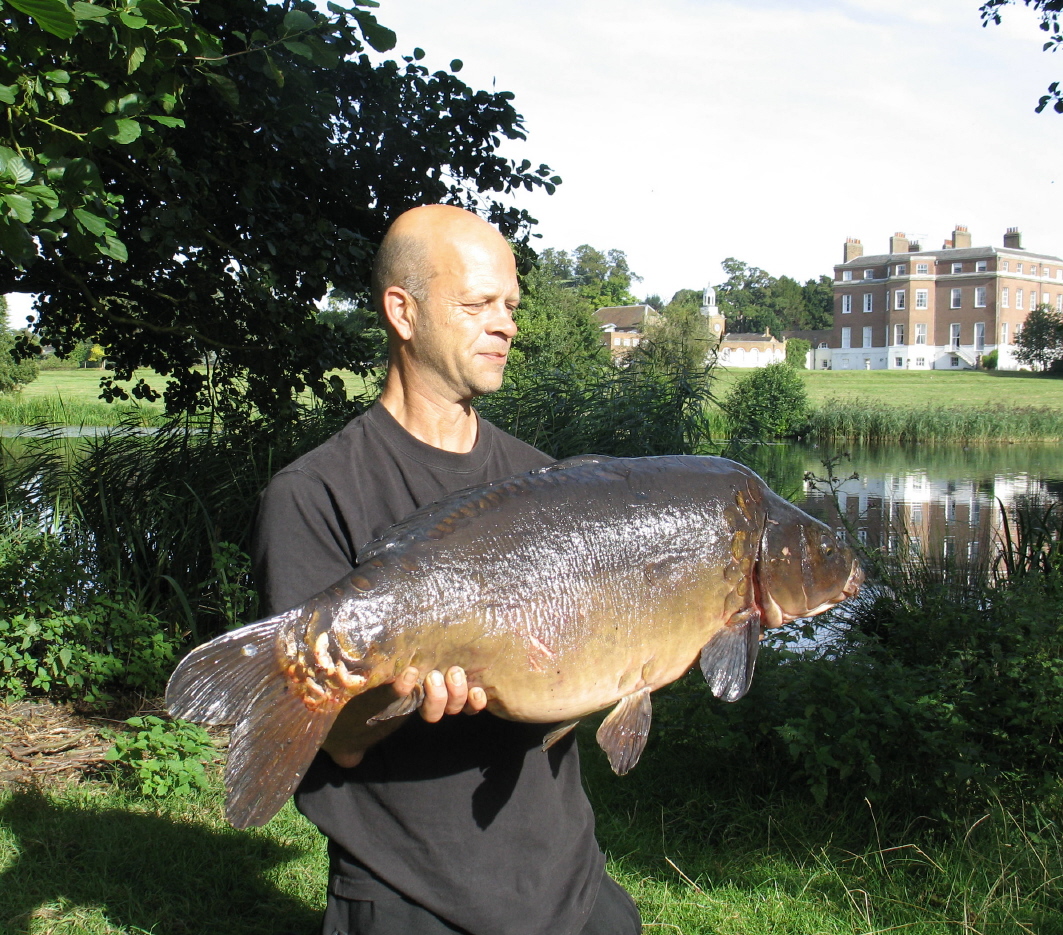
Simon with a 32lb Mirror Carp he caught in Hertfordshire.
My older brother Simon King died yesterday. Simon was 52 and had been suffering from lung cancer. In the end it took him very quickly and he was in no pain, which we have to be thankful for.
Simon was well known and much admired in two separate fields – coarse fishing and reptile keeping. Simon was by all acounts an exceptional angler, and a member of the Osprey Specimen Group.
In January this year he was on the front page of Anglers website Fishing Magic and in Anglers Mail when he landed a massive 8lb 14oz Chub.
Simon was also well known for his expertise in exotic pets, especially reptiles. Simon had been keeping snakes as a hobby for many years, and gradually became an expert in them, including breeding snakes. Simon had his own exotic pet shop in Palmers in Parkway Camden in for nearly 10 years. When Palmers closed he opened his own shop Kings Aquatic and Reptile World in Mornington Crescent (a joke not lost on him as a keen fan of I’m Sorry I haven’t a Clue). His shop became a popular place for people interested in exotic pets to congregate and it was also used frequently for filming.
Before Simon entered the world of exotic pets he was an accomplished bass player in a number of bands some of which nearly broke through – the last one being The Keatons. I think after the Keatons he got disillusioned with the life on the road and decided to concentrate on Reptiles and Fishing.
Simon was a very talented sports player at school and also excelled in music, playing cornet and piano.
Naturally siblings have rivalries, but I admired Simon greatly for his independent spirit and his total refusal to compromise or adopt an orthodox life. When he was interested in something he did it exceptionally well and gave it all his considerable focus and intellect.
I am going to set up a facebook memorial page for Simon so anyone who knew him can post memories, anecdotes, photos or anything else on there.
So it seems that having successfully killed off the valiant attempts to get the Common Agricultural Policy reformed so it provides Public Goods for Public Money, The National Farmers Union is now campaigning to to ensure that the UK government modulates as little as possible of the CAP pot back into Rural Development, part of which is for the Agri-Environment Schemes.
This is how it works. The UK gets a pot of money from Europe (paid for by Europe’s taxpayers and no-one else) to pay farmers – the biggest surviving public subsidy of industry left in Britain. Though I suppose Shale Gas might be a competitor for this dubious crown before too long. The pot is over £3 Billion pounds a year. That would pay for a lot of nurses or teachers.
The pot of money is basically divided into two – the main bit (say 75%) is just given to farmers as Single Payment, with effectively no strings attached – indeed some of the strings actively work against provision of Public Goods (see GAEC 12 below).
The other bit is for “Rural development” which includes Agri-Environment Schemes. Most of the AE money went into the Entry Level Scheme in the last CAP. This was generally agreed to have been money for old rope and provided remarkably little public goods return.
The Single Payment money is handed to landowners who have farmland. Mind you only some farmland is eligible. Farmland that is really valuable for nature for example may well find itself excluded from being eligible for CAP money – because it’s not productive enough. Yes the CAP pot pays out preferentially for intensive farmland management. Land with scrub for example is not eligible – the scrub areas have to be individually mapped and excluded. If your hedges are too wide – you get a cut in your single payment – even a fine. GAEC 12 requires farmers to cut scrub and top vegetation – the aim is actually to prevent flowers from flowering. It really is true.
New rules will make it more difficult for landowners farming with nature in mind to claim it – these rules are still being sorted out, but include a definition of Active Farmer, which may exclude part-time farmers, and even charities like Wildlife Trusts, RSPB and the National Trust. Another rule will place a minimum area threshold for CAP payments, so small parcels of land will not be eligible. This will remove a vital funding source to help support the costs of managing small fields that will otherwise be abandoned.
Then there is Greening – this was going to be the way that Single Payment was going to deliver some environmental benefits. The idea was that a proportion of the single payment Sadly, thanks to organisations like the NFU, the greening element has been watered down to such an extent that it is literally greenwash, only there’s no green at all, so it’s just whitewash. Thanks to the threat of greening though, hundreds of hectares of permanent grassland, some of it with wildlife value, all of it containing around 100 tonnes of carbon per hectare, has been ploughed.
Which brings me back to Modulation. This allows EU member states to recycle up to 20% of the Single Payment pot back into Rural Development, and actially provide some Public goods back to the public who is paying for the Farmers subsidy. Uncontroversial you might think – not a bit of it.
The National Farmers Union is waging another of its highly effective campaigns touring the country whipping up a frenzy amongst the farming community, getting its members to lobby their MPs (they are very good at doing that) to reduce the amount of Single Payment to be modulated back into Rural Development, including Agri-Environment Schemes. Their argument is that CAP money should only be spent on things which are good for the rural economy. The NFU mantra is that only farmers know best how to spend CAP money. It’s almost as though they have a divine right to the money (even though we pay out to them). Entitlement is the watchword.
The NFU complain that Rural Development payments don’t flow directly into the Rural Economy in the way that Single Payment does. As if cashflow was a public good in itself.
Defra is launching a consultation in the Autumn to garner views about how much of the CAP pot should be modulated to provide Public Goods. I have no doubt that there will be many submissions from farmers, decrying the waste of their money. It behoves on the rest of us to do the same – and ask why taxpayers money is being spent to support private profit.

I got an email from 38 Degrees – I think I must have joined in with one of their e-campaigns – possibly the Forestry one. The email was about the Transparency of Lobbying, Non-party Campaigning and Trade Union Administration Bill.
This bill will make it a criminal offence for a charity or campaigning organisation to raise money to wage a campaign or even just do some publicity on an issue which could be construed to be political, within one year of an election – a general election, a european election and council election. Since elections are going on all the time this could equate to a permanent ban on public political activity by charities and other campaigning organisations.
I have just written to Chloe Smith, the Parliamentary Secretary (Minister for Political & Constitutional Reform) who has been tasked with getting this appalling piece of legislation through the house.
here’s my email:
Dear Minister,
I understand you are responsible for the passage of the Transparency of Lobbying, Non-party Campaigning and Trade Union Administration Bill through the House of Commons. I have read, with increasing disquiet, from a number of different sources, that this Bill if made law will make it far more difficult, if not impossible, for Charities and campaigning organisations, to seek to influence Government policy and legislation – particularly through publicity campaigns.
The voluntary sector has a long and distinguished history in England of shaping public opinion, policy and legislation to the benefit of society. Charities and campaigning organisations work to influence opinion and policy in ways that are open and transparent, unlike commercial lobbyists. Moreover, charities and campaigning organisations are motivated to effect change for the benefit of society, rather than for purely financial motives, as is always the case with commercial lobbyists.
This Government has claimed it believes in “the Big Society” and the power of the voluntary sector to make society better. Why then is it planning to criminalise activities which have brought about such benefits to society as animal welfare legislation, environmental protection legislation, legislation that has cleaned our air and water, legislation that has criminalised child exploitation, and legislation that has brought about a move towards equal rights for men and women, ethnic minorities, and disabled people?
Yours sincerely,
According to Wikipedia Chloe Smith is an active volunteer for Cancer Research UK and Sport Relief. So presumably she appreciates the value of the Voluntary Sector.
If you think Charities and campaigning organisations in the third sector should be able to continue to influence policy and legislation please write to her too. Her email is ‘chloe@chloesmith.org.uk’.

Dear Reader,
you might have been wondering why there have been no new blogs since the 5th August. I have been on an unscheduled blog break – I may have Bloggers Block.
Work has intervened, in a good way – so I have had less time to write. But the main reason is because my brother is very ill with terminal lung cancer, so we have been up to London to see him and he is very much on our minds every day. We have been trying very hard to get him out of hospital into a good care home, and I hope with all fingers crossed that he will be moved today or tomorrow. I may write about the experience, or I may not. It rather depends on what happens and how I feel about it afterwards.
I think I have also got a bit stuck with the blog and the main reason for that is that I feel an obligation to write a review of George Monbiot’s Feral, but I have no enthusiasm for finishing reading the book – which I need to do to write the review. This is no criticism of George, and I did read through and comment on a draft for him about this time last year. I think it’s partly because when something major happens in your personal life, it puts academic debates about the nature of conservation or rewilding into perspective – they all seem rather less important than they did.
Anyway at least I did manage to get out for a walk when we were up in London and was bowled over by the spectacular display of wild marjoran, clustered bellflower and a hundred other chalk downland plants on the Gallops at Box Hill Surrey, where I took the photo. Good work National Trust.
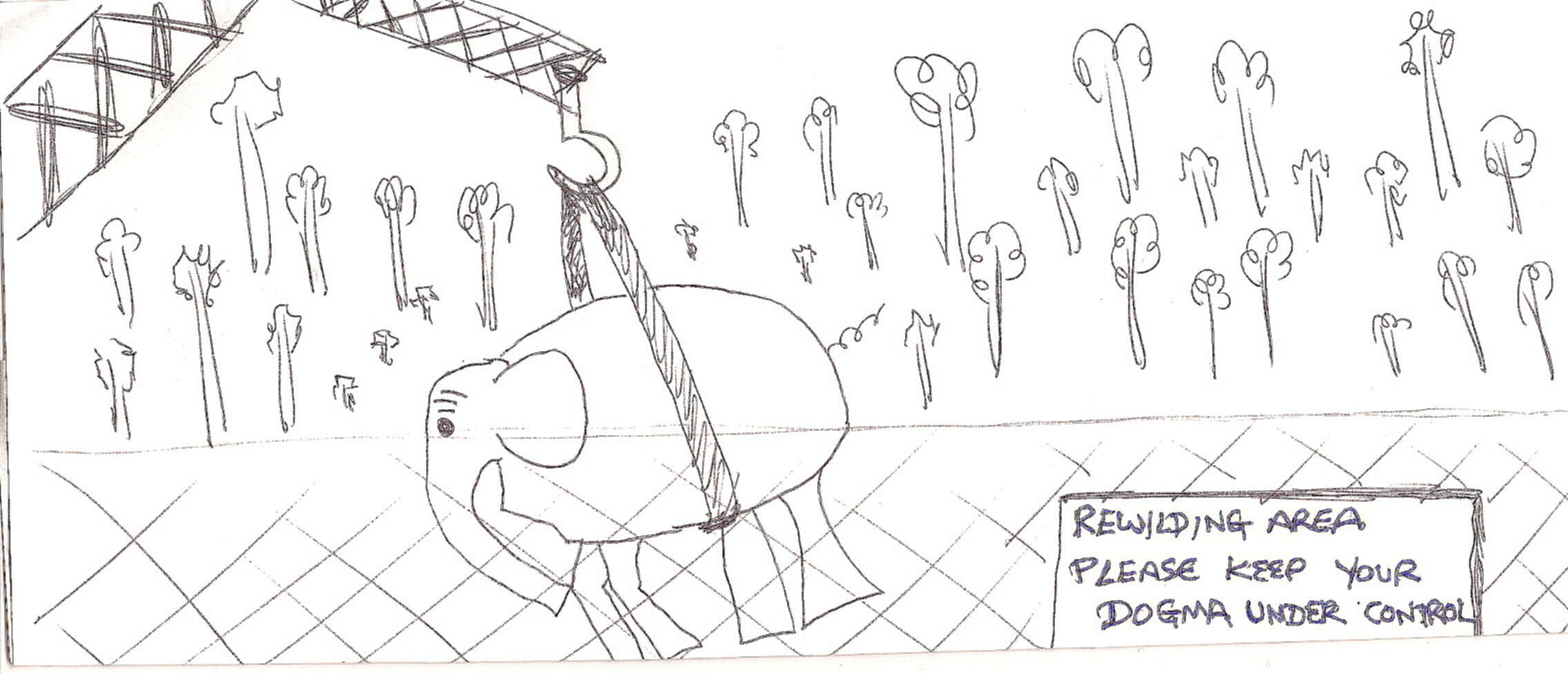
my first cartoon ever! and possibly my last.
I haven’t posted much this week as work and personal life have intervened. But I have been doing a lot of thinking.
I’m still struggling with the idea of Self-willed Land. I struggle to get off the mark, to be honest. The idea of self-willed land is a human notion, we impose that notion on the land. But going down this route means self-willed land automatically ceases to retain its meaning of “beyond human control”. The only way out of that conundrum is to place us in and of the land. In which case our interventions on the land are also of the land, just like any other ecosystem engineer species.
It reminds me of that scene in Life of Brian: “You’re all individuals”, shouts Brian to the crowd. “Yes, we are all individuals”, shouts back the crowd in unison. Apart from one person who says quietly “I’m not.”
Leaving that problem aside, what happens when we introduce a species as part of restoring self-willed land? Say – an elephant. I personally love the idea of introducing elephants into the British countryside. I think re-introduction is probably stretching that concept to breaking point for elephants, since both of the most recent species are extinct – woolly mammoth would not be too happy in our current climate, and Straight-tusked elephant hasn’t been here for over 100,000 years before it went extinct on mainland Europe around 40,000 years ago. George Monbiot in Feral suggests Asian elephant would be the closest fit, but I think African Forest elephant would be better – possibly the pigmy forest elephant. It might go down better with landowners.
But we can’t get away from the fact that once again we are ignoring the will of the land, by introducing a species which has not introduced itself. Introducing a species of any kind can have a profound impact on the ecology of an area. Look at the impact of signal crayfish, or grey squirrel. But attitudes to introductions change – and now we value ancient introductions like brown hare, cornflower and so on. So introductions might be good or bad (and we cannot tell until it’s too late), but whatever their impact, introduction is a human act and at odds with the notion of self-willed land.
Back to elephants.
African (and indeed Asian) forest elephants are amazing creatures, real ecosystem engineers. They create and maintain a large scale network of paths and forest clearings (known as Bai’s) in the African rainforest where they survive. Bai’s can be very large and numerous, and are thought to play a key role in elephant social behaviour.
In the 300,000ha of Nki National Park in Cameroon, 73 Bai’s have been found so far, the largest approaching 10ha. These Bai’s play an essential role in the functioning of the Forest ecosystem, especially for large mammals. They often occur where minerals are available (also known as salt licks) to aid digestion by large herbivores of toxic plant material.
African forest elephants also play a key role in dispersing the seeds of many species of trees that are found in the West African rainforest. I wonder whether some of the species only now found in British ancient woodlands with no obvious dispersal agent, such as Herb Paris, Spurge Laurel or Mezereon, were originally dispersed by elephants.
There is some evidence to suggest that Straight-tusked elephants were hunted to extinction in Europe by paleolithic hunters: others suggest climate change. Whatever the cause, Straight-tusked Elephants failed to recolonise Britain at the end of the last glaciation. This means that there was no ecosystem engineer species of large herbivore in the Mesolithic to create the patchwork of clearings and permanent large tracks that would have been there in previous interglacials. Indeed there is some evidence to suggest that in previous interglacials, Straight-tusked elephants modified forest landscapes sufficiently to transform them to savannah, in the same way that African Savannah elephants do today. The Mesolithic Wildwood, for however long it really existed before significant human modification, grew up without its main ecosystem engineer – it was a shadow of its previous incarnations.
Straight-tusked elephants were about 4m tall at the shoulder, compared with African Forest elephants that are around 2.5m tall at the shoulder. Simple scaling up would indicate that forest clearings created by these extinct behemoths would be around 2.5 times larger ie 25ha.
So on this basis, by maintaining open areas of this sort of scale, far from being ecologically illiterate, conservationists are merely acting as the lost elephant in the room.
 | navasolanature on Poundbury Nature for Wellbeing… |
 | Alex Tylor on ‘Look but don’t pick’ – Wild M… |
 | AllRoundNature on Will Prime Minister Truss aban… |
 | Peter Lancashire on The true story of David Camero… |
 a new nature blog