Rochester byelection; Both UKIP and Tory candidates convert to defence of Lodge Hill

The Rochester and Strood byelection is shaping up to be one of the most significant moments in British politics for many a long year. While Douglas Carswell’s victory at Clacton was long anticipated, if Mark Reckless wins next week, the shock waves will reverberate not only through the Tory party, but Labour too.

Somewhat surprisingly, the fight for the future of Lodge Hill has become a key piece of the byeletion battleground, but in unlikely and bizarre ways. As regular readers will know I have written copiously about Lodge Hill, here, here, here, here, here and here.

Reckless U-Turn

Mark Reckless, as I have written  before, was staunchly in favour of the Lodge Hill development, to the point of making a strident speech in the Commons, lambasting Natural England, tasking the then Planning minister Nick Boles with stoking the bonfire of the Quangos, railing against bugs and vegetated shingle in the process. Boles claims he was repeatedly lobbied by Reckless to push through the development, of what is effectively a new town, at Lodge Hill.

Once Medway planning committee had unanimously approved the development, against the advice of Natural England, and in the face of very stiff opposition, Reckless changed his view, and started campaigning against the development; slamming Medway Council for approving the development in the way that they did (though not on conservation grounds). Remember that the planning committee was dominated by Tory councillors, but included Labour and LibDems who all voted in favour. And the entire Tory Cabinet who run Medway Council were unanimously behind the proposal to develop Lodge Hill.

A few short weeks later Reckless joined UKIP and had, just by coincidence, a ready made cause celebre up his sleeve, with which to woo voters who were so appalled at the behaviour of their local council.

Reckless joined the numerous voices calling for the planning committee’s decision to be “called in.” That means the Secretary of State for Communities and Local Government, Eric Pickles, takes the decision out of the local authority’s hands and arranges for there to be a Public Inquiry, chaired by a Planning Inspector.

Reckless has made a very interesting accusation, that the Medway Tories have been personally assured that the Decision will not be “called in” and that Mr Pickles will give them the green light to proceed with the development. He has called this a stitch up.

A Tory Councillor who has also defected to UKIP, Peter Rodberg said:

“After they told us government and council had reached a secret deal, I recall that Peter Hicks, Deputy Chair of Planning and a Strood Rural Councillor, then said we should all keep this quiet until after the election. That was the last straw for me.”

In a very unusual move, The Department published a letter rejecting this claim. Now Reckless is a barrister and will clearly know that making such accusations is a very serious business. I doubt he would done so unless there was more substance yet to be revealed. So this particular element of the story has yet to play out fully.

Panic Stricken Tories


The panic-stricken Tory HQ launched a very expensive “primary” to give the local constituency the impression that they had some say in who the Tory candidate for the byelection would be, but in reality they were given two choices, and chose Kelly Tolworth, Medway Councillor and Education cabinet member. The Primary was an expensive flop with only 7% of voters bothering to take part.

Interestingly both candidates in the primary campaigned as opposing the development at Lodge Hill, including Tolworth who was in the Cabinet which approved the development! She claims that she has always been against the development, but we can only assume that she sat on her hands during the many cabinet discussions she must have taken part in. Tolworth continues to campaign on the no Lodge Hill development ticket, presumably to some considerable embarrassment to her fellow cabinet members. When she loses, I don’t imagine she will be particularly warmly welcomed back into that fold.

There is no great enthusiasm from the Tory Parliamentary party to support her – despite a three line whip for Tory MPs to visit Rochester. Over 100 MPs have so far failed to visit Rochester, including 11 ministers; and a disproportionately large number of eurosceptics, who no doubt will not wish to be seen challenging Reckless on issues where they may privately share his views.

The polls indicate that Reckless will win with a substantial majority. Further panic measures have now been deployed by CCHQ – including an American style “Attack Ad“. This has been released to the press, and merely shows a video of Reckless in the COmmons in 2013, saying the things we know he said. It’s a bit pathetic really; the Tories are claiming that he is trying to hide his volte face on Lodge Hill, because he took a link to the video off his website. Of course, the speech is available for all to read in Hansard, on They Work for You, and so on.

Labour falling away

Labour chose a local candidate Naushabah Khan. Khan has been campaigning tirelessly with significant support from Labour HQ and many minister, and yet Labour poll ratings have slumped – 9% down to 16% on 31st October. Khan is supporting the local Medway Labour Councillors position to develop the Lodge Hill new town. She has been misinformed that Lodge Hill is 80% brownfield land, presumably by her own local councillors. The Planning Inspector, in rejecting Medway’s catastrophic draft core strategy, concluded that Lodge Hill was closer to RSPB’s estimate of 15% brownfield than the developer’s 53%. Either way, the 80% figure is pure fantasy. A poor performance by Labour at Rochester will heap further pressure on Ed Miliband as leader of the party.

Squeezed Greens

The only party that has consistently opposed the development is the Green Party. But given that the two main players, UKIP and the Tories, at least locally, have now come out against the development, the Greens vote will be squeezed from both sides, as the protest vote will go to UKIP and the environmental vote may also be split between UKIP and the Tories. That’s assuming the voters actually believe either Reckless or Tolworth, given their rapid and change in views on it.

Lodge Hill in Limbo

Meanwhile the planning permission is in limbo, while the Department for Communities and Local Government, decide whether to call it in to be examined at a Public Inquiry.  I suspect they will sit on this decision until after the General Election.

If as seems very likely, UKIP win the byelection, they may well claim that the electorate of Rochester and Strood has spoken and that the Council should change their mind about Lodge Hill. Of course this will be rejected by the Council who may well feel that they should redouble their efforts to see the development proceed, especially after the accusations that Reckless and his fellow Tory defectors have made. Reckless will then presumably lobby CLG vociferously to have the decision called in.

In the very unlikely event that the Tories win, we will have a Tory MP for Rochester who is now firmly at odds with her former council colleagues over Lodge Hill; and who will no doubt lobby the Minister to confirm that the decision is called  in.

Either way, CLG can expect serious and uninterrupted lobbying from the Rochester MP, both publicly and behind the scenes, for a public inquiry over the entire Lodge Hill debacle.

I wonder whether UKIP will raise the Lodge Hill issue up into a national cause celebre for their General Election campaign. If so, it may force them to think seriously about the environment, instead of the weird rag bag of policies and half-baked ideas they currently have.
Posted in Labour, Lodge Hill, Mark Reckless, Tory Party, UKIP, Uncategorized | Tagged , , , | 2 Comments

Save our Woods prevents FC sell-off (again). Now We need to save other valuable public land

IMG_0513

Last Child in the Public Forest? (c) Miles King

Save our Woods has done it again, with the help of 38 degrees. Yesterday evening, in the Lords, the Government agreed to reconsider whether the Public Forest Estate should be exempt from clause 90a 0f the Infrastructure Bill, which would exclude it from land which could be handed from Government Arms Length Bodies (or Quangos)  to the Homes and Communities Agency, for house-building. Save our Forests led the previous campaign to prevent Forestry Commission land from being sold off in 2011.

Last night, I caught up with a Doctor Who from a couple of weeks ago   – trees saved the world from a solar flare, and tree spirits talked through a little girl dressed as little Red Riding Hood. The plot cleverly subverted our primal fears of forests as bad places, by making the trees the heroes.  It’s another example of the fascination, the power, of trees, woods and forests, to the public and explains their willingness to support campaigns to save them.

I wish that somehow that power could be harnessed for other land which is equally valuable, but doesn’t have the magic tree dust sprinkled over it. Because while Forest land has been saved (or reprieved) other land equally important for wildlife, for history and for other values, including community use, can still be sold off for development.

Back in the days of when there was a Biodiversity Process still operating in England, someone came up with the idea of placing a Biodiversity Duty on all public bodies. This was watered horribly by the time it became law, but it existed. Section 40 of the Natural Environment and Rural Communities Act 2006 states that:

(1)Every public authority must, in exercising its functions, have regard, so far as is consistent with the proper exercise of those functions, to the purpose of conserving biodiversity.

Now this is a weak and feeble requirement and it has often been completely ignored. Nevertheless Defra produced guidance for Local Authorities on how to implement the Duty, back in March 2011. It is quite long, but here is the link.

Just recently guidance on the Duty has been replaced with this. It says nothing beyond the obvious. For instance,

Public Authorities should consider how wildlife may be affected when making planning decisions about development.

That’s it! I kid you not.

Or: Public land might include Nature Reserves. Public Authorities can support Biodiversity when managing this land by creating maintaining and improving habitats for wildlife. I summarise but that is just what is being said. A council might own a nature reserve, so to support biodiversity it should manage it – as a nature reserve.

My old colleague Dave Dunlop summed it up by sending me this poem by Lewis Carroll:

“The Walrus and the Carpenter
Were walking close at hand;
They wept like anything to see
Such quantities of sand:
‘If this were only cleared away,’
They said, ‘it would be grand!'”

“’If seven maids with seven mops
Swept it for half a year,
Do you suppose,’ the Walrus said,
That they could get it clear?’
‘I doubt it,’ said the Carpenter,
And shed a bitter tear.”

That’s about the level of advice from Defra on the Biodiversity Duty.

With the Biodiversity Duty now demoted to the status of a Walrus on the Beach, and the Infrastructure Bill giving carte blanche to sell off any public land (except FC) for housing, this is a massive threat to nature and culture. Take military land. The Defence Estate owns 600,000 acres of land in the UK, much of it in England. Other Defence organisations own a considerable amount more. These areas have mostly escaped the toll extracted by decades of modern agriculture on their nature and history. Some are protected as SSSIs and European Sites. Many are not, because they have generally been inaccessible to wildlife surveyors.

Lodge Hill is a classic example of such a site. Although Defence Estates had a survey done in 2003, which indicated just how valuable the site was, the survey wasn’t brought to anyone’s attention. Even after the Biodiversity Duty came into being in 2006, Lodge Hill’s value was kept quiet. It was only after the process to plan for developing the site had begun, that its value came to light. How many other Lodge Hill’s are out there, now vulnerable to being destroyed, possibly before anyone has a chance to find out their value for nature and culture?

I would suggest that not only does the Infrastructure Bill need to exempt Public Forest Estate, but also any sites which are identified, before being allocated for disposal, as having significant public interests, in terms of value for nature, history and local communities.

Posted in Forestry Commission, public land, save our woods, Uncategorized | Tagged , , , , , , | 6 Comments

Liz Truss gases on about Solar Farms, ignores threat from Maize.

The new  Environment Secretary Liz Truss has led a charge against solar farms recently, announcing that they should not be used on productive farmland, which is there to produce food. She called them “a blight on the landscape” and announced that subsidies for large solar arrays on farmland would be cut next year. This should sound the death knell for ridiculous schemes such as the Rampisham Down Solar Farm, which would be built on a Site of Special Scientific Interest if it is given planning permission next week.

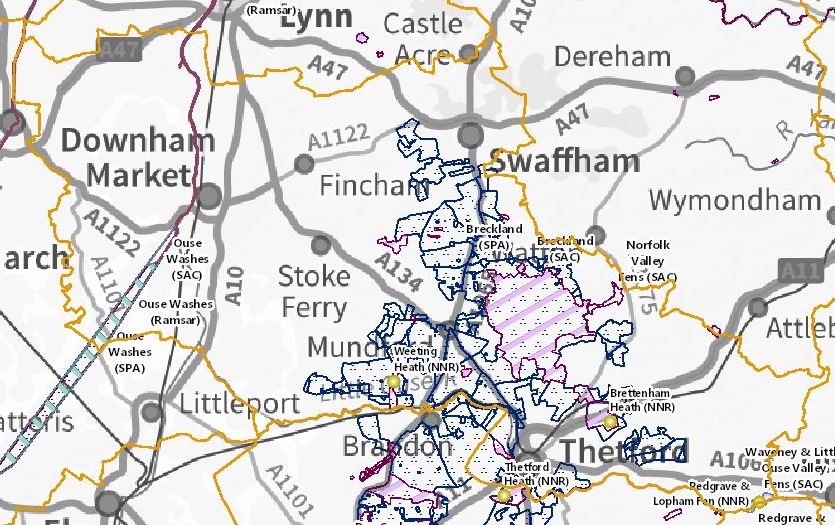
It may be that Truss has followed her predecessor Owen Paterson into this troubled area of policy, though she is not climate sceptic as he is. Alternatively it may have more to with this things closer to home. For in her own constituency, the 69ha Barnham Solar Farm application is also causing a major stir, and could become a high profile issue when it comes to voting in the General Election, just six months away. The Barnham Solar Farm, like Rampisham, sits within a protected area, but in this case it is a European Special Protection Area (SPA) for the Brecklands. The special bird of the Brecklands is the Stone Curlew which breeds on arable land.

South West Norfolk constituency with European Sites

Liz Truss’ South West Norfolk constituency is covered in European nature sites (map from MAGIC)

SPAs are very tightly protected against impacts from development, and this protection is regulated by Natural England, Defra’s nature agency.One of the main ways that European sites (especially SPAs) are protected is through the Habitat Regulations Assessment (HRA) process. If a development is deemed to have a likely significant effect on an SPA, then an Appropriate Assessment is carried out. The Appropriate Assessment looks at all the possible impacts that could have a “likely significant effect” on the interest features of the SPA (in this case the stone curlew). If the Appropriate Assessment cannot conclude that an impact will have no adverse effect upon the integrity of the SPA, they should reject the development. The test is very strong because the applicant has to show no effect.  Natural England ultimately recommend whether an Appropriate Assessment is required, from the Local Authority.

Natural England had initially objected to the proposal, on the grounds that more information was required to enable an appropriate assessment to be carried out. But it subsequently withdrew its objection. The RSPB are maintaining that Natural England were wrong and the Local Authority should have conducted an Appropriate Assessment to determine whether the application would have a likely significant effect on the interest feature, in this case the Stone Curlew populations at that part of the SPA which would be affected by the Solar Farm. Of course, it is all a lot more complicated than this, and I am no expert on it, but hopefully you get the gist of the matter.

Now all this took place before Truss took over as Defra Secretary of State, so she would not have had any say in it. Nevertheless the change in policy will play against this farm getting planning permission.

It would however be unfair to tar all solar farms with the brush that painted these two examples.

Solar farms can have a positive impact on the environment as well as generating clean electricity. I was recently contacted by a very concerned resident on the Somerset Levels who wanted help in objecting to a solar farm at Aller Moor, near Burrowbridge on the Somerset Levels. It’s true that it would have a visual impact, and given its location it would have to stick up quite high to avoid the flood waters. But although it is near to SPA land, it would actually be replacing fields of maize. As I have written elsewhere, Maize on the Somerset Levels is probably one of the worst ideas that farming has come up with in a long while. Is this a bad thing?

Maize is used to produce biogas, and while this Government are moving to shut down all new Wind and large Scale Solar production of renewable energy, they are very happy for maize and other biofuel production on farmland. To me this makes no sense on a number of levels. Maize is simply the most environmentally damaging crop grown in the UK. Growing maize to produce biogas is madness. This year, according to the NFU, 29000ha of land was used to grow biogas maize. that’s a 180% increase on last years 16000ha. The NFU are lobbying hard for 100,000ha of land to be under biogas feedstock (which would be mostly Maize) by 2020.

Compare that with the area of solar farm “in the pipeline” which, according to the Mail is 10,000 football pitches. A football pitch is not a real unit of area, but equates to about an acre. So all solar farms in the pipeline add up to about 4000ha, or less than one seventh of the area already covered in biogas Maize.

Kenneth Richter, renewables campaigner at Friends of the Earth tells me that France is already taking steps to stop biogas maize being produced there amid concerns, albeit about land being taken out of food production, as opposed to the environmental impact.

We need a campaign in Britain to get rid of the subsidies which drive increased biogas maize production, more than one to get rid of Solar Farms.

Posted in biogas, Liz Truss, Maize, Solar Farms, Somerset Levels, Uncategorized | Tagged , , , , , | 5 Comments

UKIP – the new Monday Club?

Institute_of_Directors_4_December_2011Bastions of Power: The Institute of Directors


The problem with the internet is that it is easy to make connections between people, events and organisations: you could call it a conspiracy theory generator. It is far harder to elucidate the relationship between them though – it’s the old problem of correlation and causation. Nevertheless here are some connections.

Cast your minds back, if you are old enough, to the heady days of the mid-70s. James Burke had an excellent programme called “connections” in which he showed how the invention of the paper clip led inexorably to the discovery of black holes. It wasn’t quite that silly but it was great fun for a 14 year old whose mind was filled with possibilities.

In 1975, Margaret Thatcher swept to power as the first Female leader of the Tory party. She plotted and watched as the Wilson then Callaghan Labour Governments, gradually crumbled, partly under sustained attack from some unlikely sources.  Earlier, the UK had entered the Common Market under the hapless Ted Heath, who had lost to the unions in the strikes of 1973.  Harold Wilson won the 2nd general election of 1974.

Heath was pro Europe and wanted the UK to reap the benefits of trading freely with our European partners. But this was seen as treachery, even treason by the hard right of the Tory Party. They opposed the UK joining the Common Market; were against immigration from the Commonwealth; tacitly or explicitly supported racist/fascist regimes in Europe, Latin America and especially in Africa (Ian Smith’s Rhodesia and the White Supremacists of South Africa), and promoted a policy of forced repatriation of (black) immigrants. And they had a club, called The Monday Club.

The Monday Club had been founded as a reaction against what they saw as the creeping liberalism of the Harold Macmillan Government of the early 60s. Founders included senior Tory politicians and activists, many from the Intelligence Services, especially the Secret Intelligence Service, MI6. Prominent among these were George Kennedy Young, who had been Deputy Director of MI6; and Tory MP Julian Amery, who had also been in SOE and MI6. Both shared an obsessive hatred of communism and feared communist infiltration of British society, particularly through the Unions, civil society (eg CND) and the Labour Party. Amery’s brother John had been a notable Fascist who had worked for the Nazi regime and was hanged as a traitor after the war.

After Thatcher took over in 1975, the Monday Club became very influential and this influence continued through into the early 80s. Monday Club members espoused support for the Atlantic partnership of the UK, the US and others, fighting a global war on communism, the Cold War. They were naturally sceptical of the European project, seeing it either as threatening the Special Relationship, or worse, as a Communist plot.

The Monday Club also espoused the economics of Friedman and Hayek; the pure truth of the market, or free market fundamentalism as it has also been described.  Natural allies in this belief were the Institute for Economic Affairs (IEA), the most influential Thinktank of the Thatcher years. The IEA advocated free market fundamentalism and wholesale privatisation. Lord Harris of High Cross founded the IEA, and went on to become chair, then President of the pro-smoking astroturf body FOREST. The IEA took substantial funding from the Tobacco Industry, and well may continue to do so. IEA also advocates against climate action, and receives funding from the Fossil Fuel industry. 

The Institute of Directors represents directors of businesses small and large, and advocates the needs of businesses to Government. It is a lobbying organisation as well as a sort of Trade Union: a bit like the NFU.

Back then the IoD, the IEA and the Monday Club worked closely together, influencing, developing, shaping the Thatcher project. Nor was the IoD divorced from the intelligence community. Former Director of Admin at MI6 Jimmy Jones, went straight from MI6 to the IoD in 1975, before continuing on to the Confederation of British Industry, as deputy Director General.

Graham Mather was a member of the Monday Club, organising their universities committee. During the 70s, the Anglican church community were campaigning to have sanctions imposed on South Africa. According to this account, in 1980 Mather acted on behalf of a group, which later turned out to have links to the South African Intelligence Servce BOSS, who were trying to buy a christian newspaper Christian World, and turn it into a propaganda tool for the South African state. Mather had also complained that Christian Aid were carrying out political activity by campaigning against the South African Regime and called upon The Freedom Association (of which he was a member) to be vigilant in watching these organisations who purported to be charities but were actually engaged in political activity. The Freedom Association was set up by far right protestant twins the McWhirter Brothers, of Guinness Book of Records fame. Another founder was the far-right Uber Cold Warrior Brian Crozier.

Crozier ran anti-communist black propaganda operations in Britain. Crozier and another Monday Club Tory Stephen Hastings, tried to persuade Thatcher to create an anti-communist counter subversion executive to counter the communist threat within. She was interested, but it didnt happen.

Mather  joined the IoD in 1980 and went on to become Head of Policy. In 1987 he joined the IEA as Deputy Director, then General Director. He left in 1992, following the fall-out from the ousting of Thatcher in late 1990. The Charities Commission investigated the IEA while Mather was in charge, as they were concerned it was carrying out political activity under a charitable guise.

Since then he has been an MEP and created the influential European Policy Forum, which advocates de-regulation in the UK and Europe. According to this site, ” his principle interest is ‘the advance of markets into government itself.’ Mather sees himself as part of a ‘priesthood of believers in the market’, pushing a libertarian right ideology against the ‘threat … from socialism’.”

At the same time the head of PR at the IoD was David Burnside. Burnside, from the Protestant community in Northern Ireland, had cut his PR teeth in the violent early 70s,  as press officer for the Vanguard Unionist progressive party. Burnside’s PR skills took him to the IoD from 1979-1984, and then onto British Airways where he was embroiled in the dirty tricks war between Virgin and BA. Burnside set up his own very successful PR company, became an MP and now advises Russian Oligarchs. Burnside is also, apparently a member of a very shadowy right-wing group called Le Cercle, which was set up by the French after the second world war to counter communism and promote Atlanticism ie the need for Europe and America to counter the Communist Threat. Julian Amery was chair of Le Cercle, and it was he who brought Jonathan Aitken onto Le Cercle as chair, only for him to be removed, on his conviction for perjury.

Our third character from the IoD needs little introduction – Neil Hamilton. Hamilton was a high flying Tory student activist, vice chair of the notorious Federation of Conservative Students, with their “hang Nelson Mandela” badges, who joined the Monday Club early on in his political career. He also worked as European and Parliamentary Affairs Director at the IoD between 1979-83.

Hamilton had been accused by a BBC Panorama programme, of making a Nazi salute while in Berlin, a criminal offence in Germany. Hamilton, a lawyer, sued for libel and before the case had even got to court, the BBC caved in and paid out £20,000. An internal BBC memo stated that 17 witnesses had been intimidated into changing their testimony. Hamilton had also courted controversy when involved with the Western Goals Institute who had invited neo-fascists Jean Marie Le Pen and Alessandro Mussolini, to speak at the 1992 Tory party Conference. The WGI’s hon. President in 1992, South African MP Clive Derby-Lewis, is now serving life for conspiracy to murder South African Communist Party Leader Chris Hani. When Hamilton was fighting the Al Fayed libel case, his chief fundraiser was Lord Harris of High Cross, who wrote this glowing reference for him. He had clearly failed to impress David Burnside during his time at the IoD, as this story shows.

What seems clear to me is that, in this period of the late 70s to early 80s, The Monday Club, the IEA and the IoD were at the very heart of the Thatcher project, to introduce free market fundamentalism and indeed a libertarian-right approach to Government. The involvement of MI6 and Le Cercle in promoting Atlanticism as a bulwark against perceived socialism and communism  seems pretty clear too. What of it? Isn’t all this ancient history?

Well, not necessarily. Because there is one character I have not yet introduced. The son of a solicitor, and grandson of a decorated Naval Captain, he went to Salisbury Cathedral School as a chorister, before continuing his education at a private school in North Devon. After a stint working on sheep farms in New Zealand, he went to Bristol Poly where he did an HND in Business Studies. Already interested in politics, he was President of the Student Union in 1978. He went to London, where he became Press Officer at the Institute of Directors. Here he worked learnt the PR ropes with David Burnside; and met Graham Mather, Neil Hamilton, and no doubt many other influencers. After working at the IoD during this amazing time of influence, he joined Holmes and Marchant and became a Director there.

His name? Steve Crowther, now chair of UKIP.

Crowther left Holmes and Marchant in 2000 to set up his PR company, April Six. Holmes and Marchant were taken over in 2000 by Huntsworth, created by Lord Chadlington, brother of John Selwyn Gummer, now Lord Deben.  Chadlington is also David Cameron’s constituency chairman. Huntsworth are at the forefront of the PR supporting health service privatisation. Chadlington also chairs Atlantic Partnership,  yet another Atlanticist group. AP has some very influential people on its board.

So I have found some connections. I don’t see the whole picture of course. And I don’t necessarily believe that all this proves the existence of the Synarchie. Because that ultimately takes you to dark paranoid world of David Icke and the Lizard Men.

What does seem to be clear though is that Steve Crowther, chair of UKIP, and Neil Hamilton, vice chair of UKIP, go back a long way. Back to the heady days when the Monday Club, the IEA and the IoD ran the roost; and pushed a philosophy of free market fundamentalism, coupled with a hard-right doctrine right into the heart of the Tory Government of the day.

Let’s not pretend UKIP will be any different.


Photo by Freepenguin (Own work) [CC-BY-SA-3.0 (http://creativecommons.org/licenses/by-sa/3.0) or GFDL (http://www.gnu.org/copyleft/fdl.html)%5D, via Wikimedia Commons
Posted in Charities campaigning, corporate lobbying, deregulation, neoliberalism, the far right, Think Tanks, Tory Party, UKIP, Uncategorized | Tagged , , , , , , | 8 Comments

Red-Tape fire-starter Francis Maude helped made UKIP chair Steve Crowther a millionaire

As I wrote previously, I thought that Steve Crowther, UKIP’s machiavellian chairman, had made a fortune in the world of Ad agencies and marketing. He co-founded a company called April Six in 2000 and then sold it to The Mission Marketing Group in 2007 for £9.45M.

What I had not realised was that the chairman of the Board of MMG at the time of the sale was none other than Francis Maude, now Regulation finder-general and chief fire-starter to the bonfire of red tape, that this Government is so proud to crow about at every opportunity. Oh, and he also set up Policy Exchange.

It’s fair to say that under Maude’s chairmanship MMG went on a spending spree, and were proud of this approach to expanding their company, which they called “buy and build”. This is what market analysts were saying about them back in the heady days of 2007. Basically the founders had raised cash by converting to a public company in 2006, and added to that by borrowing heavily from the banks, to go on this spending spree. The company was valued at £33M in 2007, with debts of £20M.  April Six founders Steve Crowther and Fiona Shepherd were paid £9.45M for their business, and this was paid partly in shares (1.19M each). You can see MMG’s share price in the chart below or for an interactive version, click here. It’s not pretty. At that time (3rd April 2007) Crowther’s shares were worth 135p a share, making his worth £1.61M. By the time Maude had left the chairmanship at the end of 2009, they were worth 24p each, making Crowther’s worth £286,000.  Of course, he still had the other £3M in cash he was paid by MMG.

TMMG share price jpeg


Decline and Fall. After MMG purchased Steve Crowther’s April Six, their share price crashed.

Two things come to mind from this microcosmic look into the impact of the deepest economic crisis certainly since the 1930s and possibly longer (it hasn’t finished yet).

1. Crowther will have lost about £1.4M if he hadn’t managed to sell the Mission Marketing shares before their value evaporated. From what I can see, he didn’t. I can’t imagine that will do much good for UKIP/Tory relations, while Maude is in the cabinet.

2. Maude’s actual experience of the private sector is limited to a series of directorships in blue-chip city banks (and Asda), which he gained after losing his MP’s seat in the 1992 election; and a series non-exec chairmanship and director roles in addition to MMG, many of which were in the PR world. Maude will have been involved in a number of companies whose value disappeared during the Crash. Did he have to take any financial penalty as a result? Did he suffer like so many employees who lost their jobs, found themselves unable to pay their mortgages, because of decisions made by people like Maude? Of course not.

Now, Francis Maude is hell bent on a Mission of his own, to dismantle public services, to remove regulations that protect public interests; and to “shrink the state”. Presumably he believes that the private sector does things so much better, because the market is king.

Here, he talks about privatising the NHS, by setting up employee-owned mutuals. Mutuals that, like academies and free schools, start life being gifted public property and provided with subsidised public services.

The story also reminds me of another non exec chair – Matt Ridley, who presided over the demise of Northern Rock. Paid £315,000 a year for his Northern Rock chair post, Ridley was lambasted for being asleep at the wheel while Northern Rock went on a massive borrowing spree just when global money markets collapsed. Curious why Northern Rock took on a scientist as their chair? His daddy, the 4th Viscount, was chair of Northern Rock from 1987 to 1992.

Matt Ridley is now visiting scholar at Policy Exchange.

Posted in deregulation, Think Tanks, UKIP | Tagged , , , | 1 Comment

UKIP Chairman Steve Crowther – Master of Spin, and lover of Sharks?

UKIP chairman and North Devonian Steve Crowther was heavily involved in campaigning against a windfarm out in the Bristol Channel, and worked with the local CPRE group, as I described in a previous blog.

At that time I had singularly failed to find out much at all at Crowther’s pre-UKIP history. Thanks to help from friends, I have found out rather more.

Although I have found out nothing about Crowther during the 80s other than that he was a press officer for someone, and a trade journalist, he does appear in the record in 1991. At that time he joined Marketing firm Holmes Marchant, who now describe themselves as a brand design consultancy. Crowther was at Holmes Marchant for 10 years, and became a Director of a Subsidiary, Holmes Marchant Communications Limited, from 1995-2000.

In 2000 he left Holmes Marchant, with another H-M director, Fiona Shepherd, and they set up April-Six limited. April Six, a tech marketing company, was sold in 2007 to the Mission Marketing group. By the time it was sold it had 54 staff and Mission paid £9.55M for April Six, with another £9.45M if they performed as well as expected. Given that the crash happened before the second payment I don’t know whether it was paid, but Crowther and Shepherd would have done very well from the first payment, part of which was in H-M shares.

April Six provided consultancy marketing and comms services, to the software, reseller and telecomms industry. No, I don’t know what it means either.

Here’s the information release about the acquisition. Gives a little more detail on what April Six were doing. And from this it looks like the company was owned 50/50 by Crowther and Shepherd.

Also, somewhat bizarrely, he was, for 9 months in 2001, Marketing Director of the Shark Trust, a conservation charity set up to conserve sharks rays and other elasmobranchs in the UK. But he appears to have been a trustee/director, rather than an employee director. Sadly Charities Commission online records don’t go back to 2001 for the Shark Trust which is a pity. If anyone can enlighten me about this episode in the Crowther story, I would appreciate it.

So it seems that Crowther made a small fortune providing marketing services to big players in the software and internet industries during the heady days after the dot com crash and before the credit crunch crash. And he has used his media/marketing nous to great effect, both as a campaigner against wind farms, as well as the brains behind the UKIP project.

Posted in the far right, Tory Party, UKIP, Uncategorized | Tagged , | 12 Comments

You forgot to show us the Astroturf Beefy

I don’t know whether UKIP has successfully put some psychotropic chemical in the water supply, but the bizarre stories seem to just keep on coming at the moment.

The latest is the launch of a “network” – how do you launch a network? called You Forgot the Birds, fronted by Sir Ian Beefy Botham, legendary cricketer and boyhood hero of mine and many others of my age. YFTB claims to be concerned that the RSPB is wasting its members money and not looking after birds properly. YFTB are so upset they have made an official complaint to the Charities Commission that RSPB are being naughty and not behaving proper charitably.

Who are YFTB? Botham’s photo is plastered all over their substantial publicity they have received in the last few days since their launch. Botham s a keen shooter and owns a shoot near his home in Yorkshire, so it would be reasonable to assume that the RSPB’s stance on shooting might have generated this ire. Although as Mark Avery has pointed out, their public stance is very mild indeed, as it usually is on matters where someone might get upset.

I was curious as to who might be behind this “Network”. I use quote marks because as far as I can make out, it YFTB is an astroturf outfit. It purports to be a grassroots campaign of ordinary people, who are keen on monitoring the activities of the RSPB, and it would also seem they have their sights set on the Wildlife Trusts too. Although there are two other “figure-heads”, both from the shooting fraternity, they are just photos with attached quotes as far as I can see.

The real work is done by Campaigns Director Ian Gregory. Gregory has been in the media and lobbying business for years and now works for Centaurus Communications. Gregory did PPE at Oxford (so is very well connected) and worked for Maggie Thatcher before moving to the Beeb as a producer, then onto global corporate support outfit Accenture. Centaurus Communications are in the business of corporate lobbying and reputation management. They are managing the reputation of companies that produce e-cigarettes for example. They also did a promotional job for the new authoritarian President of Hungary Viktor Orban, whose views have shocked many in Europe; and who has taken the Hungarian Government so far to the right that the main opposition party is Jobbik, who are neo-nazis.

I also recommend you look at CC’s latest “insight” into the murky world of corporate lobbying. They deride ideology, asking “how long would a climate change refusenik last at the BBC?” Now this could be read both ways, but I think the implication is that, rather than correctly casting climate change denial as an ideology, belief in human-induced climate change is part of an ideology, and the refusenik is the victim of ideology. I wonder whether CC also include the Global Warming Policy Foundation amongst their clients.

Does it matter that someone is agitating against the RSPB? Are there real issues that YFTB have raised? Hen of Save our Woods has expressed sympathy with the issues raised by YFTB. In a sense, it is right and proper that the RSPB should answer the accusation, after all, as a charity RSPB benefit from tax breaks and the opportunity to receive funding from Grant Making Trusts, benefits that individuals of corporate entities do not have. And the Charity Commission’s job is to make sure that Charities abide by the rules. They have up until recently done a pretty poor job as a regulator but profess to becoming more enthusiastic about this role from now on. Indeed they recently stepped in to quietly nudge The Global Warming Policy Foundation about their evidently uncharitable political lobbying. But rather than change their ways, Nigel Lawson and his wealthy backers, merely decided to split GWPF in two, and carry on with the cynical political-corporate work, outside the charitable sector. Of course, the Charity Commission has singly failed to address the uncharitable political activities of the right wing think tanks such as the Institute for Economic Affairs and Centre for Policy Studies; perhaps someone should ask the Commission to investigate. Oh, hold on, they have. Did anything come of it? No.

The current Government, goaded by right wing thinktanks like the IEA, are keen to clamp down on political activity by charities, by muzzling them through the lobbying act. But rather than go after the corporate mouthpieces (IEA are funded by the tobacco and fossil fuel industries) who corrupt democratic processes, instead they are gunning for Oxfam and the RSPB.

Funny old world eh?

Posted in anti conservation rhetoric, anti-environmental rhetoric, Astroturfing, blood sports, Charities campaigning, Charities Commission, corporate lobbying, RSPB, Uncategorized | Tagged , , , , | 6 Comments

Forget Gross Domestic Product, we need to measure Gross Natural Product

NY_stock_exchange_traders_floor_LC-U9-10548-6


Trading Floor at The New York Stock Exchange 1963


We have now had four and a half years of austerity, of seeing our public services, and more widely, the public realm in Britain being cut to shreds by the Tories and the Libdems. This has been, allegedly, in the name of reducing the deficit, the difference between the income the Government receives through taxation, and the spending of Government on, well in theory, things that benefit society.

The latest figures are not good. In September 2014 the Government borrowed an extra £11.8 billion. That takes Government borrowing since April to £58 billion, or nearly 10% more than was borrowed by this time last financial year. All this extra borrowing adds to the national debt. Which currently stands at £1.45 Trillion, which is £100 billion higher than it was at this time last year.

Public Sector net debt has actually increased by nearly 50% during the Coalition’s terms, when they were doing everything to “drive down the deficit”

These figures are of course meaningless.

If you go into debt and cannot pay it off, you might lose your house. If you didn’t have any assets you could go voluntarily bankrupt and your debts would be wiped out. It would mean you would probably not get a mortgage again, but at least you would have no debt to repay for the rest of your life.  That is a real world problem.

But Banks who gambled recklessly with billions of pounds of other people’s money during the crazy times before the great depression of the “Credit Crunch”, found themselves in extraordinarily huge debt, debt far greater than they could ever pay off. The Government (Labour) concluded that the risk of allowing a bank to fail was too horrible to contemplate  – remember Northern Rock under Viscount Matt Ridley’s chairmanship? So the banks agreed to simply have that debt wiped away by the Government. The Government “spent” £37 billion bailing out banks like Lloyds, by “buying” a stake in that bank. What that actually means is that the Government, on behalf of all of us, gave the Banks shed loads of cash, so they could carry on doing what they were doing before.

Where would all this extra money for the banks come from? As the Government debt increased, “quantitative easing” was introduced. This is just fancy language for printing more money. Like anything really, the more of something that’s available to buy, the cheaper it becomes. Its the same with money. The more pounds there are floating around to buy things, the less each pound is worth. That £1.45 Trillion debt is not worth as much (ie is not at big) as it was before QE started. That may well explain why people feel much poorer that the money in their paypacket would suggest, and why this so called economic recovery feels like something very different.

An astonishing £375 billion has been magically “created” by QE. Has anyone felt any richer as a result? Well yes, actually. The super rich have become a great deal richer during this time of austerity.

The disparity between the richest and poorest has grown under this Government to its largest since the Second World War.

The top 10% in the UK own nearly half all of its private wealth,

The top 1% own as much as the poorest 55% and are getting wealthier at an increasing rate.

Politicians and business leaders tell us we are in a world race to the top of economic growth. All that matters if economic growth, watch those GDP indicators, are they green or red, green or red?

GDP is Gross Domestic Product. This is an indicator, a proxy, supposedly of the health of the economy. GDP does not actually exist, it is a purely artificial construct, like money. GDP is a simplified measure of something which is supposed to be helpful to society as a whole. The problem is that it is nothing of the sort. GDP measures domestic output, so doesn’t take into account who is buying the products produced – whether they are all exported, for example. GDP is a hopeless measure of financial output  – and the byzantine nature of the way GDP is measured is understood by only a few economists – who may have got it wrong. It’s not based on physics like the basis of human-induced climate change is, for example.

If I suggested that there was no scientific basis for GDP, I’d be on much firmer ground than Climate Change denialists.

What’s also interesting is that the language of biology has been appropriated by the economists. Real growth is found in nature, and within us. We grow as we develop, our bodies grow, our minds grow (hopefully). And our human culture grows, as we pass information, knowledge and wisdom down the generations. Nature grows in many senses, durnally, seasonally, but also through evolution. But nature’s growth is cyclical, as things grow, so they must decay.

Where is the analogy in our modern economy?

We are being subtly driven to believe that real growth, the growth of nature, and the growth within ourselves and within society/culture, is less important than the illusory growth of economies and financial capital.

We need to start subverting this obsession with teh language of Neoliberal Economics; and start talking about the Natural Debt and Natural Deficit. When are we going to pay off the Natural Debt?

Modern farming and forestry have run up a massive natural debt – this comprises the loss of wildlife, healthy carbon-rich soil, clean water, clean air, but also all the wonderful things that nature provides people with, from inspiration to well-being, joy to a chance for reflection.

 Yes many do not even realise this debt exists, and it continues to increase. When a farmer converts a piece of grassland into a maize field (yes that’s happening a great deal down here in the South West.), that’s effectively a transaction between the economy (GDP goes up) and nature (the natural debt increases). The farmer gets richer, society and nature get poorer.  But no-one is measuring this change.

I suggest we need a new measure Gross Natural Product. If the Government used this as an indicator of the health of society, alongside (or instead of) GDP, we would have a much clearer idea of what is happening in the world. Countries like ourselves who hacve already utterly transformed out environments would naturally have a massive long term natural debt and arguably our annual natural deficits would be relatively small compared to, say, Brazil which still has a great deal of nature that hasnt been transformed. But their annual natural deficit will be increasing more quickly, as they convert forest to grow soya beans to export to us to feed our animals. These relationships would become much clearer if the natural debt/deficit approach was adopted. Under our current system, Brazil converting rainforest to soya or beef adds to their GDP – and is seen as a good thing!

This is one of the many problems with Biodiversity Offsetting. The BO approach only accounts for the transactions happening at the time – biodiversity lost on one site, generates credits which in theory mean biodiversity gain occurs at another site.

Of course, if one replaces an ancient woodland, with a thousand new trees, that is the equivalent of ecological quantitative easing, or printing money.

 Photo By Thomas J. O’Halloran, photographer [Public domain], via Wikimedia Commons

Posted in economics, neoliberalism, Uncategorized | Tagged , , | 4 Comments

UKIP’s Roger Helmer ventures into supporting renewable energy, and gets it all wrong.

Champ_de_blé_Côte-d'Or_Bourgogne_avril_2014


More UKIP bonkersness.

Roger Helmer has now decided he supports renewable energy, but only if it is bioethanol distilled from wheat.

This appears to be because he doesn’t want a bioethanol distillery built in Stocton (sic) on Tees to lie dormant.

Helmer displays his usual casual disregard for facts by claiming that bioethanol can be produced at the same cost as fossil-fuel derived petrol, because it has no subsidy. Wrong on both counts.

British Farmers grow winter wheat across 2 million hectares of farmland to feed to beef cattle. You may think cows eat grass – think again. They are fed wheat to make them grow quicker. Feeding wheat to cows is good for farmers profits but otherwise is not such a great idea. Intensive wheat production is also a high impact land management practice which affects the environment, landscape and society. To suggest it has no cost is beyond naive.

Anyway some of the energy in that wheat is converted into vehicle fuel: bioethanol is produced by distilling the alcohol from fermented wheat. That wheat is grown in Britain by British farmers, receiving £200 per hectare per annum (plus bonuses) just for the privilege of owning land. This is the madness of the Common Agricultural Policy. And the idea that this is a co-product which would have been thrown away had it not been made into ethanol is of course nonsense. As I said, the energy has been removed from the crop to make ethanol. That energy would have ended up in the cow or been returned to the soil.

So Helmer is of course wrong to suggest that the bioethanol has no subsidy. I’m surprised that his Climate Adviser Ben Pile hasn’t spotted this basic gaff. I have written about Pile before.

Secondly Helmer is wrong to suggest that the Fossil Fuel industry doesn’t get a subsidy. In fact the Fossil Fuel Industry is one of the most heavily subsidised industries on the planet. According to the International Energy Association, hardly a radical outfit, Fossil Fuel Subsidies globally were $544 billion in 2012. Renewable Energy subsidies were just $100 billion.

OK so those are both wrong, what about the plant – who paid for that? As always it’s not as easy as you might think to follow the money. Helmer quotes a £750M investment in the plant. But Ensus, who run the plant only mention £240M and say that the plant was funded by “both private investments and grants from the government.” Grants is another word for subsidies. If anyone can tell me how much Ensus (or indeed the other bioeth plants) received in government grants I would be grateful.

Finally scientists have looked at whether bioethanol plants in the UK are economic or not. They concluded that, at an oil price of $100 a barrel, they aren’t economic.

Based on this effort, I suggest UKIP sticks to its current position on renewables; that they are all bad. At least that keeps it simple (and also wrong.)


Photo: Myrabella / Wikimedia CommonsCC-BY-SA-4.0


Posted in biofuels, renewable energy, UKIP | Tagged , , , | 4 Comments

Lib Dems continue to haemhorrhage voters to left and right

More on that Lib Dem – UKIP connection.

The most recent YouGov poll shows the libdems on 8%, with UKIP on 18% and the Greens on 7%.

It’s worth noting that of those who voted LD in 2010, only 32% intend to vote for them in 2015. This compares with 71% continuing to vote Tory, and 78% continuing to vote Labour. I suppose this shows that the Lib Dem voter is more of a floating and tactical voter, so no great surprise there.

Where are the other 68% of the previous LD vote going?

26% are going to Labour and 12% to the Tories. This leaves a whopping 30% voting for “none of the above”, which is as many as are going to vote LD.

These voters are heading left and right – 14% to the Greens and 12% to UKIP, with the rest to the Celtic Nationalists.

UKIP are picking up most votes from disgruntled Tories (21% of those who voted Tory in 2010 are heading right) with only 9% from Labour.

The Greens are now up to 11% for young voters in both the 18-24 and 25-39 age brackets, while UKIP have 23% of the 60+ voters.

It’s also worth considering that 20% of those asked, either would not vote or haven’t decided yet. This means only 57% of voters are saying they will support the 3 traditional parties in the election, which is only a little over 6 months away.

I don’t remember a time when there was this much disillusion with mainstream politics in Britain, but then I don’t remember the 30s, or the preceding decades when there was so much more interest and activity in politics.

Posted in General Election 2015 | Tagged , , , | 5 Comments