My tuppence worth on the EU Referendum – and a poll

flag_yellow_low

The big news for the Environment in 2016 is that, as a result of the divisions within the political right in England, we are being forced to vote on whether we want to stay in the European Union in a few months time.

Coming up to two years ago now, I wrote about the the EU and the benefits and drawbacks that being in the European Union has created for nature in the UK. I weighed up the benefits to nature from things like the Nature Directives (Birds and Habitats), the Nitrates Directive, the Water Framework Directive and the EIA Directive – and looked at the enormous environmental cost of thigns like the Common Agricultural Policy and the Common Fisheries Policy. Back then I was in two minds – it occurred to me that outside the EU there would be far less money from the Treasury to subsidise farmers or fishermen, compared with what they receive via the EU.

Last year I looked at the state of nature across the EU, based on the EU’s own reporting. The state of nature across the EU is pretty dire, unless you happen to be a Birds Directive-listed bird or a Habitats Directive-listed species, in which case things are a bit better than dire. I suppose one question is, if the EU had not existed, would nature be in a more parlous state 50 years later, or not? Of course, it’s impossible to tell because we don’t have a second earth to act as a control for the experiment.

I think we can say that in the UK, the Birds and Habitats Directives, and the other European environmental Directives, even though they have been poorly implemented, have meant that things have not declined as quickly as they otherwise would have. And this is mainly down to the existence of regulation and legislation, rather than through the provision of incentives, such as via Agri-Environment Schemes. The combination of legislation (eg designating a Special Area of Conservation) backed up by funding from agri-environment or LIFE funds has been more effective than just legislation or just agri-environment.

In the 90% of the UK which falls outside the protection afforded by the European Directives, the Common Agricultural Policy is still funding damage to what little nature is left on the 75% of the UK which is classed as farmland. It’s not deliberate damage, of course, it’s “incidental” damage. If we left the EU, it seems very likely that the UK Government would continue to fund some sort of farm subsidy system, much as they did before we join the Common Market. There may be an opportunity to influence the rules around that system, though in truth, under this Government, the only people likely to have any influence on the new rules will be the NFU, and certainly won’t be Civil Society including the nature NGOs. UKIP has already clearly stated that they are only interested in supporting intensive farming and would remove environmental protections.

It’s worth remembering that our Farm minister George Eustice, who has already signalled he will be campaigning alongside Boris Gove et al to leave the EU, was a UKIP candidate before joining the Tories.

There is no doubt that the European Union has a great deal of problems. It is mercilessly lobbied by, and therefore often at the mercy of, corporates and private interest groups  – and this is why we still have such a ridiculous thing as the Common Agricultural Policy, doling out money to landowners just for owning farmland, with no requirement to provide public benefits in return. There are structural problems in getting 28 sovereign states to agree to anything quickly – witness the paralysis induced by the Syrian refugee crisis. But, the question is would be better off outside the EU, or inside it?

If we can reform the CAP so that it pays farmers to deliver public benefits, then we would achieve a great deal for nature in the UK and across Europe. It seems like an impossible task and Lord knows it has been tried and tried over the past 25 years. But then it really would be an impossible task if we weren’t in the EU. And there are many other countries in the EU whose Governments do want to reform things like the CAP, where their farm ministers are not under the influence of the most intensive farmers. There is a consensus across the EU on the urgent need to tackle climate change. But in the UK, climate change deniers are hugely influential and are successfully sabotaging actions such as the need to increase renewable energy sources like wind and solar. And if we lost the protection afforded to sites via the Birds and Habitats Directives, we would undoubtedly lose some of the places which we cherish, as reminders of what the British landscape once looked like, and the nature that once thrived there. This may well not be the nature which we should be looking to see thrive in the future, but nevertheless we should treasure these places, just as we treasure other aspects of our past, such as bronze age wheels.

I suppose in my own mind it comes down to this:

Do we as a country want to look backwards to Empire days, seeing ourselves as having the opportunity to once again be a big player on the global scene?

Do we want to look to America and the special relationship, liberty, the unfettered market and the supremacy of individual freedom?

Or do we want to value the positive relationships we now have with our long-time former enemies such as France and Germany (and an unprecedented period of relative peace in Europe), and play our part in a Europe that is influential globally, and can act for the good of humanity and nature.

I have no doubt how I will be voting in the referendum. How about you?

Posted in Birds Directive, Boris Johnson, Common Agricultural Policy, corporate lobbying, Europe, European environment policy, George Eustice, Habitats Directive, Nature Directives, NFU, public goods | Tagged , , , | 5 Comments

Badger-Cull Roll-Out and Charity Gagging show Government is living in its own Bubble

My_First_Badger_large

badger linked to sock-puppet scandal

This week Natural England announced that it had received 29 applications for new badger cull areas, covering the entire south-west of England, extending to Herefordshire Worcestershire and Gloucestershire. Under the beady eye of their masters at Defra, Natural England have opened a “consultation”. But this consultation does not extend to telling anyone exactly where the cull areas are to be located, how many badgers are currently in these areas, nor how many badgers would need to be culled to be judged a success. From previous culls we can assume that Defra will be aiming for around a 70% cull.

Killing badgers is very, very expensive. Just policing the cull in an area of Dorset last year cost £694000 for 756 badgers – that’s an eye watering £918 per dead badger. Total costs during the Somerset/Gloucestershire pilots were £6775 per badger killed.

Compare this with the  National Wildlife Crime Unit’s budget of £278000 a year – a Unit which is under threat of its own cull by Defra.

All the scientific evidence indicates that killing badgers is not the right way to tackle bovine TB in cattle. One leading badger/bTB scientist writes about her experience here.

But this isn’t about science, it’s about politics. The south-west is part of the Tory heartland (especially now with the demise of the south-west LibDems) and it’s no coincidence that Neil Parish, Tory chair of the Environment Food and Rural Affairs Select Committee, is a Devon MP and cattle farmer. Or that Defra Number 2 Minister George Eustice is a Cornwall MP.

It’s also now very clear that the National Farmers Union is firmly embedded within the Defra political apparatus –  it’s no longer appropriate to call them lobbyists, as that would imply they were on the outside, when they are very much on the inside.

It’s also no coincidence that the Government should ignore science and take one special interest group’s position as gospel when it comes to the Badger cull.

As I wrote earlier this week, the Government has decided to listen closely to another favourite interest group, the free-market fundamentalist Institute for Economic Affairs, and their utterly spurious but toxic claims about Charity lobbying, and implement them in haste without consultation.

The decision, to stop charities from using “tax payers’ money” to lobby Government or Parliament (or the EU), will not have any impact on NFU’s capacity to influence UK and European policy as they are not a charity and they do not – directly – receive government funding. Indirectly of course they are very much funded by tax-payer’s money, as their members receive huge subsidies from the Government, via the European Commission. And they pass on this income to the NFU through their membership subs.

It seems depressingly ironic that the Government should be shutting down opportunities for Civil Society to say things to it, that it doesn’t want to hear; while paying ever greater attention to private interests groups, driven by personal profit or an extreme ideology that puts profit before everything else.

This Government is becoming increasingly picky about who it wants to hear from, and who it is going to listen to. The trouble is, if you only listen to what your friends tell you, and only hear what you want to hear, you end up living in a bubble – and becoming a narcissist.

Posted in badgers, Charities campaigning, Institute of Economic Affairs, lobbying, NFU | Tagged , , , , , | 3 Comments

IEA may end up gagging on its own sock puppet

Carlb-sockpuppet-01


Charities are to be banned from using “tax payers’ money” to influence Parliament, Government or Political Parties, the so called “sock puppet” issue.

The Government has decided to introduce this change in legislation, as a result of a campaign led by a charity, The Institute of Economic Affairs (IEA). The IEA proudly boasts that it receives no Government funding, though, as I shall explore below, this is a half truth at best.

Although charities are supposed to be apolitical, the IEA is a right wing – as in corporate-libertarian American Tea-Party style, right-wing, not jack-booted, flag-waving nationalist thug right-wing, “think tank”, beloved of Margaret Thatcher. It has blazed the trail for the neoliberal ideology, where the market is king, Government is bad and regulation is positively evil.

The IEA has previously taken money from big tobacco while challenging regulations to make smoking less attractive and more expensive; and scores very low on the transparency around its own funding – though one step up from the execrable Taxpayers Alliance. Even  so, given their own opacity, one might think they were not the best people to decide how other charities raise or spend their money.

Unusually for a significant change in legislation, there will be no consultation period, and no opportunity for charities, or anyone else, to comment, suggest unforeseen circumstances, or seek to amend the legislation. Whether you agree with the corporate libertarians at the IEA, as the New Philanthropy Capital think-tank has mused

“What is clear though is that this is an extraordinarily poor way to make public policy—no consultation, little clarity about how it will practically work, and all on the back of some pretty thin, and ideologically driven, research.”

A letter sent to Cameron protesting against this decision has been signed by about 150 CEO’s of charities, including some of the very large Grant Making Trusts. This is also highly unusual as the GMTs don’t tend to like being drawn into the party political arena. Clearly they are very concerned about what is one more brazen attack on the Charity Sector.

What is all the fuss about? The IEA sock-puppet campaign has been running for about four years now. Initially funded from the IEA’s own sources, in 2014 someone liked what they were doing enough to bung them £15k to do more work on it. That was money well spent, as two years later, the Government has decided to change the rules.  Because the IEA are opaque about who funds them, the donor (corporate or individual) remains anonymous. And of course they are entirely within their rights to remain anonymous.

The complaint was that charity recipients of tax payers’ money, and in particular grants from Government departments or Agencies, were using this money to lobby Government. That lobbying might be for a change in the law, or to better implement an existing law, or indeed to lobby for a load of regulations to be ditched. It might also include lobbying for more money to be spent on something, or less. It’s a very broad area, isn’t it?

The sock-puppet analogy was that Government was in effect talking to itself but pretending that it was someone else doing the talking. But the analogy only works if you assume that what is being said, already chimes with what the Government wants to hear. Which is extremely ironic, because that is exactly what this gagging of charities will actually happen in practice – because Charities tend to say the things Governments really don’t want to hear.

What it won’t stop is the highly effective lobbying of Government by a veritable phalanx of right-wing thinktanks such as the IEA, Policy Exchange, CPS, CSJ, Taxpayers Alliance, Adam Smith Institute and so on and so on. But who funds these outfits? It’s very difficult to say, as their funding is so opaque. However, the IEA has let slip that it is funded by The Nigel Vinson Charitable Trust. Vinson is also a funder of the Global Warming Policy Foundation. Another funder of the GWPF is Neil Record, who has recently been appointed chair of the IEA.

Where else might their £2m a year income emanate? Like so many other British corporate-libertarian organisations, we need to look across the Atlantic to the USA. The IEA receives a lot of funding from the Earhart Foundation – over 50% of the $2M funding IEA received from American charitable foundations between 1996 and 2013, according to climate change blog Desmogblog. The Earhart Foundation supports libertarian causes in the states, as does the Atlas Economic Research Foundation (now Network), which is a sister organisation to the IEA and funds it via American Friends of the IEA.

But there’s another place which the IEA gets its funding from, much closer to home. And it’s Taxpayers’ money! Because every individual or corporate donation or subscription the IEA receives from an individual taxpayer of a company that has declared a gross profit, is eligible for a tax refund, also known as gift aid.

The IEA declare voluntary income of £1.7M last year. If everyone who gave money to the IEA was willing to sign the form to allow gift aid to be claimed at 20% (the basic rate), That would mean £340,000 of their income came from the tax payer. But you can imagine that, given the IEA’s raison d’etre, a significant proportion of supporters will be paying tax at the top rate, at least those who are paying any tax in this country and not just offshoring all their income to tax havens. So these supporters will be able to reclaim up to 40% of their tax paid (to the Government) and hand it over to their favourite think tank. Assuming all the donors to the IEA were top rate taxpayers then £680,000 of tax-payer’s money was handed to the IEA last year. The same applies to companies who can donate part of their pre-tax profits to the IEA who can then claim back the tax rebate at 20%.

Given that the IEA receives between £340,000 and £680,000 a year from “tax-payers’ money”, specifically to influence Government Policy, it may just rue the day it decided to create the sock-puppet campaign.

Image by Carlb: Public Domain, https://commons.wikimedia.org/w/index.php?curid=89314
Posted in Charities campaigning, Institute of Economic Affairs, libertarians, neoliberalism, sock puppet, Think Tanks, Tory Party, Uncategorized, voluntary sector | Tagged , , , , | 8 Comments

Select Committee takes floods evidence from George Monbiot, bars Richard AE North for “offensive remarks”

I had been looking forward to watching (and you can now on Parliament tv) the Envronmental Audit Committee evidence session for the Floods inquiry, in which George Monbiot was called, alongside Richard AE North, former Environmental Health Officer and now leading Eurosceptic blogger.

After a long delay caused by Cameron’s blather about what a fantastic deal he’d got from the EU, the session began. George gave his evidence in his usual articulate manner, peppered with anecdotes to bring the dry statistics to life. Even the notorious Peter Lilley failed to make any impression on George, and Lilley’s rather lame attempts to blame the EU for the floods were brushed aside as the fantasy they are. The only thing George got a bit mixed up on was in relation to how much water a river channel held, and why dredging did nothing (usually) to reduce flood problems.

Peter Aldhous was in the chair, as Huw Irranca-Davies had resigned to stand in the Welsh Assembly. George’s evidence had finished and I was waiting to hear what Richard AE North had to say, when Aldhous made an announcement – North had been barred from giving evidence, because of allegations that had been drawn to the attention of the Committee, that he had made offensive remarks online, and that “on balance” the committee had decided not to take evidence from him.

This is, in my experience, pretty unusual. What could North have said that was so offensive that the Committee felt it would be inappropriate to take evidence from him? Did they think he was going to start calling for Prince Charles’ head on a stick?

As I mentioned earlier this week, I have come across North myself before. I don’t think it would be too fanciful to suggest that North is the brain behind Chris Booker. Booker, the “journalist” you may remember who wrote a number of articles claiming that the Somerset Levels floods in 2013/14 were caused by EU policies, such as the Water Framework Directive and the Floods Directive. This is of course EU phobic lunacy but it fits well with North who sees himself as a leading campaigner for the UK to leave the EU. North is, I would suggest, a right-libertarian – which is bizarre for someone who made a career in the foood-regulation industry. Ok so far so mildly offensive. But surely select committees take evidence from libertarians all the time.

I had a quick look online to see if I could find to what the committee might have had its attention drawn and found this piece by George Monbiot from back in 2010.  Yes, certainly plenty of offensive remarks here.

North was livid that he had been invited to give evidence then barred. He fulminated on his blog yesterday against the “loathsome creatures” of the select committee and took aim at its chair in particular. North was particularly offended that it was the select committee

clerk who yesterday conveyed the news that Mr Irranca-Davies didn’t have the guts or courtesy to tell me to my face.”

Evidently North has not heard that Irranca-Davies is no longer the chair of the committee.

So he lashed out against an entirely innocent person accusing them of cowardice.

Afterwards, I asked him on twitter what “offensive remarks” he thought the committee referred to  – and in reply, he blocked me. I think that says all it needs to about Dr North – this sort of behaviour is, I have found, fairly typical of those on the libertarian right.

As a leading player in the Brexit campaign, we can only hope that North falls out with everyone over the next 3 months and does the campaign real damage.

Posted in Environmental Audit Select Committee, flooding, George Monbiot, RIchard AE North | Tagged , , | 17 Comments

UKIP reiterates its opposition to nature protection.

Some have recently  suggested that UKIP has a coherent environmental policy. Well, a few UKIP supporters have, anyway. I’ve written previously about the bizarre views of UKIP’s environment spokesperson Andrew Charalambous aka Dr Earth.

And then there’s UKIP’s MEP and agriculture spokesman Stuart Agnew, who notoriously expressed alarm that climate change action would suck so much Carbon Dioxide from the atmosphere that plants would not grow.

Yesterday the European Parliament considered a report into the implementation of the EU Biodiversity Strategy, and in particular the European Commission’s review of the Nature Directives, the Birds and Habitats Directives. The Parliament overwhelmingly voted in favour of the report, which highlighted the need for Europe to do much more to protect its biodiversity, and to strengthen the implementation of the Nature Directives.

The vote was 592 MEPs in favour of the findings of the report, with 54 against; and 45 abstentions.

I was interested to see who were the 54  who voted against; 18 of the 54 were from the UK. They were:

the ECR group: James Nicholson – Ulster Unionist

the ENF group: Janice Atkinson former UKIP, who has now joined forces with neofascists, the French national front.

the EFDD group: Stuart Agnew UKIP, Tim Aker UKIP, Jonathan Arnott UKIP, Gerard Batten UKIP, David Coburn UKIP, Bill Etheridge UKIP, Nigel Farage UKIP, Ray Finch UKIP, Nathan Gill UKIP, Roger Helmer UKIP, Mike Hookem UKIP, Diane James UKIP, Paul Nuttall UKIP, Patrick O’Flynn, Margot Parker UKIP, Jill Seymour UKIP.

Interestingly three MEPs from UKIP, William Earl of Dartmouth, Julia Reid and Jim Carver, abstained.

So a third of those who voted against doing more for nature across Europe, were from the UK and almost all of these were from UKIP.

This shows very clearly how much UKIP cares about nature. 

If you care about nature and have a UKIP MEP in your area, why not let them know what you think about their attitude towards nature.


Posted in Europe, European environment policy, Nature Directives, UKIP | Tagged , , | 8 Comments

Oliver Letwin reveals enthusiasm for natural flood management

IMG_0421

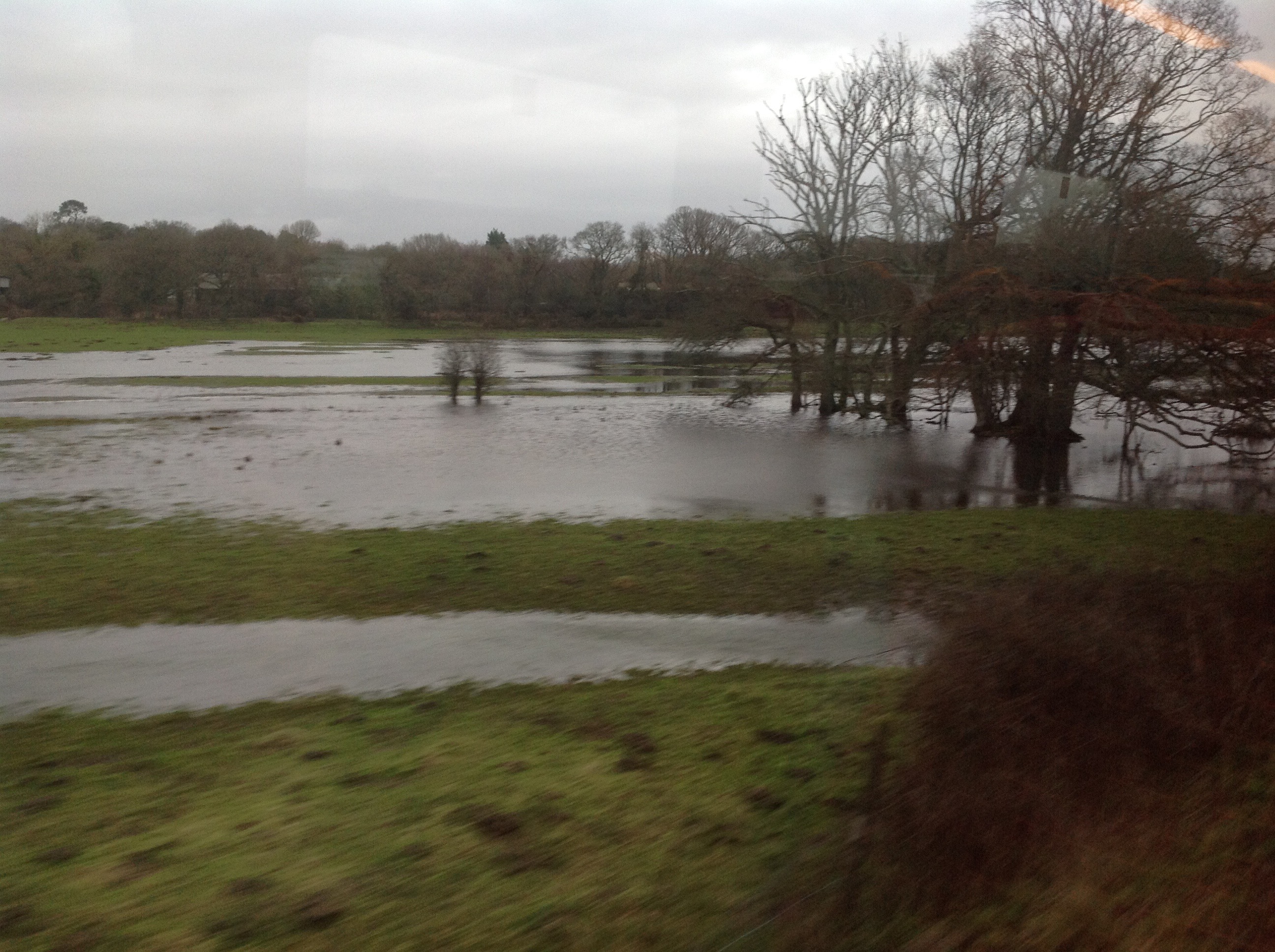
Dorset under water (c) Miles King

Oliver Letwin is our local MP here in West Dorset.

I’ve met him a few times, to talk about different environmental issues. He’s friendly, fiercely intelligent; and loves a good argument. I don’t agree with his politics at all, but he has always listened to whatever it is I’ve been advocating and evidently knew what the arguments were.

He’s also extremely gaffe prone (eg this recent revelation about events long past) and consequently has been in the back room as Cabinet Office minister for quite a while, but that is a very influential job. He will now chair the National Flood Resilience Review, which will report in the Summer.

Letwin writes a regular feature in our local paper the Dorset Echo. Most of the time it’s anodyne stuff, but this morning’s piece is quite an eye opener.

During the deluge that hit first the Lake District and then much of the rest of the north of England at the turn of the year, I am sure I was not alone in hoping that this would mark the end of the rain. So much water descended in such a short period that we seemed to have had a whole year’s rainfall by the end of the first week in January.

But, as we all now know, this was considerably too optimistic.

I really can’t remember a time when the water table locally has been so high for so long. Even during the period when the Somerset Levels were submerged for weeks, West Dorset seemed drier than it does at present.

I hope it isn’t tempting fate to say that we haven’t, so far, experienced anything like what has afflicted some parts of the west and the north. And we have also, so far at least, avoided the combination of fluvial, surface water and sea-storm flooding that can prove so damaging for our coastal settlements.

But it has been, and remains a continuing concern.

As I have mentioned in previous columns, some straightforward measures – such as the reconfiguration of the bridge at Charminster – clearly achieved a good deal just through simple engineering (admittedly at considerable cost). And I am delighted to see that engineering projects like the pinning of the land above the tunnel at Beaminster and of much of the coastline at Lyme Regis seem to be doing their work admirably well when faced with prolonged adversity.
Share article

But I think it is becoming increasingly clear that the nation is not going to be able to provide itself with sufficient long-term protection on an affordable basis just by undertaking the massive further investment programme of engineering works that is now scheduled.

We are going to need to plan really seriously for a restoration of natural capital to slow down the water cycle by planting trees and making other landscape adjustments to our various water catchments over the next couple of decades. (my bold)

On a point of information, I would say that Winter water tables in Dorset have been higher before eg 2000. But we have just had 193mm of rain in January, so everything is awash. And of course the ever expanding area of Maize in Dorset, increases the amount of water and mud on the roads.

Regular readers will know of my antipathy to the Natural Capital approach.  But the principle being established by Letwin goes beyond whether we see nature through an economic frame or not. Letwin, a senior figure in the Government and one very close to the current PM, is saying that we as a society have to move beyond business as usual and change the way we manage the landscape, ie river catchments, to slow the flow of water.

Next week sees Parliament’s Environmental Audit Committee continue its investigation into the floods. They have called George Monbiot to speak.

Bizarrely, they have also called Richard AE North, who I have run into before, and who will no doubt blame it all on the EU. Still that should be entertaining, if nothing else.

I hesitate to say it, but it does seem as though there is some momentum building as a result of the appalling flooding that has happened this winter. It’s incumbent on us all to keep pushing at this issue, keep it at the top of politician’s agendas, to achieve a recognition that we need to work with nature, not against it.

Posted in flooding, George Monbiot, Oliver Letwin | Tagged , , , , | 5 Comments

Natural Capital Day

IMG_0421

can natural capitalism help reduce flooding? (c) Miles King

Monday was Natural Capital day at the Green Alliance. They produced a report called Natural Partners, in which they sought to explain that Natural Capitalists and Nature Conservationists could get along fine, instead of bickering. On the same day, they held a Natural Capital debate in London, which I went along to. There was a very good turnout.

I read the report on the train to London. At first I was not sure about it; was it entirely sensible to frame the debate as either traditional nature conservation, or natural capital? Other options are available – for example a broader environmental stance, or indeed the new kid on the block – rewilding.

A deeper problem for me was that the report failed to mention the vital importance of education and raising awareness. Education and raising awareness drives societal change at a number of levels – in terms of personal (consumer) choice but also, more importantly, changing perceptions of the value and importance of nature to people; and the need to change the way people live with and in nature. This has profound implications across other activities – people will not support the need for more regulation or incentives (the main policy levers that nature conservation uses, according to the report) to support nature if they do not understand its value to them (and society). Education and awareness raising also drives pro-environmental behaviours, which are in themselves beneficial to nature eg people changing consumption habits.

Perhaps the biggest problem with the proposed solution laid out in the report ie Natural Capital and Nature Conservation approaches are complementary,  was that the report entirely omits the problems associated with framing. Cognitive Linguistics research shows time and again that one frame dominates others. If the dominant frame is an economic one, only the economically relevant values of nature will be considered in decision making, or by individuals.

For a clear exposition of framing in nature debates, here’s an excellent blog from my namesake Miles Richardson. Others who have written deeply about the problems of using economic language as a frame to view actions for nature include Sian Sullivan and Common Cause Foundation. I would recommend reading both of them to gain a wider understanding of this critical issue.

I thought the authors of the report really struggled to find examples of where a Natural Capital approach was actually working. The report gave an example of flooding and the Natural Capital approach drawing in private sector funding. In reality this has not happened – the facility has been there for five years but the amount of private sector funding has been pitiful. £600m of the Govt’s £2.3Bn flood defence budget is expected to come from outside Govt. So far, only £61M has come from private business sources, while cash strapped local authorities have stumped up £190M.

I was not really convinced that the comparison between the pros and cons of Natural Capital vs Nature Conservation really worked (eg Page 15).

Green Alliance argue that Natural Capital operates on the presumption that the economy and environment are interdependent – but other Natural Capital devotees eg Prof Dieter Helm, are far more neoliberal – arguing that the environment is part of the economy.

I would suggest that in both cases, the assumption is contested. The environment existed before the economy was created (the economy is, after all, a social construct) and will exist after the economy has long gone.

the report suggests that for a natural capital approach, Natural assets are prioritised according to utilitarian values;  whereas for nature conservation, the priorities are based on threat, or for cultural or scientific values. But these are also utilitarian values.

But things got better – the report (to me) seemed to be putting forward the position that Natural Capital views nature through the lens of business – what can nature provide to a business bottom line, and what risks can nature put in the way of increasing shareholder value?

Let’s be clear – and this is not a criticism of business: Businesses are not there to increase natural value, they are there to increase sharedholder value. Sadly, in most cases, there is an inverse relationship between the two.

To look at this from the most sceptical position, a Natural Capital approach is about redefining the environmental crisis in a way that enables business as usual to continue. Even though business as usual is exactly what is causing the environmental crisis.

The main problems causing the environmental crisis are a burgeoning global population, unsustainable consumption of natural resources; and the increasing disparity in global wealth patterns. If a Natural Capital approach is going to do anything, it has to recognise these facts and act accordingly.

But my fear is that a headlong drive towards Natural Capital framing will create a global market in natural capital credits and debts. What would happen? The creation of natural capital offshoring – akin to corporate tax avoidance. Companies would set up subsidiaries in natural capital havens, where the “debits” would accrue without penalty. Natural Capital credits would be accounted for in those countries which required it (through regulation or “best practice”). Create a global market in natural capital and you create an opportunity for Natural Capital flight to the country with the weakest ethical framework (or none at all).

The report concluded, wisely, that “only in rare circumstances could a Natural capital approach lead private investment into restoration of lost or degraded ecosystems” but, intriguingly suggested that it may work best in the sphere of productive land-use.

The debate was quite interesting – I though Professor Georgina Mace spoke the most sense, urging great caution with how Natural Capital may end up not only delivering nothing new, but providing a justification for business as usual to continue. Prof Mace made a heartfelt plea that Natural Capital approaches could work but was clearly doubtful whether they would. Mace also pointed out that a Natural Capital approach has to recognise that there will be winners and losers – and that disparities may function between different sections of society, across different locations, and at different points in time – eg future generations may pay the cost of our inability to protect stocks of natural capital now.

Duncan Pollard, a senior executive from Nestle, who are funding the Green Alliance work on this issue. He was trying very hard to show how seriously Nestle take Natural Capital, but made a particularly telling remark – that any additional costs associated with adopting Natural Capital accounting would be passed on to the consumer. As far as Nestle are concerned, this is not about changing their business model.

Johnny Hughes, chief exec of the Scottish Wildlife Trust, gave a typically rosy view of Natural Capital, for he is a cheerleader among the Trusts; and the wider NGO movement, for adopting Natural Capitalism. Johnny sought to explain how good for businesses adopting Natural Capital acounting would be.

Questions came from the floor – many were very sceptical of the Natural Capital approach. One commentator mentioned that he was struck by the scale of finance moving into this area.  Apparently the green Bond market is booming and scale of city money is colossal. One green bond released last week as oversubscribed by eight times.

I was lucky enough to be able to ask a question – so I said this:

“When I hear that the green bond market is booming, my greatest fears for natural capital appear to be coming into focus. Give how the global finance sector has operated in the past, can we expect a trade in natural capital debt to lead inexorably to natural capital offshoring and natural capital debt havens? IF business WILL seek to pass on any extra costs associated with natural capital accounting, won’t consumers end up footing the bill AND all natural capital turns out to be is an inflationary measure, akin to a bout of ecological quantitative easing.”

Yes it got a few laughs but it was a deadly serious point. Georgina Mace echoed my concerns and Johnny agreed that was a great danger of Natural Capital going to the dark side (ok he didnt actually say that).

Johnny pins his hopes on a Natural Capital ethical framework or charter, which he is working on and hoping IUCN will adopt. But if it’s only voluntary – how will it be enforced?

I came away feeling even more strongly than before that, at least the way the Natural Capital debate is going, it is being captured by corporate interests who will use it for their own benefits. I’d like to believe that Natural Capital can be a force for good, as Professor Mace hopes for, but I fear it will not.

Posted in Green Alliance, Natural Capital | Tagged , | 15 Comments

More Maize Madness: Far from being a climate change panacea, producing Biogas helps intensify its consequences

Tackling climate change is one of the most pressing and urgent things facing humanity, alongside (and related to) the 6th Global Extinction crisis. Some suggest that tackling Climate Change trumps all other considerations.

One of the biggest consequences of climate change facing the UK is severe flooding due to increasingly intense rainfall.

But flooding is exacerbated by unsustainable types of land-use. Maize is one of the most unsustainable and environmentally damaging crops it is possible to grow in the UK.

maize field flooded

Somerset Levels Maize field, flooded.

One of the reasons for this is that Maize is harvested so late in the season that the ground is too wet to do anything with, after the harvest. So fields are left either with stubble over winter, or rough-ploughed. This field is in the Somerset Levels, the scene of intense flooding two years ago.

Maize harvesting involves a forage harvester driving up and down over the field and tractors and trailers driving alongside collecting the maize harvest. So all the traffic across the field compacts the soil which leads to water running straight off the compacted surface – akin to a tarmac-ed car park.

It is therefore somewhat ironic that the NFU are pushing for much more Maize to be grown – to supposedly help alleviate climate change. Maize for biogas, they say, will help mitigate climate change by replacing fossil-fuel derived natural gas with biogas, produced by fermenting maize. the NFU would like to see well over 200,000ha of land converted to grow biogas Maize. I’ve previously criticized the maths underpinning the idea that growing biogas Maize actually saves any carbon at all; and the ridiculous double subsidies that support its production. What I hadn’t appreciated then was how much maize is needed to fuel these Anaerobic Digester (AD) plants.

We have an AD plant on the outskirts of Dorchester at Rainbarrow Farm, next to Prince Charles’ model village of Poundbury. In fact the plant is partly owned by Prince Charles via his Duchy of Cornwall. I imagine Duchy farms in the area (for there are many) also grow the maize to fuel the plant. I was a bit surprised, last Autumn, to see tractor with trailers full of Maize trundling through the streets of Dorchester on their way to the digester.

Anaerobic Digestion can in theory turn all sorts of green waste into environmentally friendly biogas. But in the case of Rainbarrow Farm, two thirds of the plant’s feedstock is maize – that’s 26000 tonnes of maize. If that sounds a lot, that’s because it is a lot. Maize is highly intensive crop, producing around 50 tonnes per hectare of farmland. That means over 500ha (1200 acres) of farmland is needed, just to supply one small AD plant. Still, you might think that’s worth all the environmental damage, increasing the risk of flooding, destroying the wildlife (and fishing) quality of rivers by filling them with polluted sediment. After all, what’s more important than tackling climate change?

The only problem is this: apart from the fact that growing maize to produce biogas has a much bigger carbon footprint than anyone in the industry likes to admit, this AD plant creates enough gas for around 2000 houses per year. With 200,000 households in Dorset, we would need to be growing 50,000ha of maize to supply them with gas.

That’s half the area of arable land in Dorset.

Meanwhile the NFU continues to push for landowners to be paid for the loss of crops when floodwater is stored on farmland, following the successful case last week. This would presumably include loss of Maize crops grown for biogas, on land that had formerly been permanent pasture. Pasture which, until it had been converted into Maize, had been very good at holding and storing flood water, without any damage to the grass crop. As Private Eye would say, Trebles all round.


Posted in Anaerobic Digester, biogas, climate change, flooding, Floodplains, Maize | Tagged , , , , | 25 Comments

All Carrot and no stick

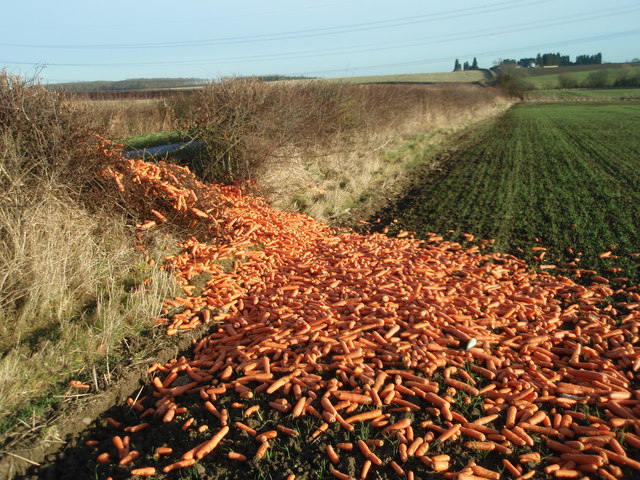
Carrot_Mayhem_Milking_Slade_Lane_-_geograph.org.uk_-_1090544Last week a farmer in the Yorkshire Wolds successfully sued East Riding Council for compensation of £14500 for the loss of a field of carrots. The carrot crop was apparently lost when floodwater was pumped onto the field at Burton Fleming, to prevent houses in the village from being further damaged by the water. This is apparently the first case of a farmer claiming compensation against a Council under the 1991 Land Drainage Act. The Council are waiting to see the Land Tribunal judgement before deciding whether to appeal.

The farm in question, Robert Lindley Limited, is a 670 acre (284ha)  farm in the Yorkshire Wolds. In 2013, the most recent years for which figures are available, they received €134,000 of farm subsidies. This relatively small amount for the area indicates that the farm uses some land to produce food which is not eligible for farm support payments – perhaps their large flock of free range chickens. Carrots are eligible for farm subsidies.

Robert Lindley Limited has received farm subsidies totalling €1.175 million euros since the Common Agricultural Policy rules changed in 2003. Before that time, farm subsidies were paid to farmers to support food production. Since 2003, payments have, in theory, been “decoupled” from production – from that date, landowners can receive payments under the CAP without producing any food, as long as their land is in “Good Agricultural and Environmental Condition”. The change was intended to reduce the overproduction of food which had been one of the consequences of the CAP in the previous decades.

The business also appears to be doing pretty well – shareholders funds increased from £1.35M in 2013 to £4M in 2014.

Carrots are an extremely lucrative crop: 700,000 tonnes of carrots are produced every year in the UK from just 9000ha, producing a crop valued (at sale) at £290M. While most of the value is captured by distributors and retailers, even if only 20% of that value went to the farmer, it would be worth £6400 per ha.

It was a strange coincidence that also last week, Neil Parish, Farmers Friend, and chair of the EFRA Parliamentary Select Committee, suggested in conversation with the Prime Minister

“In some areas the rivers need to be dredged in order to get the water out to sea faster. In other areas, perhaps upstream, you actually need to hang on to that water for longer. Therefore, perhaps planting trees or perhaps re-wetting that land —the farming practice — is necessary. At the moment, most of that compensation to farmers is for loss of profit, and it is not actually very much of an incentive for farmers, necessarily, to produce that land and use it for flooding. What I would like to see — I don’t know whether you would agree with me — is a much more proactive policy, where farmers are actually encouraged more to take on that water and manage it, and for that to be part of their farming practice, rather than being forced into it, so that we are using more of a carrot”.

Carrot indeed. Parish was reflecting the NFU position that farmers should not only receive farm payments for not necessarily producing food on their land, but should also receive top up payments for allowing it to flood in times of dire emergency. And, as the Burton Fleming case shows, if they are not dangled this additional carrot, they can sue the local council for compensation, with the support of the NFU and its insurance provider NFU mutual.

For the National Farmers Union, and, inter alia, its membership, have a direct financial interest in farmers receiving compensation from councils where farmland is flooded and crops lost. Farmers receive insurance from their union’s insurance company NFU mutual. So, if they can get compensation from somewhere else (eg Councils) then they can avoid having to spend the farmers money paying insurance claims, with consequent increases in the insurance premiums. No wonder NFU Policy Director Andrew Clark was pleased;

“We are very pleased it was decided that the authority should compensate Mr Lindley. It demonstrates the need for the flood authorities to be aware of the consequences of actively flooding farmland when carrying out flood risk management.

“It’s really vital to consider that many fields are used for food production and are the most important part of a farm business. The NFU is committed to supporting members affected by flooding issues.”


I wrote last week about the balance between private profit and public benefit. Society as a whole has to consider whether rural land should be managed in such a way that water is either retained so as to avoid downstream (urban) flooding, or that water is drained as quickly as possible from that land to maximise food production and farmers profits.

Given that landowners are no longer paid to produce food, for what are we paying them their subsidies, if not to provide public benefits? Public benefits that include, for example, retaining flood water on their land to avoid people’s homes being rendered uninhabitable and their treasured possessions destroyed. Surely this should be a condition of receiving CAP subsidies.

If the Burton Fleming case is upheld, it would indicate that landowners are going to be paid by UK taxpayers, to drain their land and create downstream flooding (via the CAP), and then paid again, by local council tax payers, when their land is used to hold flood water back.

I wonder whether the residents of Burton Fleming, whose houses were flooded in 2012, are aware that the Council Tax they are paying, is being used to pay their local farmer compensation (and therefore keep other farmers’ insurance bills down), instead of paying for essential services like schools, or the fire service. East Riding Council will need to have found £194M of savings from its budgets in the 10 years to 2020.


photo: “Carrot Mayhem Milking Slade Lane – geograph.org.uk – 1090544” by Michael Trolove. Licensed under CC BY-SA 2.0 via Wikimedia Commons.
Posted in Common Agricultural Policy, drainage, farming, flooding | Tagged , , , | 7 Comments

Two epiphanies at Kelmscott

Dante_Gabriel_Rossetti_Water_Willow_1871

Water Willow, by Dante Gabriel Rosetti (Kelmscott in the background)

David Cameron isn’t the only person to have had a personal epiphany about nature at Kelmscott. Cameron related a story about Two Water Voles, to the Parliamentary Liaison Committee yesterday, about which I have just written.

The PM used his “two voles” story, to illustrate why landowners should be given the freedom to dredge and ditch without interference from red-tape wielding hi-vis jacketed busybodies from the Environment Agency. He and others also used it to make the point that nature gets in the way of progress.

But there is another Kelmscott story. Because Kelmscott was home to William Morris. Morris was an anarchist/socialist, so perhaps he might not be welcome on the PM’s radar.

Morris also helped found the National Trust. But Morris is more famous as one of the founders of the Arts and Crafts movement; a movement inspired by nature, by the plants and animals that Morris and his fellow artists found in the countryside around them, in places like Kelmscott.

Morris understood that People Need Nature. When will we get a Prime Minister who understands?


“Dante Gabriel Rossetti Water Willow 1871” by Dante Gabriel Rossetti – Wikipaintings.org. Licensed under Public Domain via Commons – https://commons.wikimedia.org

Posted in David Cameron, People Need Nature | Tagged , , | 4 Comments