further thoughts on the Net Gain consultation


Following on from my general critique of the Net Gain proposals, here are a few specific comments in case anyone is thinking about responding to the consultation before the deadline of the 10th February.

1. On page 6 of the consultation Defra proposes populating the standard biodiversity metric using surveys from consultants working for the developer. Can anyone see a problem here? Who checks whether the consultants have accurately and objectively mapped the resource? Call me a cynic but I would have thought it’s in their and their clients interests to minimise the existing value of the resource – saves on time and money.

2. As soon as I saw mention of “Habitat Creation Markets” (Page 35) my heart sank and I was reminded of George Eustice’s dream of tradeable biodiversity credits. Let that dream go, Minister. It also reminded me that the Environment Bank was merrily proposing biodiversity offsetting at Lodge Hill, even while it was being designated as a SSSI.

3. I thought this quote (page 10) was quite telling:

The government will only mandate biodiversity net get if it is satisfied that it will deliver benefits for development, including greater certainty and process cost savings

I wonder whether this is really the right place to start thinking about the principles for Net Gain. Had one started from the position of “how can we end up with more wildlife than we started with”, rather than “how can we make it easier for developer to build market housing”, I might be prepared to be more positive about it.

4. Might funding via the tariff only be channelled into replacing other sources of public funding which have been cut? What about funding for existing local parks and other open spaces where LA funding has been starved? Would this be real net gain or merely robbing peter to pay Paul.

5. There are plenty of nods to the mitigation hierarchy, which were welcome. But I did wonder to what extent these were providing cover for the more hard-core natural capital approaches being advocated.

6. The Natural Capital Committee was very critical of the Net Gain proposals, in particular querying why only Biodiversity was being considered, and not other aspects, such as water quality, carbon sequestration etc. One reason may be because biodiversity is, even in Natural Capital Accounting, often assigned a zero value (thus blowing a massive hole in the NC philosophy), whereas economists have found it easier to price the value of flood reduction or carbon. I’m not making any comment as to whether I agree with the approaches they have taken to create these prices.

7. In this context I was interested to read that Natural England is developing an “eco-metric” designed to show how much value a wildlife habitat delivers to society in terms of its ecostystem services (page 18). To which my responses is…. arghhh.

8. Another interesting point made in the Natural Capital Committee response was that they questioned why Net Gain was only measured from a base-line of what the current value of a site was; and why there was no consideration of potential value of a site. It also occurred to me that if business as usual land-use practices were contributing to ongoing net loss of wildlife from eg farmland, how this would be factored in. When and how is the base-line to be set, using what data?

9. It’s not as though the base-line is level at the moment. Net gain has to be set against ongoing net losses. So part of the net gain only really addresses the continuing declines. That’s a big hurdle to get over in the first place. Also historic activities which have stopped, are continuing to have an impact eg historic Nitrate fertiliser use causing water quality pollution decades later.

10. Defra’s ambition is for a 10% gain (in terms of Biodiversity Units). Would this even be enough to address the ongoing declines?

11. The Net Gain consultation proposes excluding alterations to buildings – what about roof-dwelling bats?

12. There is also a proposal to exclude developments of less than 10 homes or 0.5ha. Given how small some surviving wildife sites are, there should at least be some mechanism to check whether a small site is nevertheless valuable.

13. The Proposal to exclude all brownfield sites from the Net Gain requirement really does seem like madness to me. Both Lodge Hill SSSI and Rampisham Down SSSI were brownfield sites when they were designated. And Brownfield sites often have far more wildlife value than farmland, precisely because they have not been soused in Nitrogen and Phosphorus for the past 50 years.

14. The proposals include excluding any consideration of species interest on a site, other than Great Crested Newts (which are to be dealt with using the area licence approach.)

15. Why put a time limit (eg 25 years) on Net Gain? How does this make any ecological sense?

16. There is no effort to resolve the conundrum of “irreplaceable habitats” in the consultation. At present there is a definition of irreplaceable habitats in the NPPF.

Irreplaceable habitat: Habitats which would be technically very difficult (or take a very significant time) to restore, recreate or replace once destroyed, taking into account their age, uniqueness, species diversity or rarity. They include ancient woodland, ancient and veteran trees, blanket bog, limestone pavement, sand dunes, salt marsh and lowland fen.

within the Net Gain consultation only Ancient Woodland (which is not a habitat but a historical category) is mentioned. Lowland heathland or ancient pastures like chalk downlands are not mentioned, although they would fit the broader definition in the NPPF.


Posted in biodiversity offsetting, housing, Natural Capital, net gain, NPPF, planning | Tagged , , | 1 Comment

Accountancy will not save nature: the problems with “Net Gain”

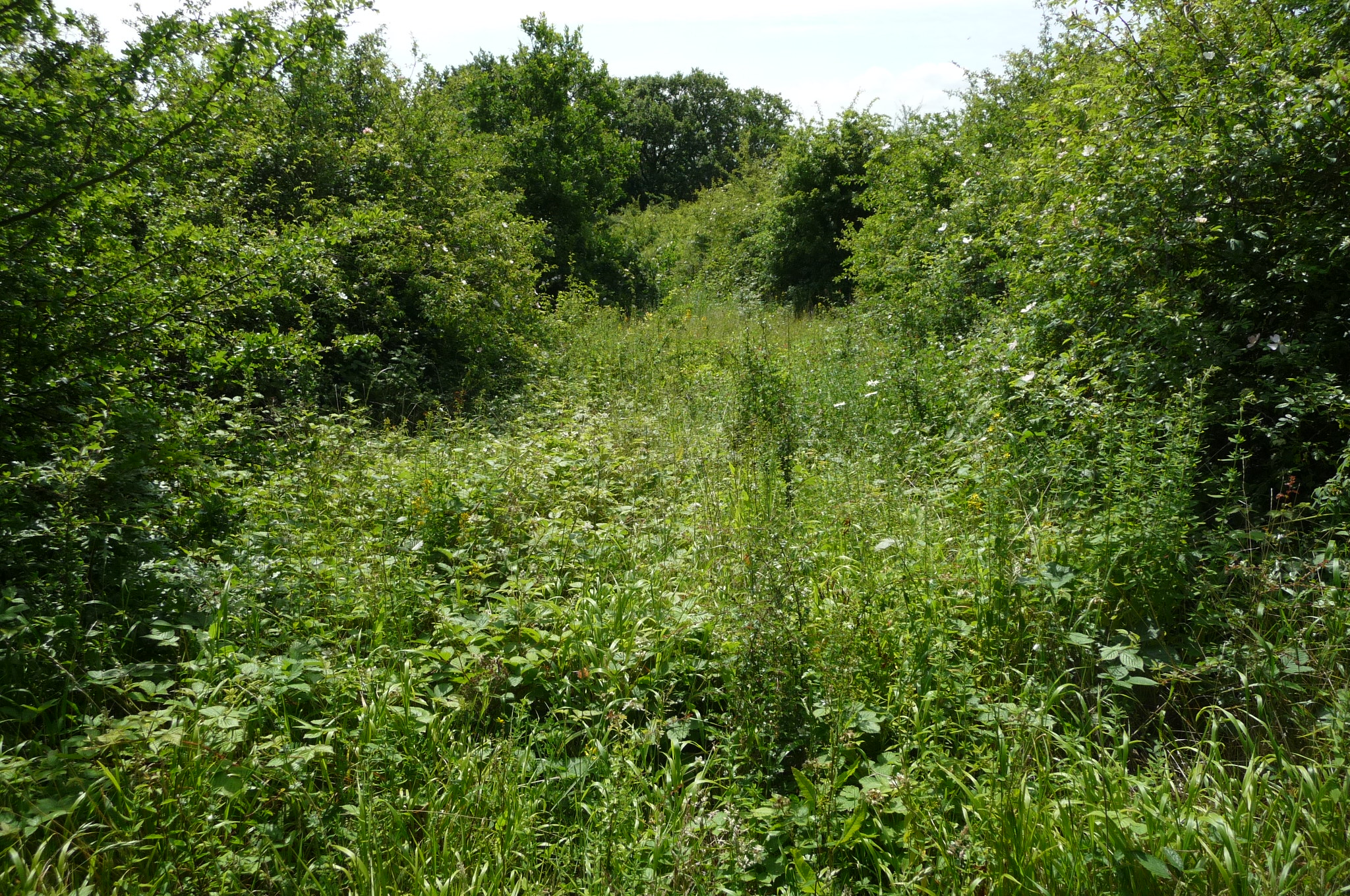
How many biodiversity metric credits are these plants worth? ©Miles King

It’s difficult to believe that while we watch – ok, there are probably only a few of us now hanging on to the bitter end, as most will have given up and gone off to do something more sensible – a series of Parliamentary cans being kicked down the road towards a no-deal Brexit, that there might still be some other things happening; new ideas being developed, new policies being proposed etc. to improve our collective lot.

One such idea is called ‘Net Gain.’ It doesn’t sound very promising does it? But I doubt the best minds of Defra were called into action to work on an exciting title for this project since they have all been seconded onto the team planning how to use the army to distribute food to the masses, without using the gridlocked motorway network, if we do crash out of Europe without a deal.

Net Gain is an idea that’s been around for a while, but has re-emerged with a new name. The old name was Biodiversity Offsetting which became tarnished, by association with Owen Paterson, the ardent ‘Brexist’ and former Environment Secretary, who enthused over how ancient woodland could be easily replaced with new trees.

The premise laid out in Defra’s consultation on how Net Gain would work, is that when new houses are built, wildlife is lost from the land – usually farmland – where the houses are built. Normally, there would be a collective shrug and “oh dear how sad, never mind” before the Council leader ceremonially cut the ribbon on the latest shiny new housing project (which of course won’t solve the housing crisis anyway – as I explained before) and the caravan would move on.

Net Gain seeks to not only address the loss, but to actively create more wildlife than was lost – hence “net gain” – it’s a type of environmental accounting.

A calculation is made. The losses – which could range from Badgers and Great Crested Newts being evicted, hedges full of songbirds or butterflies being destroyed, ancient soil under wildflower meadow or heathland being dug up and shifted elsewhere – are totted up. And the totting is converted into a number – technically called a metric (let’s call these metric A). Then the replacements – ranging from a bird box on the side of a building, a new amenity pond in a housing estate, some urban green space where trees are planted and seeds of flowers sown, right through to the creation of large new plantations or wetlands  – are also converted into a number; another metric (yes, you’ve guessed it – Metric B) and the final calculation is done. Is Metric A more or less than Metric B (gains)? If B is greater than A then a Net Gain has been achieved and, as Charles Dickens said, “result – happiness.”

Those of you who have read some of my writing, here and elsewhere, will know that I am not enthusiastic about this accountancy approach to wildlife or Nature – it’s the natural capital approach; the idea that the extraordinary, wondrous and infinite value of Nature to people (quite apart from to itself) can be boiled down to a few numbers, for the purpose of converting that value into financial value. Because, despite the new terminology, this is what lies underneath Net Gain.

On the surface the idea of ending up with more wildlife after a housing development than was there before it was developed, seems intrinsically appealing. Who could argue that this would be a bad idea? We know that people are happier when they live in surroundings with more Nature, more greenery, more open spaces. Having Nature around makes people happier and more contented, we know that’s true.

Some canny developers are already working with conservation charities to incorporate wildlife into their developments – I wrote recently about an interesting development near Aylesbury where the developers are working with the RSPB on just such an approach. And what could possibly be wrong with trying to quantify the gains for Nature resulting from such developments?

Those in the conservation world are always using statistics to argue for changes in policy or law e.g. “these farmland birds are declining because of these types of intensive agriculture, so if we change that policy, so farmers will be supported to change their practices, then farmland birds numbers will go up again.”  This is an argument you will often hear, entirely dependent on data collected by people (mostly volunteers) going out, rain or shine, and counting the number of farmland birds they see, week in, week out, year in, year out.

The problem arises when scientific statistics are converted by economists into the language of accountancy.

Instead of farmland birds – yellow hammers, corn buntings, skylarks – we have a metric, a number. Think of it like this – “Yes, we’re very proud of the wildlife on our farm. We have yellow hammers. There are hares. I saw a hedgehog last week. The primroses in the wood are beautiful in the Spring, they remind of that day when….” you get the picture. All of that  – that wildlife, that history, those memories and stories – boiled down into: Yes, that farmland has a value of 2.63 on the Defra biodiversity metric.

According to the proposals from Defra, Net Gain will be defined by a 10% gain in the metric; so Dickens’ “happiness” will be a value of 2.893. This figure of 2.893 might mean any number of different things: It might mean a new park with a pond is incorporated into the new housing development; it might mean swift tiles in the roof of every house; it might even mean a new 10ha wildflower meadow is created on some other farmland 10 miles away. All of these things might contribute to 2.893. But can they replace what has been lost – can a metric include all of those aspects of a place with a history? Of course not. But then these things are usually lost when farmland is converted to housing – or rather, with those losses, a new chapter in that history unfolds.

The really odd thing about Net Gain to me is that it only applies to housing developments. Over 80% of the UK is farmland or forestry (and that’s where most wildlife is found), but there’s no suggestion that Net Gain should apply to these activities – why not? The simple answer is that it’s too difficult. Developers need to go through the process of gaining planning permission before they can build houses. Ploughing up a heathland or converting woodland into conifer plantation is much easier.

While Net Gain might make sense on one level, as a way to extract a financial contribution from a developer to pay towards improving the overall lot of wildlife in the area where the development takes place, one has to wonder whether the money will come from? After all, who pays?

Defra’s idea is that the developer will know, before shovel hits ground, how much they will have to pay towards Net Gain – in real cash terms. Developing on a particularly wildlife-rich site will mean more is paid out for Net Gain (and in theory could act as a disincentive to develop such land.) The developer won’t see this come out of their profit margin, so it either comes off the purchase price paid to the landowner, or it goes on the cost of the houses. I’d bet on the latter. You might end up paying more to buy a new house in a wildlife-friendly housing development, unaware of the destruction of nature that led to its creation.

Net Gain though? That’s for the birds.

PS: I’ve posted some more detailed comments on the consultation here

this column first appeared on Lush Times.

Posted in biodiversity offsetting, housing, Natural Capital, net gain | Tagged , , , | 6 Comments

Some thoughts on the EAT-Lancet report and the anti-vegan backlash against it

We already know that globally, human diets are seriously out of balance. We spend far too much effort growing cereals like wheat – much of which ends up being fed to animals – and nowhere near enough time and resources producing vegetables, fruit and sources of plant protein, like pulses and nuts. In this context, a new report from the unusually named “EAT-Lancet Commission”, called Food in the Anthropocene: the EAT–Lancet Commission on healthy diets from sustainable food systems has been causing a bit of a stir.

The report, produced over a three year period, and supported by a Scandinavian thinktank (called EAT) and the UK’s Wellcome Trust, has some profound recommendations including reducing the proportion of meat and dairy in our diet, and increasing what are termed “plant-based foods”.

It’s a long, dense report. It covers a wide range of issues, including human health and environmental impact, especially the climate change impact of food production. The simple message is contained within what the authors call the Reference Diet, which outlines which foods nutrients should be derived from – and it is mainly (but not exclusively) vegetarian.

As an aside, I have a slight problem with the phrase “plant-based foods.” Other than mushrooms (which are not plants, but fungi), all food is plant-based because plants form the foundation of the planet’s ecosystem. Plants and their components – seeds, the flesh of underground tubers, and so on, are not “plant-based”, they are plants. And anyone eating fish or meat is eating an animal which lived and grew by consuming plants. If you want to be pedantic, it’s true that marine fish (and shellfish) eat a diet derived ultimately from phytoplankton  – which is a complex mixture of tiny plants, bacteria and archaea. But, to a simple approximation, and for most purposes, it’s fair to say that all food is plant-based food.

The report highlights the appalling amount of food which is grown and never eaten, but lost or thrown away. It supports the Half Earth strategy to halt this current mass extinction of Nature that we have caused. And it argues, quite rightly, that the retail price of food does not reflect the total cost of its production and consumption. It proceeds through the evidence which points towards an urgent need for us, at least in the West, to change our diets or face environmental catastrophe. And whilst it recognises the need to reduce Carbon Dioxide emissions from agriculture to zero, I was surprised that the authors did not feel that the impact from the two other main greenhouse gases associated with agriculture, Methane and Nitrous Oxide, also needed similar reductions.

Methane (from agriculture) is produced by ruminants such as Cows and Sheep (and rice paddies), while Nitrous Oxide is released mainly from the use of artificial fertilisers made from Nitrogen, about which I have previously written. The report only sees the need to keep levels of these two gases at their current levels – this may be a sop to those who advocate the need to continue using synthetic Nitrogen fertiliser (and the industry that depends on it) instead of adopting agro-ecological approaches which reject this argument.

Indeed, the authors actually recommend that the application of Nitrogen fertilisers, (which we know cause so much damage to the environment), should increase – albeit with a redistribution from farmers in the developed world, where use would decrease; to farmers in the developing world, where use would increase. This is part of what is called “sustainable intensification”, whereby (in theory) more crops are grown on less land, with more efficient farming techniques. It has to be said that this is controversial – and at odds with the principles of Agro-ecology that Lush supports.  An agro-ecological approach would often use animals, via their manure, to redistribute nutrients to fields where they are needed to help crops grow more quickly.

A vegetarian/vegan conspiracy?

There are some other real contradictions – for instance the reference diet include up to 6g of palm oil, from Oil Palm. There is no sustainable source of Palm oil, so including any in a reference diet would bring into question whether the authors had fully considered all the environmental impacts of the foods included. Even under the best future scenario where global food waste is halved, the authors anticipate around 30% increase in Palm Oil production over the next 40 years. This increase would surely devastate what little is left of the Tropical Rainforests of South-East Asia, and elsewhere.

Although welcomed in some quarters, perhaps more surprising than the report’s findings, are the extraordinary attacks aimed at it, for being part of some global Vegan/Vegetarian conspiracy. No seriously. I have read critiques from people who I had previously considered to be sensible, which claim that this is part of a secret global food industry plan to get us all eating a “plant-based” diet over which they will have total control – forcing us all to become vegan zombies.

This ties in with a more general backlash against Veganuary, which is being painted as something supposedly forcing people to give up eating meat or dairy products. But the reference diet specifically states that up to 84g (3 ounces in old money) a day of protein can be derived from meat, eggs or fish; plus up to 500ml of milk of equivalent in cheese/yoghurt.

How many subsistence farmers and the families they feed, across the world, get this much animal protein every day? The report references figures of around 30g of animal-derived protein per day per person, globally. So the Commission is actually recommending a substantial increase in animal protein consumption, per person, from the current situation. It’s just that this would also mean a substantial, or indeed dramatic, reduction in animal protein consumption from the current high rates in some western developed nations. Such as the UK.

Others have criticized the report for failing to recognise that sustainably produced red meat can produce healthy food, support Nature and tackle climate change. While this is true, it also seems somewhat parochial – growing lamb or beef organically on the Welsh hills is not exactly representative of the kinds of problems being identified at a global level by the authors. Conditions in the West of Britain and Ireland are certainly conducive to growing grass and (in the past) wildflowers, which produces fantastic quality meat. But this cannot sensibly be extrapolated to provide a solution to our global food crisis.

It should come as no surprise to anyone that the hard-right “thinktank” and questionable charity the Institute of Economic Affairs attacks this EAT-Lancet repor, as an emanation of the International Nanny Superstate. The IEA was founded by Antony Fisher, who made his fortune introducing intensive “battery chicken” production systems from the USA to the UK. The IEA’s food-nanny finder-general, Chris Snowden, has denounced the report

“The potent combination of nanny state campaigners, militant vegetarians and environmental activists poses a real and present danger to a free society.”

Could this splenetic attack have anything to do with the IEA being funded, even now, by Agri-Industry? Greenpeace revealed recently how the IEA was being funded by US intensive beef producers, looking for ways to access the UK’s food market post-Brexit, by reducing food and animal welfare standards.

I think this report makes a serious contribution to the debate, both here (especially as Brexit-driven impacts on our food system loom ever closer) and internationally. While some of the solutions it proposes are problematical and therefore unpalatable, it at least recognises the problems of a dangerously imbalanced global food system, and the need for fundamental change.

This article first appeared on Lush Times

Posted in Food, food security, veganism | Tagged , | 9 Comments

St. Boniface, Avatar and West Ham United – in the realm of sacred trees

spirituality cartoon from ORFC by @envirovisual

It’s not often that a giant magical tree stars in a Hollywood mega blockbuster film. And what could possibly connect it to a key story in the transformation of Northern Europe from pagan-worshippers to Christians? These are the kinds of thoughts which wash around my brain after an invigorating mental workout at the Oxford Real Farming Conference, about which I wrote last week.

The film in question is director James Cameron’s 2009 blockbuster Avatar, where the very tall blue indigenous people of the planet Pandora live in their sacred Home Trees. One of these is deliberately destroyed by the colonising humans, who are intent on obtaining access to an unimaginably valuable mineral resource which sits under the tree.

There are other even more sacred (and magical) trees in Avatar – and I wonder whether James Cameron was influenced at all by the story of St. Boniface. St. Boniface was a Christian missionary from Devon. Boniface’s original name was Winfrith – which by strange coincidence was the village chosen in the 1940s to host the UK Atomic power research facility, and just down the road from where I am writing.

Winfrith travelled to what is now western Germany to help with the conversion of the pagan Franks living in that part of Germany to Christianity. He found some continued to worship a sacred Oak tree, later called Jupiter’s or Donar’s Oak.

Boniface, with the help of some followers started to chop the immense tree down. Legend has it that as the first axe-cuts were made to the tree, a great wind blew up and split the enormous trunk into four equal pieces, imperilling the fellers. But Boniface emerged unscathed from the ruins and it was deemed a miracle. The pagans were so impressed by this miracle that they gave up their pagan beliefs. The tree’s timber was then used to build a church dedicated to St Peter, near the site of the sacred tree. Boniface went on to become one of the most significant founding figures of the Church in Western Europe.

A wave of desecration

This story neatly summarises centuries of activity, where sacred trees and other natural features, such as sacred wells and springs, were either expunged from the landscape, or appropriated into Christianity, at least until the 16th Century Reformation. At this juncture, the new Protestant faith rejected the false idolatry of shrines and images – and a further wave of desecration  – literally meaning the removal of sacred objects – took place.

Have any sacred trees survived to this day, especially in our mainly secular society? You might be surprised that they do, and in the most unlikely places.

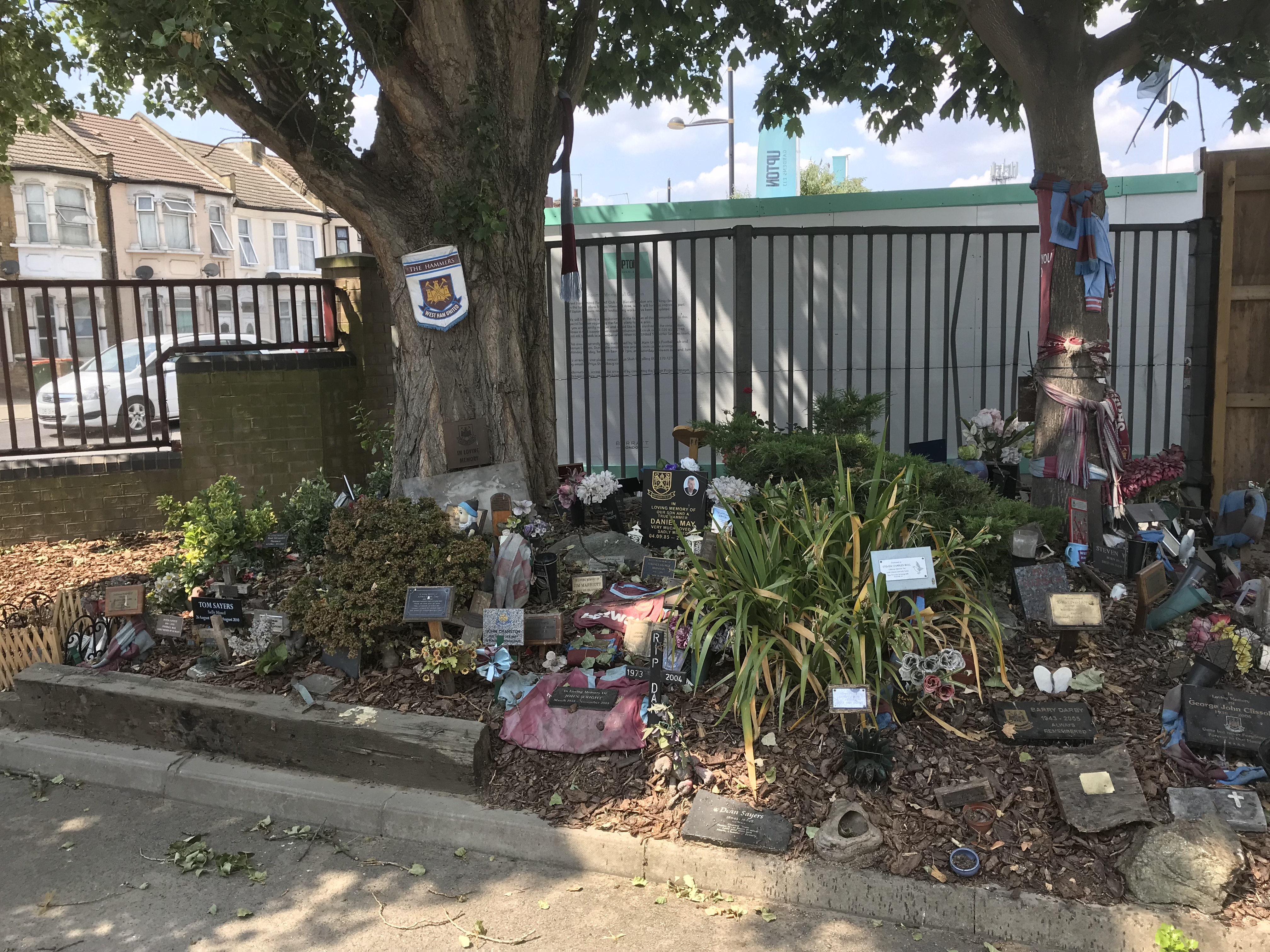
Upton Park memorial garden and trees ©Miles King

It’s coming up to the tenth anniversary of my father developing, what would be for him, a fatal form of cancer called Acute Myeloid Leukaemia. Peter was a lifelong, die-hard West Ham fan, having been born within a few hundred yards of the Boleyn ground in Upton Park, West Ham, in East London. His father had also been a fan, and had been part of the famous crowd at the first FA Cup final at the new Wembley stadium when the Hammers lost to Bolton Wanderers in 1923. There was such a large crowd (estimated at up to 300,000) present for that game that it spilled onto the pitch stopping the match.

Peter was not expected to survive the Leukaemia, but incredibly, he did and in the end had a little over a year’s extra time, before it returned – and he died in July 2010. During this time he had decided that he wanted his ashes to be spread on the pitch at Upton Park, as many lifelong Hammers fans do. When we approached the club they explained that this no longer happens (on account of the players not really wanting to tread on people’s ashes as they played) and that over the last few years, ashes had been interred around a large Lombardy Poplar tree near to the club entrance.

We duly arrived at the ground to meet the Chaplain, who performed a simple ceremony as we interred the ashes under the tree. Around the base of the tree were a small sea of plaques and other memento mori, all in memory of Hammers fans, whose ashes had been sent from all around the world, to return to their spiritual home.

The tree (and a younger one next to it) had been festooned, time and again, by the grieving relatives of Hammers fans, festooned with scarves, badges and other memorabilia. Time, and the ravages of the weather (and London street pollution) had left some of these as strands of wispy fabric caught in the bark of the Poplar. A rather forlorn looking garden gnome, in claret and blue sat, unblinking, at the base of the trunk. This was clearly a sacred tree.

I do not use the words “spiritually” or “sacred” lightly in this context. I would certainly not be the first person to draw an analogy between football and religion. As the legendary Liverpool manager Bill Shankly said:

some people believe football is a matter of life and death, I am very disappointed with that attitude. I can assure you it is much, much more important than that”.

My dad wasn’t religious, indeed he was what I would call a fanatical atheist. But he had faith in West Ham, following them through thick and thin, through the glory years when West Ham effectively won the World Cup for England in 1966 – and also through many years of mediocrity and failure.

Football has many elements of a religion – a shared faith in something bigger than yourself – opportunities to sing together, the many rituals associated with thousands gathering at a place (of worship) every week. A place where you can forget the troubles and difficulties of daily life, for a couple of hours. Where there are heroes (and villains) to be worshipped – and also idols to knock off their plinths, when they fail.

When West Ham sold the Boleyn ground (for a housing development) and moved to Stratford, my mum and I were very concerned about what would happen to the tree and its sacred burial ground. After some cajoling, the developers (Barratts) committed to protecting the tree and creating a new memorial. They asked us for our views about what the memorial would look like and it was gratifying that they recognised how important this place, and that tree, had become.

Elsewhere in the world, you will find many examples, in a variety of different cultures, of sacred trees being venerated and dressed, as memorials for people, who were loved and lost. Despite living in materialist secular societies, we still have a deep need to find what I would call a spiritual connection to Nature.

As the West Ham tree shows so clearly, there is no need to formalise this relationship through religion – and few would argue that West Ham has any properties that one would associate with the supernatural. On one level this is about humans, and the things that we need – that Nature provides. Things like solace and the opportunity to remember our loved ones in ways that are healing and strengthening.

This article first appeared on Lush Times

Posted in Oxford Real Farming Conference, sacred trees, spiritual value, spiritual value of nature, West Ham | Tagged , , , , , , | 4 Comments

Some thoughts on the Oxford Real Farming Conference 2019

cartoon by Rebecca Roberts @envirovisuals

Last week’s 10th Oxford Real Farming Conference was bigger than ever, with over a thousand delegates attending – and nearly as many again, on the waiting list for returned tickets. The conference was spread over even more venues this year, to cater for the extra people, and the organisers also used a local church/community centre, as the food venue, where an eclectic mix of stalls provided sustainably produced and cooked food, catering for vegans and meat eaters alike.

As usual, there were many different sessions covering topics from the ever present questions over how Brexit will impact on food producers in the UK, through to the more esoteric – including soil health, agroforestry and genome editing; to food labelling, land reform, and the county farm sell-off.  (As I was only able to go to a small selection of the sessions, this review will be very selective. Lush’s Ben Davis is also writing about the conference so look out for his upcoming piece about about other topics covered by the conference.

The conference kicked off (for me) with a session on the Agriculture Bill which is currently passing through Parliament. Sustain’s Vicki Hird joined Tom Lancaster from RSPB and farmer Stephen Briggs to discuss the “good, the bad and the ugly” of the Bill. Vicki expressed her concerns that the Bill was potentially just greenwash and all the fine words about “public money for public goods” would come to nothing if all the powers were handed to Government ministers. Farmer Stephen Briggs was disappointed that so few farmers were actively engaging and seeking to influence the content of the Bill, preferring to “sit on their hands” until the decisions had been made.

A far more uplifting session was to be found in the main hall (of the rather grand Oxford Town Hall) where Palestinian seed library founder Vivien Sansour, “the Seed Queen of Palestine” showed a film (which can be found here) which tells her story.

A story of love and resistance

It is a story of love and resistance by growing traditional cereals, fruit and vegetables. Sansour returned from working in Mexico to realise that heirloom varieties which the Palestinians had grown for generations were disappearing – these included a special drought resistant “dark” wheat; a giant variety of watermelon and a purple carrot variety, which was used in a traditional dish where it was stuffed with pine-nuts (it was her mother’s favourite dish).

Sansour searched for these lost crops – was repeatedly told they no longer existed but did not give up hope. Eventually, she found that they were still being grown (almost in secret in some cases) despite the immense difficulties inherent in that region. Big agribusiness is taking over the land, to grow things like tobacco – as she put it, crops like tomatoes, grown under plastic, which are cheap and have no flavour.

Sansour explained how saving heirloom varieties and encouraging farmers to grow them again, brings people together and helps them believe that their lives do have value despite what they are told. She has created a mobile kitchen which cooks food with these heirloom varieties to encourage Palestinian communities to rediscover their food culture. She also made a passionate case to argue that seeds belong to people, not companies, and explained how every grandmother in Palestine used to have a tin full of saved seeds to plant in the next season.

From the sublime to the…. Next on stage was Environment Secretary Michael Gove in a session with Labour MP and environment stalwart Kerry McCarthy. Much of what Gove said was familiar and there was little new – although apparently he expressed some sympathy with the Sustainable Food Trust’s Patrick Holden, who asked him when he was going to introduce a Nitrogen Tax, to help reduce the enormous excess of Nitrogen in the farmed (and wider) environment.


The spiritual value of Nature

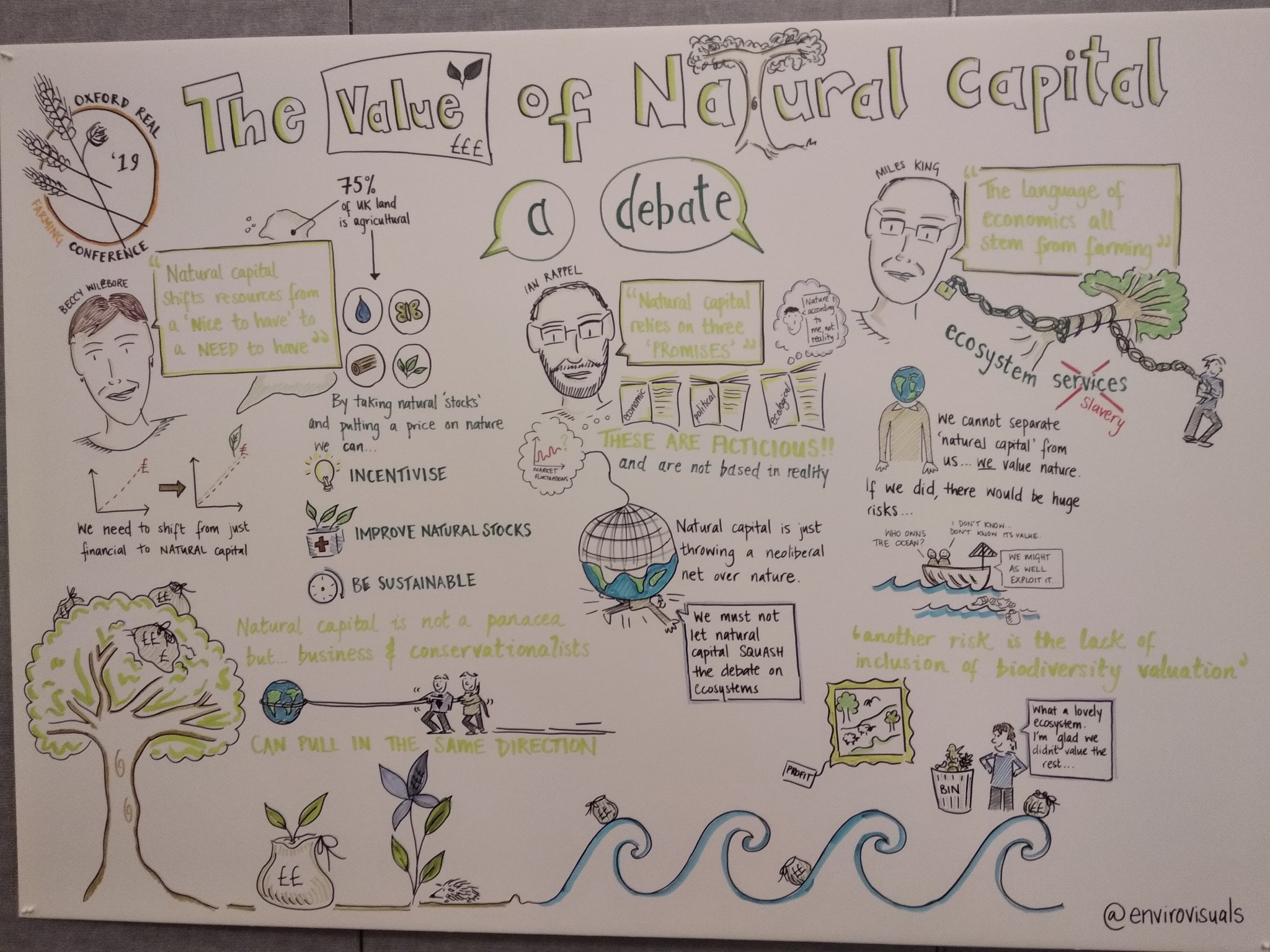
With my People Need Nature hat on, I was involved with two sessions at the ORFC – one was a debate on natural capital, the other, on the spiritual value of Nature. While it would be inappropriate for me to write on how great these sessions were, I certainly enjoyed helping to organise them and take part. The audience was very lively in both and I hope they went away with much to think about on both of these, closely interrelated topics.

Much of what I said on natural capital can be found in an earlier Lush Times article, here. I set out a bit of a challenge to the audience (many of whom were farmers) asking them whether – and if so how – they could provide opportunities for people to have spiritual experiences of Nature on their farms – and whether these would qualify as “public goods” for which they might be paid by the Government. In truth I think this is unlikely, but you never know.

Two French environmental law and agriculture policy experts (Ludivine Petetin of Cardiff University and Viviane Gravey of Queen’s University Belfast) who have made their homes in the UK, provided a very interesting and informative session looking at how the Common Agricultural Policy is likely to change in the coming years, partly as a result of the UK leaving the EU but also because it was going to happen anyway.

The upshot of their research (for an upcoming Soil Association report) is that the Common element of the EU-wide agriculture policy is likely to become increasingly weak in the coming years, as each member state adopts its own approach, under a loose common framework. They argued, with strong evidence, that the UK had made its own mess of the CAP by implementing it in unhelpful ways. For instance, Michael Gove had complained that the CAP restricted payments to farmers who owned over five hectares of land and that leaving the EU would enable the UK to support small-holders. Not so! Over half of all EU member states paid support to farmers with less than 5ha of farmland – the UK had just decided not to.

Promoting agro-ecology

In Italy, CAP funds were being used to support care farms – with 400 social/agricultural cooperatives being funded to provide a range of support for social inclusion and care, rehabilitation and education through growing local sustainable food. The UK could have adopted this approach but chose not to.

Meanwhile, in France CAP funds had been used to promote agro-ecology through France’s many agricultural schools and colleges. Though this had prompted some backlash against what was derisively called “the new religion of agro-ecology” France also has a grassroots movement known as “We want poppies” where citizens, inspired by agro-ecological principles, are campaigning against the ubiquity of pesticide use. Sustain, the Land-workers Alliance and others, will continue to lobby for agro-ecology to appear explicitly in the UK Agriculture Bill.

As has been my experience in the past, I found the Oxford Real Farming conference inspiring and also a great opportunity to catch up with old friends and make new ones. I would certainly recommend it to anyone with an interest in food, farming and Nature. But I also predict tickets will sell out even more quickly next year.

this article first appeared on Lush Times

Posted in Oxford Real Farming Conference, People Need Nature | Tagged , , | Leave a comment

Merry Christmas/Solstice/New Year

Winter Solstice sunset, Burton Bradstock. ©Miles King

It’s been a funny old year, hasn’t it. The Brexit fall-out just seems to have become more and more deranged as the year progressed, culminating in the last few week’s utter chaos.

There have been a few chinks of light though. The new Agriculture Bill makes its slow progress through Parliament and continues to promise a new approach to supporting farmers, paying them to provide public goods, rather than just because they own the land. Just last week the first clues to what the new Environment Bill will offer, in the way of a replacement for previous environmental protections provided via the EU, were less promising, but it’s early days and there will I am sure be opportunities to strengthen weak protections. And then we were treated with the excellent news about Lodge Hill last week.

This year, sharp-eyed readers of this blog (that’s all of you, of course) will have noted that I have been mainly writing over at Lush Times, then reprinting those columns on here. I have been writing a more or less weekly column over there  – and it’s surprising how much time it takes to write a thousand words a week, but I am enjoying it a great deal. Thanks to Lush (and all my friends there) for supporting me and giving me the opportunity to write about the things I care about.

Once again, as in 2017, Brexit has been a huge distraction and is probably now a displacement activity for many (including me). Will it cease to be so, once March 2019 passes (assuming it isn’t postponed or cancelled.) Who knows. I have no crystal ball.

People Need Nature has not progressed quite as quickly as I had hoped. I really was very naive in thinking that charity funding was out there in the same way that it was in previous times. It has been a shock to discover how little funding is now available. Anyway I will try and make progress with PNN as and when I can. Emphasising the spiritual value of nature and nature as a source of inspiration for creativity continues to be my overall goal – and given how nature and wellbeing is now so well established as a reason for valuing it, I think the prospects continue to be good. I look forward to seeing some of you at the Oxford Real Farming Conference, where I am talking at a couple of sessions, one on the spiritual value of nature, the other on the perils of natural capital.

A few of you will also know that this year has been very difficult for personal reasons, which I cannot go into at this time. I’m hoping that 2019 will be much better.

So it just remains for me to wish you all a very Merry Christmas/Solstice/New Year  – for if you aren’t Christian it is all the same mid-winter/turning of the year, celebration. My Christmas present to you is that I have taken out a subscription to wordpress, so you won’t see any more annoying adverts. At least that’s what I’ve been promised!


Posted in Christmas 2018 | Tagged | 6 Comments

Lodge Hill Saved

the remarkable scrub/grassland mosaic at Lodge Hill ©Miles King

There was some very unusual good news late last week as Homes England announced that it was no longer pushing for housing development on the protected areas of Lodge Hill – the former military training ground (and munitions works) on the Hoo Peninsula, Kent. Instead they will push for a 500 house development on the former MoD land outside the SSSI.

As long-suffering readers of this blog will know, Lodge Hill and its remarkable array of natural history and historical interests, was threatened with total destruction, in the form of a 5000 house new town. Despite Natural England finding the gumption, under severe pressure from conservation NGOs, to notify Lodge Hill as a Site of Special Scientific Interest (SSSI) in 2013, Medway Council and the MoD pushed ahead with their development plans. I have chronicled most of the story on here (search for Lodge Hill). Up until this latest announcement, we were waiting for a Public Inquiry to be called to determine the site’s future.

Make no mistake, this is a major victory for nature conservation. Thanks, at least in part, to “controversial” notifications such as Lodge Hill and Rampisham Down, Natural England has been eviscerated – see my previous blog on Natural England’s demise. Despite their claims, it seems unlikely to me that the hollowed-out remnants of a nature conservation champion had that much to do with this change of heart at Homes England. Nor can I really believe that RSPB was able to bring this about through their continuing efforts.

Much more likely is the intervention of Secretary of State for the Environment Michael Gove. Gove may well have felt now would be a good time to persuade new CLG Secretary James Brokenshire that getting 500 houses built on the former MoD land would be a big win, without the controversy that would inevitably accompany a Public Inquiry. Such a Public Inquiry, with the Government effectively arguing for the complete destruction of a site it had protected only a few years ago, would make a big dent in the notion of Gove’s Green Brexit. You may feel that the GGB is a bit of a joke anyway, given the threats to the environment that Brexits of all colours will bring. Nevertheless it’s something that I am sure Gove believes in – and there are still promising signs that the new Agriculture Bill will bring about improvements for nature in the farmed environment.

Natural England’s marginal involvement in the decision is also reflected in the fact that Homes England didn’t tell NE of their intention to make this momentous announcement last Thursday. We’re still waiting for a substantial comment from Natural England – other than a rather belated tweet pointing out its key role in protecting the site.

Some have complained that building 500 houses near to a SSSI will still be enormously damaging to the value of the site for nature. That remains to be seen, but it should not detract from the importance of this decision. This isn’t just about Lodge Hill. It sends a signal to housing developers and local planning authorities, that SSSI designation is a powerful regulatory tool which can stop housing development. Eight years ago no-one would really have thought that this was something worth debating or even an issue. It shows how much the political and policy landscape has changed since 2010. Hopefully this decision could be a sign that the pendulum is swinging back towards a position where regulation for nature is seen as a good thing rather than a hindrance to economic growth, though there are so many other factors still pointing in the wrong direction that it’s probably far too premature to make such a claim.

So let’s congratulate Natural England, Defra and Michael Gove, for making the right decision at Lodge Hill. This is a most unlikely and very welcome early Christmas present for the environmental movement.

Posted in Lodge Hill, Michael Gove, Natural England, Nightingales, SSSis | Tagged , , , , | 6 Comments

The ideology that drives homelessness

This week, I’m straying out of my comfort zone, as I’ve been asked to write about homelessness. This feels appropriate, as we approach that time of the year which is inextricably linked to the story of a homeless family searching for somewhere to sleep, being turned away, again and again, until they find a stable where a mother can give birth to her baby.

In our small town of Dorchester in Dorset homelessness has become increasingly visible over the last 10 years. The extreme end of the homeless spectrum – rough sleepers – sit in shop doorways under multiple layers of sleeping bags during the day. I honestly don’t know where they go at night, but I have seen glimpses, through the trees, of small tented camps on the wooded slopes of the bypass, and a tent has appeared in the water meadows by the Frome river.

I wonder how they can sleep with the constant traffic noise. Nationally, the number of homeless people sleeping rough in the UK has almost tripled since 2010 and with changes to Universal Credit, which mean people in temporary accommodation are unable to pay their rent, these figures are likely to increase substantially over the next couple of years – unless Universal Credit is substantially reformed.

Of course homelessness is about far more than rough sleepers. Homelessness, according to the UK charity Shelter, includes people who are in temporary accommodation like B&B’s, hostels, staying with family or friends, squatting, at risk of domestic abuse (which might mean you have to leave home to find a place of safety), living in such poor housing it affects your health; and living apart from your family because you don’t have a place to live together. There are all sorts of reasons why people end up homeless, but one of the main reasons they stay homeless is because they do not receive sufficient financial support, from the State, to find a home; and because there aren’t enough homes available for people in poverty.

In rural West Dorset (which includes Dorchester) nearly 1700 families are on the housing register, but only 68 were housed in the quarter to September 2018. The Council is responsible for finding homes for homeless people. It seems like ancient history, but for a large chunk of the 20th Century, local Councils provided housing to the poor, specifically to prevent homelessness. Before this, for the homeless, there was the appalling prospect of ending up in the workhouse.

The myth of a property owning democracy

Immediately after the First World War, Councils started building their own housing – initially these ‘Homes for Heroes’ were intended to house soldiers returning from the Great War. Between 1921 and 1932, London County Council, for example, purchased farmland outside London and built 25,000 houses on the Becontree Estate outside East London. My father and grandmother took refuge with cousins in Becontree, when their house (near to the London docks) was damaged during the Blitz.

Further Council housing was built after the Second World War and this continued through to 1979 when Mrs Thatcher decided to sell off Council housing, to create that mythical Property Owning Democracy. 4.5 Million Council houses were sold from 1979 to 2013, leaving only 2 million with Councils. Councils also passed over their housing stock to Housing Associations – and there have been more recent moves to allow tenants to buy their housing association homes in an extension of the Right to Buy scheme. In this way the enormous safety net of Council Housing, built up over a 50 year period, has been reduced to a flimsy fabric of holes, through which more and more people are falling.

To a large extent, social housing has been replaced by the private rented market, where private landlords are paid to provide housing via housing benefit. Once again this is a kind of privatisation, which sees public funds end up in private pockets. The demand for private rented housing in some areas also encourages profiteering – including charging prospective tenants for basic rights such as viewing a property.

One of the many attacks on the public sector and public provision in the last eight years has been the prison system. Prison reform, (a euphemism if ever I heard one), has led to Victorian prisons being closed down and sold off, with plans for private prisons to replace them. Dorchester prison was sold as part of a bundle of town centre sites, to a property developer – City and Country properties. It picked up Dorchester, Gloucester, Shepton Mallet and Kingston (Portsmouth) prisons in 2014, for an unknown sum, but presumably not very much.

The developer gained planning permission for 900 homes across the four sites, so you can see that a tidy profit is likely. At Dorchester Prison, the developer proposed that not a single one of the 189 new homes it will build there, will be designated as affordable, let alone social housing. The developers used a loophole in the planning law, introduced by David Cameron’s Government, which meant that they could prepare a secret  housing viability assessment, which assessed whether they should be required to provide affordable or social housing as part of the development. Because the assessments are secret, it is not possible to challenge their findings. The Council, although furious, could not reject the planning application on these grounds, knowing it would have lost on appeal (with expensive costs incurred).

Private sales for private profit

If the Government were serious about tackling homelessness, it could have handed these old prisons over to their local Councils, and allowed them to borrow money to convert them into social housing, to replace some of the millions of Council Houses that were effectively privatised during the Thatcher era; or it could have used the proceeds from those sales to build new Council or Housing Association housing. Instead, the Government has sold these sites to private developers, for private profit – and the sale money (what little there was) has been kept by the Treasury.

Meanwhile flagship housing policy Help to Buy (cost £9Bn so far) provides a subsidy to people who already have the resources to buy property – as well as lining the pockets of those house-builders like Berkeley’s Tony Pidgely or Persimmon’s Geoff Fairburn. House Builders are prominent donors to the Conservative party.

This really epitomises the ideology that drives homelessness in Britain. Policies are driven by a belief that the State  – whether central Government or local Councils – should not own land or housing – and so every available scrap of public land and housing is being sold off, without any requirement to recycle the income generated into providing decent housing that is available to everyone.

Until this changes, homelessness will only continue to rise, with all the suffering, pain, humiliation and damage to our social fabric, that accompanies it.


This article first appeared on Lush Times

Posted in housing, Lush Times | Tagged , | 4 Comments

Apocalyptic visions raise false prophets of climate action


sea levels could rise by over a metre this century ©Miles King

Climate Change is in the news. Global climate policy makers meet today, in Poland, for the 24th Conference of the Parties (COP) of the United Nations Framework Convention on Climate Change. The assembled climate actors will talk of ambitious emissions reductions and how on earth we will adapt to the changes which are already baked in, as a result of greenhouse gas emissions that we cannot, easily or quickly, remove from the atmosphere.

With a sense of urgency to be expected where global environmental laws are concerned, this year the COP will seek to agree how to implement what was agreed, three years ago, in Paris. The USA has already withdrawn from the Paris Agreement and Brazil, under its new neo-fascist President, (who believes climate change science is a “marxist plot”), may well also leave.

Things are looking up though, even in the States. Two days after President Trump asked “whatever happened to Global Warming” after a record cold Thanksgiving holiday was predicted, his own administration, as if trolling its President, released a major new report – the Fourth National Climate Assessment – detailing how the USA will be devastated by the effects of climate change. Of course it’s possible that the President’s own staff (or at least the climate-denying ones) had tried to bury the report by releasing it on the Thanksgiving holiday in the hope that no-one would notice. That doesn’t seem to have been too successful though. The report is uncompromising in its language, the authors no doubt confident that the President wouldn’t be reading it:

Observations collected around the world provide significant, clear, and compelling evidence that global average temperature is much higher, and is rising more rapidly, than anything modern civilization has experienced, with widespread and growing impacts (Figure 1.2). The warming trend observed over the past century can only be explained by the effects that human activities, especially emissions of greenhouse gases, have had on the climate.”

Woefully Unprepared

Closer to home, our own Met Office published its first new projections for how climate change will affect the UK, in almost 10 years. Summer temperatures could be over 5C higher than now, by 2070 – and if you thought this Summer was hot, that was only 1.7C higher than average. Temperatures this high will mean that the crops and livestock which currently grow and live in the UK will no longer be suitable. With the sea over 1m higher by 2070, our coastline will also be unrecognisable and millions will have to move. Higher temperatures and changes in rainfall patterns affect human health too – in fact it’s already happening, as this report shows. MPs had already criticized the Government for being woefully unprepared for the Summer’s heatwave and estimate 1 in 5 houses dangerously overheats in such conditions. Imagine what those houses will be like with a 5C Summer temperature rise.

It was encouraging, in a small way, to see Environment Secretary, Michael Gove, speak at the launch of the Met Office report. He clearly believes in the threat of Climate Change. It seems less likely that one of his predecessors, Owen Paterson, would have been so sanguine. Paterson oversaw savage cuts to the Environment Agency’s work on climate change adaptation when he led Defra. Shortly after he was sacked from Defra, he made a major speech to the climate change deniers of the Global Warming Policy Foundation. But despite Gove, this Government’s commitment to tackling climate change is  – well let’s say, patchy, at best.

As chair of the Environmental Audit Select Committee Mary Creagh said last week, the Government’s commitment to climate action, was “incompatible” with its stated policy of supporting the extraction of fossil fuels from the Arctic – the most rapidly warming part of the Planet. What exactly is the Government doing, continuing to support the production of fossil fuels?

Meanwhile the backlash continues, against the Climate Change Committee’s proposals for massive land-use and dietary change in response to the Climate Crisis. The farming industry – particularly those involved in producing cattle and sheep – is still trying to argue that red meat is not a climate change villain. Those arguments are shaky. Producing red meat releases Methane – mostly from cow burps. Methane is a short lived greenhouse gas (it lasts 10-20 years) but during its time in the atmosphere it is 24 times as powerful as the more common Carbon Dioxide (CO2).

So, while in the long-term methane production and destruction in the atmosphere cancels out, we don’t have “a long term” to put off taking action. We are now at the point where short term dramatic action is needed to prevent climate catastrophe. It’s no use the livestock industry saying today’s Methane will have disappeared in 20 years time – by that time it will be too late. The livestock industry has a bigger climate footprint than just from cow burps too. Livestock produce muck, and when this decomposes, it releases CO2, Methane and Ammonia. When Ammonia breaks down it releases Nitrous Oxide, an even more potent greenhouse gas than Methane. (Nitrous Oxide is up to 300 times as powerful as CO2, and lives for even longer in the atmosphere.)

False Prophets

Apocalyptic visions spawn false prophets. One of these false prophets claims that we can replace fossil fuel gas – euphemistically known as ‘natural gas’ – with gas from renewable sources. And one source of renewable gas is to take waste from livestock and convert it into “biogas”, via the process of anaerobic digestion (AD). I have written before about the scam where very generous tax-payer funded subsidies are paid for growing Maize to produce biogas. Some analysts believe that the entire biogas industry is actually just a cover for the fossil fuel gas industry to continue to operate. After all, biogas will need a gas grid to distribute it; and that grid will also be needed if, for example, fracking really takes off in the UK – as this Government hopes will happen.

Recent investigations in Northern Ireland have exposed another scam – investors have been persuading small farmers to have large industrial AD plants built on their land. These plants then receive vast quantities of cattle and pig slurry, produced by a burgeoning livestock industry. In fact, as this File on Four programme, explained, the livestock industry works very closely with the AD plant developers to create more intensive livestock production factories, and build more AD plants to take their slurry. And the AD plants attract very generous subsidies, which are paid not to the farmers, but to large agri-businesses or London-based venture capitalists. It’s just another case of subsidies driving all sorts of unforeseen consequences, many of them horrendous.

Fighting back

Local activists are fighting back – such as this group campaigning against yet another massive pig production unit. But consider that Northern Ireland’s pigs already produce as much waste as six times the entire human population of the Province, and you can see the problem. And if anyone thinks this gas is “green”, the pigs are fed soya beans grown in Brazil or Argentina, on land that was previously a huge carbon store, which has now gone.

Northern Ireland also appears to be suffering from a bad case of regulatory capture, where large agri-industry businesses took over the role of government or its regulators to ensure government policy worked in their favour. Moy Park chicken farms (whose waste also went to AD plants) took over developing the Northern Ireland agri-food growth policy, when the DUP’s Arlene Foster was the Minister for Enterprise. Ms Foster is also caught up in the not entirely unrelated Cash for Ash renewable heating scandal, where empty chicken sheds were heated, just to receive the very generous renewable energy subsidy.

Subsidies can help shift behaviour and provide solutions to our problems. Subsidies which supported rooftop solar on domestic and commercial buildings have helped create a sustainable source of electricity, as did subsidies for wind farms. But for some reason the rooftop solar subsidies have been withdrawn and offshore wind farms have been actively discouraged by the Government. Despite this, on a relatively windy day last week wind farms provided a quarter of the country’s electricity and it could be far more, if more wind farms were built (onshore or offshore). Practically every house and every new building could have solar panels. Yet the money (public taxpayer money) flows, via fake renewables, into the pockets of agri-business and venture capitalists looking for easy returns. Meanwhile, the Government makes cosmetic efforts or pays lip service to the need for us all to change – how we travel, what we eat, the products we buy, and how we heat our homes.

When will we finally have politicians we can vote for, who realise the dramatic urgency of the situation, and take real action? Or will it be left to radical social action, like the Extinction Rebellion movement.

this article first appeared on Lush Times

Posted in biogas, climate change, Intensive Farming | Tagged , , , , | 1 Comment

Chronicling the Sad Demise of Natural England

Nightingale-filled scrub and wildlife-rich grassland at Lodge Hill ©Miles King

One of the more interesting consequences of having written a blog about Nature and politics for eight years, (aside from a short break between July 2012 and May 2013), is that you can look back at earlier ramblings, thoughts and predictions and see what actually happened.

The gradual demise of Natural England – the champion for Nature in England – started way back, when the Coalition Government came into power in May 2010. And on looking back, it appears I have unwittingly been chronicling that demise.

So, here’s the story, as I see it.

Outgoing Natural England chair Andrew Sells (who will no doubt be looking forward to meeting the Queen to receive his K, for services rendered) recently made an appearance before a very small gathering of the Environment Food and Rural Affairs Select Committee (EFRA). Former RSPB Conservative Director Mark Avery, in his excellent blog, has written about some aspects covered in the outgoing Chair’s hour-and-a-half exit interview – notably that Sells is now in favour of introducing vicarious liability for (grouse moor) landowners. But only after leaving the job where he could have pushed for its introduction.

The tone of Sells’ thoughts is one of regret. Sells regrets that Natural England lost its independence from Defra; Sells regrets that “we as a society haven’t been very good” about dealing with wildlife crime. And Sells mourned the 55% loss of resources Natural England have to notify, protect and ensure the good management of Sites of Special Scientific Interest (SSSI). He didn’t even mention the badger cull.

Sells was also unhappy about Countryside Stewardship, complaining that the scheme – introduced to pay farmers to manage their land for wildlife, landscape and so on – was doomed from the start; “like a badly designed car…various parts never worked.” This apparently was not Natural England’s fault, but no-one’s;  he “can’t point the finger” of blame anywhere. But he did note that Defra had parachuted in managers on secondment to run Countryside Stewardship, so perhaps it was their fault after all. The colossal failure of the Rural Payments Agency in failing to create the correct maps for farmers to use when applying for Countryside Stewardship was mentioned in passing – but since Defra decided to hand CS over to the Rural Payments Agency to run, it seems, as usual, that failure is rewarded.

But let’s rewind back to November 2013 when it was announced that Andrew Sells had been chosen to chair Natural England’s board. Sells was a player in the Tory backroom influence machine. He had been treasurer of Michael Gove’s favourite Tory dark-funded lobbying operation – otherwise known as Policy Exchange. Policy Exchange was and continues to be the crucible in which Tory policies – policies promoting less regulation and more privatisation – are forged and future Tory Ministers trained. You don’t get to be treasurer of such a key part of the deregulatory apparatus without (a) being very generous with your cash and (b) believing unflinchingly in the ideology.

A murky web

Sells had also been a key player in the “no2av” campaign. Those who will remember back that far will recall that one of the deals Nick Clegg made with David Cameron (remember them?) was that there should be a vote on introducing proportional representation. Clegg utterly fluffed this once-in-a-political lifetime opportunity to improve our democratic process. But more importantly, a highly effective Tory campaign was set up to kill the idea stone dead.

Step forward Andrew Sells – working hand-in-glove with the Matthew Elliott on the No2AV campaign (Sells was donor and fundraiser; Elliott Campaign Director). Matthew Elliott, for those who don’t know, set up the ironically-named ‘Tax Payers Alliance’, which lobbies to get rid of taxes, and the public services taxes fund. Matthew Elliott also ran the Vote Leave campaign in the EU referendum – the one that was found to have acted illegally. Elliott sits at the very centre of the very murky web of right wing lobby groups, which we could call the Tuftocracy, on account of them all being housed in one building in 55 Tufton Street, Westminster.

It would not be any exaggeration to suggest that 55 Tufton Street has more influence over UK politics than any other address, including 10 Downing Street. Sells was also generously giving donations to the Tory party – a total of £143k donated up to the point when he became Natural England chair.

Before Sells went into politics he made a massive fortune – first as a Venture Capitalist – setting up a private equity firm with John, now Baron Nash. Nash, once ennobled, went on to become a Tory Education Minister, and set up a chain of academy schools. Sells also founded Linden Homes, a house-builders firm which specialised in brownfield development sites. When Linden Homes was sold to Galliford Try, Sells walked away with millions.

Sells was chosen to chair Natural England by former Secretary of State for the Environment Owen Paterson. Paterson was famous for a number of ridiculous statements such as “badgers moved the goalposts”  – but Paterson’s brother-in-law is Viscount Matt Ridley, a Policy Exchange visiting scholar. Paterson had been vilified in Cabinet over Natural England’s brave decision (though they were being pushed all the time) to make Lodge Hill a Site of Special Scientific Interest.

Lodge Hill on the Hoo peninsula in Kent is a former defence training camp which was being sold off by the Government, for housing. As a brownfield site, it seemed like a no-brainer, until someone pointed out to Natural England that it supported the UK’s largest Nightingale population and is one of the largest areas of wildlife-rich neutral grassland in the country. (Several people have said to me that Natural England’s decision to protect Lodge Hill was akin to it signing its own death warrant. I have to admit some responsibility having been part of the RSPB team which successfully lobbied, and presented evidence, in favour of its protection.)

More stick, less carrot

You can imagine the scene – how dare Natural England interfere with the Government’s business of selling off public land to their private housing developer mates (and generous Tory party donors) for private profit? Who did these people think they were? There was a big row in Cabinet. George Osborne was livid.  The answer, obviously, was to install, as the new chair; a Tory donor who had founded a very successful brownfield housing developer. As Sells put it to the EFRA committee: “The Cameron era Government wanted much less stick and more carrot.” In other words, stop using the law and start asking people nicely, and pay them, to stop doing bad things.

One idea Sells seems keen on is “net gain.” This is where developers, say, of new housing, compensate for destroying wildlife by paying money into a ‘pot’, which is then spent creating new wildlife habitats somewhere else. It used to be called Biodiversity Offsetting (partly because of proposals to use it at Lodge Hill), but that got a bad name so it was rebranded. Biodiversity Offsetting, (I mean Net Gain) Champion David Hill, who set up the Environment Bank, an organisation that was created to .. err.. take the money from the Developers and give it to landowners to create wildlife habitat, was Sells’ deputy chairman at Natural England for most of the time Sells was Chair. So, it’s not surprising that Sells is so keen on it. (Hill is now promoting Net Gain alongside Matt Ridley, Owen Paterson’s brother-in-law, in a paper produced by that other dark-funded, pro-deregulation, “the market will solve everything” lobby group, the IEA. Small world.)

This wasn’t the first time the Tories had given Natural England a good kicking.

Shortly after Natural England was created – by amalgamating the Nature experts at English Nature, with the people who paid farmers to farm slightly less intensively; and the Countryside Agency in charge of landscapes – new NE boss, Helen Phillips, frightened the horses at a National Farmers Union conference in 2007. The NFU had successfully lobbied the Labour Government so that most of the farm payment budget back then was handed over to farmers for doing nothing. Phillips said she wanted to “raise the bar” and make farmers do something for their payments. This was entirely beyond the pale (she had kept her speech secret from her own Board of Directors) and the knives were out from then on. By 2009, Shadow Environment Secretary, Nick Herbert, was making dark threats that Natural England should not be openly criticising Government policy and that NE had become a “political lobbyist.”  The then NFU President Peter Kendall weighed in:

“When I see Natural England having a large policy section I ask if that really is the best use of our money. Defra should be developing policies and its agencies should be delivering them.”

And so it came to pass – when the Coalition Government was elected, it did just that – removing Natural England’s ability to develop policy, advocate that policy to Government, or even carry out its own publicity.  (It’s worth noting too that Nick Herbert originally ran the British Field Sports Society, which became the Countryside Alliance and founded his own Right Wing Think Tank, Reform, which worked closely with Policy Exchange. He went on to occupy a number of Ministerial positions.)

Two birds, one stone

It’s interesting to note to what extent Natural England’s statutory role of notifying SSSIs to protect our best wildlife sites was abandoned once Sells took over: After a busy year in 2013/14, when five sites were protected, this dropped to zero in the two subsequent years. Only a handful of sites have been protected since then, including the very large West Pennine Moors SSSI.

Sells also shook up the Natural England Board, bringing in reps from the NFU, upland farmers and the Game-shooting lobby, alongside conservation NGOs. He also lobbied for Marine Management Organisation Chief Exec James Cross to be installed. NE staff view Cross’ recent departure with relief – he was regarded as weak and biddable. As a result, the Board became more heavily involved in the day-to-day running of NE projects. Interference is the word that has been used.

Natural England doesn’t even report on how many new SSSIs it has notified now, just that there is a “pipeline”. Even when it does notify new sites, like this one yesterday, it doesn’t make any announcement to celebrate the fact. It’s almost as if NE is embarrassed about saving wildlife.

Following the very controversial decision to notify Lodge Hill as an SSSI – the controversy partly centred around whether the grassland there was sufficiently valuable to warrant protection –  Natural England reviewed its approach to choosing grassland sites. Having looked at the data, and the extremely perilous state of so many of our grasslands, it decided that it should effectively protect the entire remaining resource for a number of grassland types. Needless to say this has barely even begun. It takes a lot of expertise to notify a site as a SSSI. I know many of the people working at NE and have worked with them closely. I have the utmost respect for them. They are doing their level best in the circumstances. And then there’s Brexit …

As Andrew Sells noted “Brexit has consumed Defra”. And Defra, in turn, has consumed many of the best minds in Natural England. Sells claimed he was happy to see NE staff seconded to Defra to work on where to site the emergency food supply dumps, although he had worried they may not come back. At least he need worry about that for only another few weeks before his retirement.

So where does all this this leave Natural England – and indeed England’s Nature?

We await the publication of Michael Gove’s second big ‘it’ll all be fine after Brexit’ Parliamentary Bills – the Environment Bill. This will tell us of his plans for a fantastic new environmental regulator. The Withdrawal Bill includes text explaining how this new regulator will replace the work previously done by the European Commission and EU Court of Justice. Forgive me if I’m a little sceptical. And it’s not just me –  influential Think Tank, Green Alliance, also express doubt. Bearing in mind that RSPB took a complaint against Natural England to the EC over its failure to stop grouse moor owners damaging internationally important peatlands, it seems unlikely that this new regulator will be just another reincarnation of Natural England. It can’t mark its own homework and be an effective regulator.

Now that Natural England has lost its function of paying farmers to manage their farmland slightly less intensively, what role does it have? I would argue its primary role should be protecting England’s wildlife – and that means finishing the job of protecting all sites which meet the criteria as Sites of Special Scientific Interest.

This is also probably one of the best ways to identify farmland which would benefit from the new “public money for public goods” approach to paying farmers to farm in an environmentally-friendly way, so it kills two birds with one stone.

NE also needs to focus on protecting species which occur outside SSSIs; not through biodiversity offsetting, or net gain, or whatever you want to call it, but by protecting their habitats where they are now. It doesn’t help NE’s reputation when it advises landowners to kill native wild animals, because people might be worried about them.

We need a new champion for Nature in England, and will need one more than ever after Brexit. NE needs to evolve again, into a new organisation, independent of Government. That won’t happen until we have a Government which recognises the value in that independence.

this article first appeared in Lush Times.
Posted in Andrew Sells, Natural England, Think Tanks | Tagged , , , | 3 Comments